Albert Camus
Who grew up in poverty in colonial Algeria, contracted tuberculosis at seventeen, and built a philosophy of human dignity rooted not in hope of transcendence but in the refusal to give in — the philosophy of revolt.
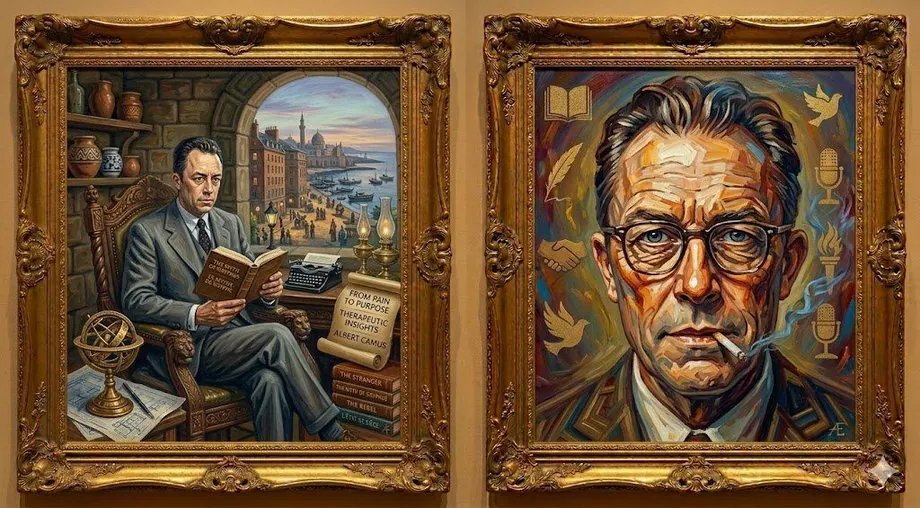
In the middle of winter, I at last discovered that there was in me an invincible summer.Albert Camus — Return to Tipasa, 1952
Albert Camus was born in Mondovi, Algeria, in 1913. His father, a French Algerian agricultural worker, was killed at the Battle of the Marne in 1914 when Camus was less than a year old. He grew up in extreme poverty in a two-room apartment in Algiers with his mother — who was partially deaf, almost illiterate, and worked as a cleaning woman — his brother, grandmother, and uncle. His mother almost never spoke to him. He later described her silence as one of the most formative presences of his life.
He was brilliant in school and his teacher Louis Germain recognized it, personally intervening to secure him a scholarship to the lycée when his family's poverty would otherwise have ended his education. At seventeen he contracted tuberculosis — a disease that would return throughout his life and that ruled him out of military service in the Second World War. He recovered, studied philosophy at the University of Algiers, joined and then left the Communist Party, worked as a journalist, and wrote.
The Stranger was published in 1942, the same year as The Myth of Sisyphus. He was twenty-eight. The Plague followed in 1947. The Rebel in 1951. He was awarded the Nobel Prize in Literature in 1957, at forty-three — the second youngest person ever to receive it. He died in a car accident in January 1960, at forty-six. In his briefcase was an unfinished manuscript — The First Man, an autobiographical novel about his Algerian childhood — that was published posthumously in 1994.
Camus's central philosophical concept is the absurd — the confrontation between the human need for meaning, clarity, and order, and the universe's complete silence in response to that need. This is not nihilism. Nihilism concludes that because there is no inherent meaning, nothing matters. Camus argues the opposite: because there is no inherent meaning, everything we choose to value matters enormously, because it is our choice that gives it value.
The Myth of Sisyphus addresses this directly through the image of Sisyphus condemned to roll his boulder up the hill for eternity, only to watch it roll back down. Camus's conclusion — one must imagine Sisyphus happy — is not ironic. It is a precise philosophical claim: that the person who has fully confronted the absurdity of their situation, who has refused both the escape of false hope and the escape of suicide, who chooses to engage fully with life precisely because it offers no guarantees, has achieved something that the comfortable optimist never reaches. The revolt against the absurd — the insistence on living fully in the face of it — is itself a form of human dignity.
The Rebel extends this into political philosophy: the person who revolts against injustice — who says no, this is wrong and I will not accept it — is affirming something universal in the act of refusal. Every genuine act of revolt contains within it an implicit appeal to values that transcend the individual and bind human beings to each other. This is Camus's secular humanism: a philosophy of human solidarity rooted not in God or history or ideology but in the shared experience of human suffering and the shared refusal to be indifferent to it.
You will never be happy if you continue to search for what happiness consists of. You will never live if you are looking for the meaning of life.Albert Camus — as attributed
His philosophical manifesto — on the absurd, revolt, and why one must imagine Sisyphus happy. Begin here.
His greatest novel — an allegory of occupation, resistance, and human solidarity in the face of catastrophe.
Some links may be affiliate links. They help support the site at no additional cost to you.

