Albert Schweitzer
Who was a world-renowned organist, theologian, and Bach scholar at thirty — then gave it all up to study medicine and spend the rest of his life running a hospital in equatorial Africa, winning the Nobel Peace Prize in 1952.
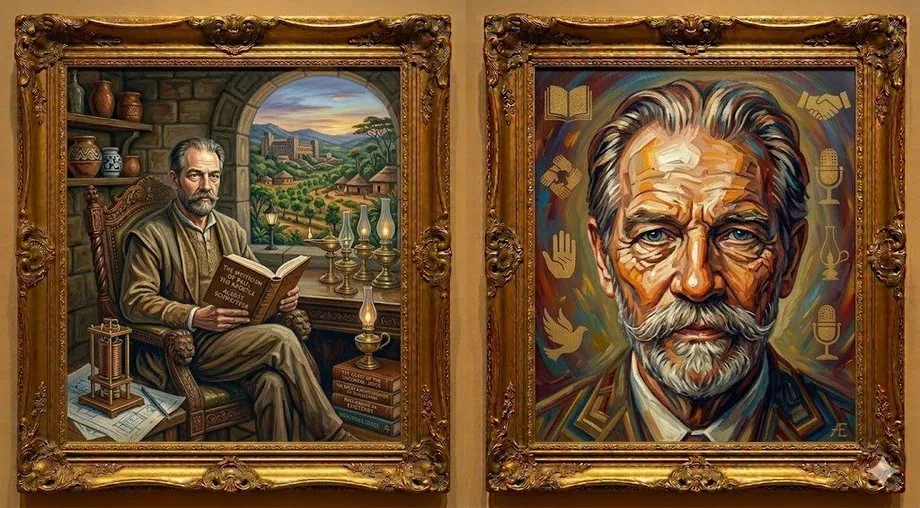
The only ones among you who will be really happy are those who will have sought and found how to serve.Albert Schweitzer — as attributed
Albert Schweitzer was born in Kaysersberg, Alsace — then part of the German Empire — in 1875. He was a prodigy: he could play the organ before he could properly reach the pedals, and by his twenties he was recognized as one of the greatest Bach interpreters alive. He earned doctorates in philosophy and theology, published the landmark book The Quest of the Historical Jesus in 1906, and was a professor at the University of Strasbourg. He had achieved what most people would consider a complete and distinguished intellectual life before the age of thirty.
Then, in 1904, he read an article about the desperate need for medical doctors in French Equatorial Africa. He decided to become a doctor. His friends and colleagues thought he was having a breakdown. He studied medicine for seven years while continuing to lecture, write, and perform. In 1913, at thirty-eight, he went to Gabon — then French Equatorial Africa — with his wife Helene Bresslau, a nurse. He built a hospital at Lambarene and ran it, with interruptions forced by the two World Wars, for the rest of his life.
He continued to write, to perform organ concerts on his European fundraising trips, and to correspond with philosophers and scientists around the world. He received the Nobel Peace Prize in 1952. He used the prize money to expand the hospital and to build a leper village. He died in Lambarene in 1965 at ninety, still running the hospital.
Schweitzer's central philosophical contribution is the concept of Reverence for Life — Ehrfurcht vor dem Leben — which he arrived at on a river journey in Africa in 1915 while struggling to find a comprehensive ethical principle. The phrase came to him fully formed: reverence for life.
The argument is simple: I am a will-to-live surrounded by other wills-to-live. The person who recognizes this — who experiences genuinely, in the encounter with any living thing, the same will to live that drives them — cannot remain indifferent to suffering. Not because a rule requires them to care, but because genuine recognition of shared existence produces care naturally. Ethics, for Schweitzer, is not a system of rules applied from outside but the expression of a recognition that has been allowed to penetrate fully.
This philosophy is not naive — Schweitzer was acutely aware that life feeds on life, that the bacteriologist who saves thousands of human lives necessarily destroys thousands of microbial lives, that reverence for life does not dissolve the tragic conflicts that life imposes. What it does is insist that those conflicts be taken seriously, that the decision to harm any living thing be made consciously and with genuine regret rather than indifferently, and that the person who has truly recognized shared existence cannot remain passive in the face of preventable suffering.
His own life was the demonstration of this philosophy. He gave up more than most people ever have — a brilliant career, comfort, recognition — not from masochism but from the simple recognition that he could help and therefore he should.
One thing I know: the only ones among you who will be really happy are those who will have sought and found how to serve.Albert Schweitzer — as attributed
His autobiography — one of the most remarkable accounts of a deliberate life ever written. The section on Reverence for Life is essential reading. The 1931 original is now in the public domain, but the most commonly available English translations incorporate later revisions Schweitzer made through 1960, which remain under copyright. Look for the original 1933 C.T. Campion translation in library collections.
Public domain · Library collections recommendedSome links may be affiliate links. They help support the site at no additional cost to you.
