Andrew Carnegie
Who emigrated from Scotland at thirteen with nothing, built the largest steel empire in history, and then gave every dollar of it away — setting the template for American philanthropy and inspiring Napoleon Hill's life work.
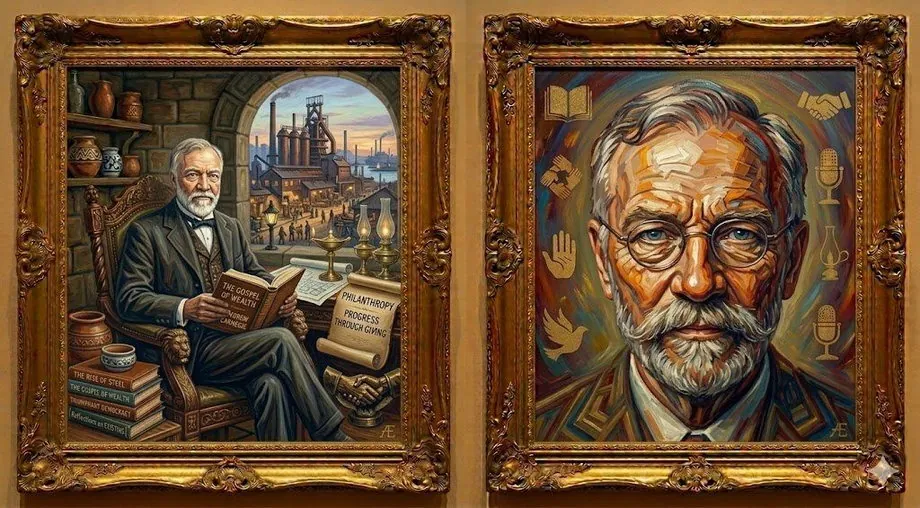
No man will make a great leader who wants to do it all himself, or to get all the credit for doing it.Andrew Carnegie — as attributed
Andrew Carnegie was born in Dunfermline, Scotland, in 1835, the son of a linen weaver whose livelihood was destroyed by the mechanization of the textile industry. The family emigrated to Allegheny, Pennsylvania, in 1848, arriving with essentially nothing. Carnegie was thirteen. He went to work immediately — as a bobbin boy in a cotton factory, then as a telegraph messenger, then as a telegraph operator. He was quick, he was charming, he had an extraordinary memory for faces and names, and he attracted the attention of Thomas Scott, superintendent of the Pennsylvania Railroad's western division.
Scott hired him as his personal telegraph operator and secretary. Carnegie learned the railroad business from the inside, made his first investments — at Scott's suggestion, in a sleeping car company — and began accumulating the capital and knowledge that would eventually make him the richest person in the world. He built the Carnegie Steel Company over several decades, introducing the Bessemer process to American steel production and driving costs down through relentless efficiency and vertical integration. In 1901 he sold Carnegie Steel to J.P. Morgan for $480 million, making him, at sixty-six, the wealthiest private individual in American history.
He then spent the next eighteen years giving it away: 2,509 public libraries, Carnegie Hall, the Carnegie Endowment for International Peace, universities, research institutions, and the Pittsburgh Symphony. He gave away more than $350 million — roughly ninety percent of his fortune — before his death in 1919.
Carnegie's philosophy had two phases. The first — the accumulation phase — was built on the principles Napoleon Hill would later study and codify: definiteness of purpose, the mastermind alliance, going the extra mile, and the conviction that the person who delivers more value than they are paid for creates a surplus that eventually returns to them in abundance. Carnegie himself was the case study that Hill spent twenty years documenting.
The second phase — the giving phase — was shaped by an essay Carnegie wrote in 1889 called The Gospel of Wealth. Its central argument was simple and radical: the person who dies rich dies disgraced. Wealth accumulated beyond what is required for a comfortable life is not a personal achievement but a public trust, and the wealthy person's obligation is to administer it for the public benefit during their lifetime rather than bequeathing it to heirs who had not earned it. The library system he built — giving communities the buildings on the condition that they fund the staff and collections — was his model of giving that required effort from recipients rather than creating dependency.
It was Carnegie who set Napoleon Hill's life work in motion. In the three-day interview of 1908, he proposed the research project, provided introductions, and sent Hill on his way with no guarantee of payment. His conviction that the philosophy of achievement could be systematized and made available to ordinary people — not just to the gifted and well-connected — is the intellectual origin of this entire library.
Surplus wealth is a sacred trust which its possessor is bound to administer in his lifetime for the good of the community.Andrew Carnegie — The Gospel of Wealth, 1889
Short and essential. His argument that surplus wealth is a public trust and that the wealthy person who dies rich dies disgraced. Changed American philanthropy permanently.
Read Free Online →Some links may be affiliate links. They help support the site at no additional cost to you.

Andrew Carnegie speaks on the interactive trails — the passage large, the background, the sources, and paths onward.