Benjamin Franklin
The fifteenth of seventeen children who left school at ten and became a scientist, publisher, inventor, diplomat, and Founding Father — the original American self-made man.
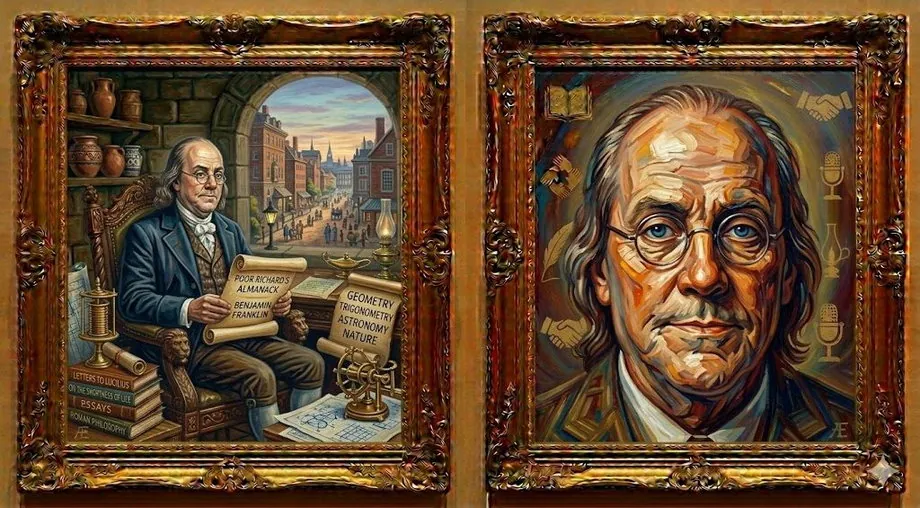
Energy and persistence conquer all things.Benjamin Franklin — as attributed
Benjamin Franklin was born in Boston in 1706, the fifteenth of seventeen children of a candlemaker. He attended school for only two years — his family could not afford more — and was apprenticed to his older brother James, a printer, at age twelve. At seventeen he ran away to Philadelphia, arriving with almost nothing. Within a few years he had his own printing shop. By thirty he had retired from active printing work, having made enough money to pursue the rest of his life on his own terms.
What followed was extraordinary even by the standards of an extraordinary century: he invented bifocals, the lightning rod, and the flexible catheter; founded the first public library in America, the first fire department in Philadelphia, and the University of Pennsylvania; served as postmaster general; represented the American colonies in London for years before the Revolution; negotiated the Treaty of Paris that ended the war; and helped draft both the Declaration of Independence and the Constitution. He was the most famous American in the world for the last three decades of his life, celebrated in Europe as the embodiment of a new kind of human possibility.
He was also, crucially, a systematic practitioner of self-improvement. His autobiography — written for his son and never quite finished — is the original American self-help document, describing in practical detail how he taught himself everything he needed to know and how he attempted to cultivate thirteen specific virtues through deliberate daily practice.
Franklin's thirteen virtues — temperance, silence, order, resolution, frugality, industry, sincerity, justice, moderation, cleanliness, tranquility, chastity, and humility — were not abstract ideals. He created a small notebook with a grid: one page per virtue, one row per day, one column per week. Each day he marked a dot for every failure to practice the virtue of the week. He worked through all thirteen virtues four times per year for the rest of his adult life. He never achieved perfection at any of them and said so frankly. He claimed, however, to have become measurably better at all of them through the practice of attention.
This is the most practically important thing about Franklin's philosophy: it is empirical. He treated character development as a project of observation and experiment rather than a matter of will or grace. You identify specifically what you want to improve, you track your performance honestly, and you adjust. The gap between knowing and doing is not filled by knowledge — it is filled by practice sustained over time.
His Autobiography is written with characteristic plainness and humor. He does not present himself as a model of virtue — he presents himself as a man who tried systematically to become better and failed frequently and kept trying anyway. This is more useful than hagiography. It is an honest account of what deliberate self-improvement actually looks like from the inside.
Tell me and I forget. Teach me and I remember. Involve me and I learn.Benjamin Franklin — as attributed
The original American self-improvement document. Written for his son, never finished, and more useful than most books that are. Begin at the beginning.
Read Free Online →A short compilation of Poor Richard proverbs that contains more practical wisdom per page than almost anything else on this list.
Read Free Online →Some links may be affiliate links. They help support the site at no additional cost to you.

Benjamin Franklin speaks on the interactive trails — the passage large, the background, the sources, and paths onward.