Bertrand Russell
Who was orphaned at three, raised by his grandmother, became the most celebrated philosopher of the twentieth century, won the Nobel Prize for Literature, was imprisoned for his pacifism, and lived to ninety-seven.
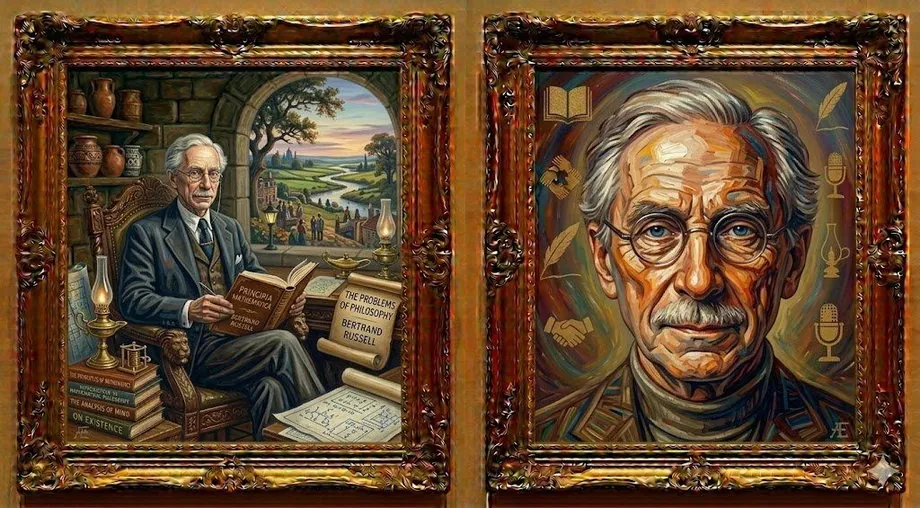
The good life is one inspired by love and guided by knowledge.Bertrand Russell — What I Believe, 1925
Bertrand Arthur William Russell was born into the British aristocracy in 1872. His parents died within two years of each other — his mother of diphtheria when he was two, his father of bronchitis when he was three. He and his brother were sent to live with their grandmother, the Countess Russell, a formidable woman of strong principles who raised him in a household of high intellectual seriousness and strict morality. He was educated at home until Cambridge, where he studied mathematics and philosophy and published his first major work — on the foundations of mathematics — before he was thirty.
He lost his Cambridge fellowship in 1916 when he was convicted of making statements likely to prejudice the recruiting of soldiers. He was imprisoned for six months in 1918 for a similar offense. He was dismissed from appointments in the United States in the 1940s — once by the College of the City of New York on grounds that his views on marriage and morality were incompatible with his fitness to teach — and was a lifelong target of censure from institutions that found his opinions on sex, religion, and pacifism intolerable.
He won the Nobel Prize for Literature in 1950, was readmitted to Cambridge fellowship in 1944, co-founded the Pugwash Conferences on nuclear disarmament in 1957, was imprisoned again at age eighty-nine for his anti-nuclear protest activities, and died in 1970 at ninety-seven, having published more than seventy books.
Russell's philosophical contributions are too numerous and technical to summarize here — he made foundational contributions to mathematical logic, the philosophy of language, epistemology, and the theory of knowledge. But his contribution to this library is his secular account of how to live well: the good life is one inspired by love and guided by knowledge.
His essay In Praise of Idleness argues against the glorification of work for its own sake — that leisure is not laziness but the precondition for all genuine creativity, reflection, and human development. The person who is always busy, always productive in the narrow economic sense, never has the time or space to become interesting to themselves or anyone else. This is not a counsel of laziness. It is an argument that the quality of attention you bring to your life depends in part on having enough unscheduled time to actually think.
His Conquest of Happiness, written during a personally difficult period, is a practical account of what makes people miserable — envy, competition, boredom, fatigue, sense of sin, persecution mania, fear of public opinion — and what genuine happiness actually requires: interesting work, affection, family, and a consciousness of oneself as part of a stream of life that extends beyond the individual. It is the most accessible and least pretentious of his books and remains useful eighty years after its publication.
Three passions, simple but overwhelmingly strong, have governed my life: the longing for love, the search for knowledge, and unbearable pity for the suffering of mankind.Bertrand Russell — Autobiography, 1967
His most accessible book — a practical analysis of what makes people unhappy and what genuine happiness actually requires. Remarkably honest and still useful.
Read Free at Gutenberg →A collection of essays including his argument for leisure as the precondition of all genuine human development.
Available at libraries and booksellersSome links may be affiliate links. They help support the site at no additional cost to you.
