Booker T. Washington
Born into slavery, self-educated, and the founder of the Tuskegee Institute — one of the most direct accounts in American history of what patient, dignified, determined effort actually looks like over decades.
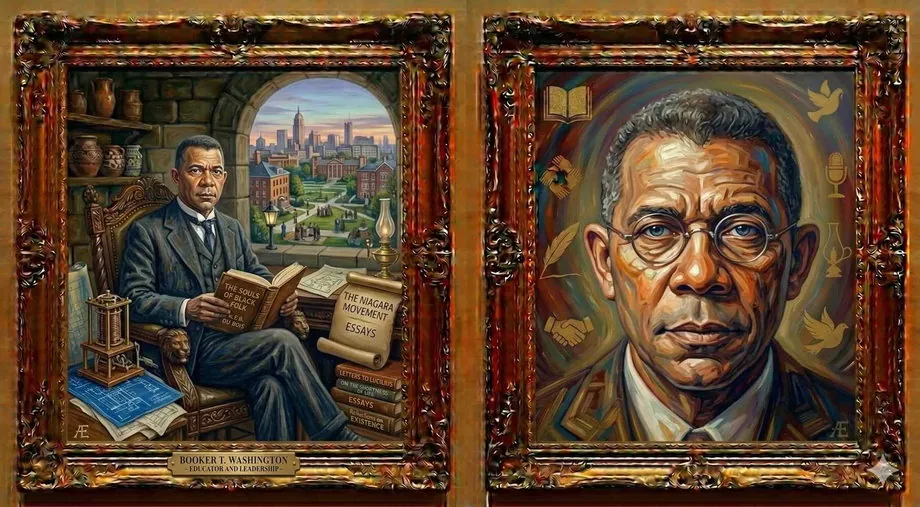
Success is to be measured not so much by the position that one has reached in life as by the obstacles which he has overcome.Booker T. Washington — Up From Slavery, 1901
Booker T. Washington was born into slavery in April 1856 on a small farm in Virginia. He never knew his exact birthday — he shared this with Frederick Douglass, whose Narrative he later read with profound recognition. His father was a white man whose identity he never learned. He was nine years old when the Civil War ended and he was legally free. The freedom was real but the circumstances were not: he was nine, he was Black, he was in the post-war South, and he had nothing.
His family moved to West Virginia, where his stepfather worked in the salt furnaces and mines. Washington worked in the mines from age nine while teaching himself to read from a Webster's spelling book. At age fourteen he heard older miners talking about the Hampton Normal and Agricultural Institute in Virginia, a school for Black students. He decided to go. He walked, begged rides, and slept under a boardwalk in Richmond when he ran out of money, arriving at Hampton with fifty cents in his pocket. He was admitted after the school's head teacher set him the task of cleaning a recitation room and he cleaned it three times, to standard.
He graduated from Hampton, returned to West Virginia to teach, was invited back to Hampton as a teacher, and in 1881 was recommended to lead a new institution in Tuskegee, Alabama. He arrived to find no buildings, no equipment, and $2,000 allocated by the state legislature. He built the Tuskegee Institute from that beginning, training Black students in agriculture, industry, and the trades, and making it one of the most important educational institutions in America.
Up From Slavery, published in 1901, is the account of that journey. It is one of the most readable and least self-pitying autobiographies ever written — Washington describes injustice clearly and without embellishment but his attention is always on what could be done, not on what could not. This is not naivety. It is strategy: in the post-Reconstruction South, the space available for Black advancement was narrow, and Washington's philosophy was built for that space.
His educational philosophy was practical: train people in skills that produce economic independence, because economic independence creates the foundation for all other kinds of freedom. He was criticized for this in his lifetime by W.E.B. Du Bois and others, who argued that he was accommodating a racist system. The argument was real and substantive. What was also real was that thousands of students passed through Tuskegee, acquired skills, built businesses, and created lives that would not otherwise have been possible.
For this library, what matters most about Washington is the quality of attention he brought to the question of what was actually within his power and what was not — and his refusal to allow what was not in his power to prevent him from maximizing what was. This is Stoic practical wisdom expressed in specifically American circumstances by a man who had every reason to know what it cost.
I have learned that success is to be measured not so much by the position one has reached as by the obstacles overcome in trying to succeed.Booker T. Washington — Up From Slavery, 1901
One of the great American autobiographies. Remarkably free of self-pity and rich in practical wisdom. Begin at the beginning.
Read Free Online →Some links may be affiliate links. They help support the site at no additional cost to you.

Booker T. Washington speaks on the interactive trails — the passage large, the background, the sources, and paths onward.