Carl Jung
Who broke with Freud, suffered a period of near-psychosis that lasted six years, and built from that darkness an account of the human psyche that continues to shape how we understand dreams, archetypes, and the shadow.
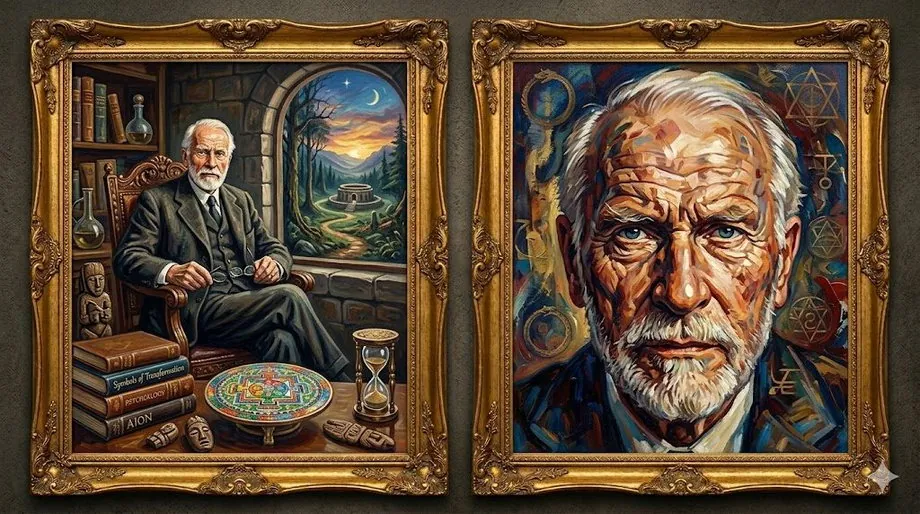
Until you make the unconscious conscious, it will direct your life and you will call it fate.Carl Jung — as attributed
Carl Gustav Jung was born in Kesswil, Switzerland, in 1875, the son of a Swiss Reformed pastor. He was a lonely, introspective child who spent considerable time in a private fantasy world and who was acutely conscious of what he later described as two personalities within himself — an ordinary boy and a wiser, older presence who observed the ordinary boy. He studied medicine at the University of Basel and psychiatry at the Burghölzli psychiatric hospital in Zurich, where he worked under Eugen Bleuler and developed the word association test that first brought him to Freud's attention.
His relationship with Freud was intense, brief, and transformative. Freud called him his crown prince and designated him to lead the psychoanalytic movement after him. Jung broke with Freud in 1912 over fundamental theoretical disagreements — particularly over the nature and role of the libido and over Freud's insistence that the unconscious was primarily a repository of repressed sexuality. The break was personally devastating and intellectually necessary. What followed was six years of extreme psychological disturbance — visions, voices, and fantasies that brought Jung to the edge of psychosis — during which he deliberately descended into his own unconscious and recorded what he found in the Red Book, a massive illuminated manuscript that he kept private until 2009.
The analytical psychology he built from this experience — with its concepts of the collective unconscious, the archetypes, the shadow, the anima and animus, individuation, and synchronicity — became one of the most influential frameworks in twentieth-century psychology, therapy, and culture.
Jung's contribution to this library centers on his concept of the shadow — the parts of the personality that are rejected, denied, or simply unconscious — and the process he called individuation: the lifelong project of integrating the unconscious contents of the psyche into a more complete and authentic self.
The shadow is not simply the evil parts of a person. It is everything that the conscious ego has rejected — including positive qualities that for some reason were unacceptable: creativity suppressed by a family that valued conformity, assertiveness trained out of a person who learned early that it was dangerous, tenderness dismissed by an environment that valued toughness. The shadow is the sum of what has been left out of the conscious identity, and it does not disappear because it has been excluded. It operates from the unconscious, projecting onto others the qualities the person cannot acknowledge in themselves, emerging in dreams, slips of the tongue, and emotional reactions disproportionate to their apparent causes.
Individuation — the work of becoming more fully oneself — requires engaging with the shadow rather than continuing to project and suppress it. This is not a pleasant process, which is why Jung insisted that it is the work of the second half of life: the first half is appropriately devoted to establishing an identity in the world; the second half to discovering who one actually is beneath and beyond that identity. The person who avoids this work does not thereby escape the shadow — they simply remain unconsciously driven by it.
The privilege of a lifetime is to become who you truly are.Carl Jung — as attributed
His autobiography — one of the most unusual and illuminating self-accounts ever written. Begin here before any of his theoretical works.
The most accessible introduction to his theoretical framework — on the personal and collective unconscious, the shadow, and individuation.
Some links may be affiliate links. They help support the site at no additional cost to you.
