Marcus Tullius Cicero
The Roman lawyer, philosopher, and statesman who was exiled, restored, and eventually executed for refusing to submit to tyranny — and whose writings kept Greek philosophy alive for the Western world.
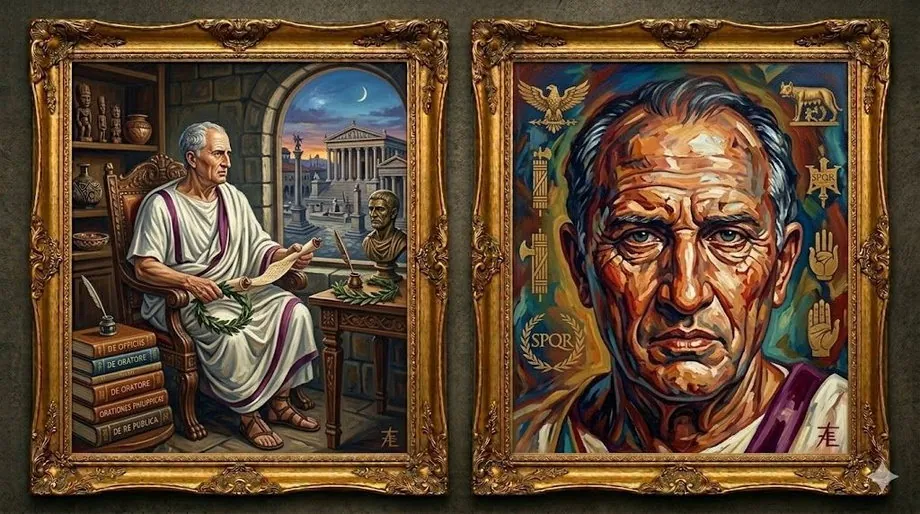
The function of wisdom is to discriminate between good and evil.Cicero — De Officiis, 44 BC
Marcus Tullius Cicero was born in Arpinum, southeast of Rome, in 106 BC into an equestrian family with no political connections in Rome itself. He was a novus homo — a new man — which meant he had to build everything from scratch in a society that ran on inherited status. He educated himself ferociously, studying rhetoric, philosophy, and law, and became the most celebrated orator in Rome by his thirties. His prosecution of the corrupt governor Verres in 70 BC established his reputation; his consulship in 63 BC, during which he suppressed the Catilinarian conspiracy, made him briefly the most powerful man in Rome.
The political fortunes that followed were less kind. He was exiled in 58 BC when a tribune used his execution of the conspirators — without trial — as the basis for a prosecution. He returned in 57 BC but spent the following decade navigating between increasingly incompatible powers: Caesar, Pompey, and eventually Antony. After Caesar's assassination in 44 BC, he delivered the Philippics — fourteen speeches attacking Mark Antony with a ferocity that sealed his own fate. Antony had him killed in December 43 BC. His severed hands and head were displayed in the Forum.
He had been writing philosophy throughout the final years of his life, producing an extraordinary body of work in an astonishingly short time — De Officiis, the Tusculan Disputations, De Natura Deorum, De Finibus — that transmitted the Greek philosophical tradition into Latin and made it accessible to the Roman world and, through Rome, to the entire subsequent Western tradition.
Cicero was not an original philosopher in the way that Aristotle or Plato was. He was something equally valuable: a great synthesizer and translator, who took the best of Stoic, Epicurean, and Academic philosophy, rendered it into Latin prose of extraordinary clarity, and made it available to an audience that would never have accessed it in Greek. Without Cicero, the recovery of classical philosophy in the Renaissance would have been far more difficult, because much of what Cicero transmitted in Latin survived while the Greek originals did not.
De Officiis — On Duties — is his most practically important work, written in the last months of his life as a letter to his son. It addresses the question of how to act when moral duty and personal advantage seem to conflict, and argues consistently that genuine advantage is always aligned with moral duty in the long run. The man who appears to profit by dishonesty has made a bad calculation: he has purchased short-term gain at the cost of the trustworthiness that makes all long-term gain possible.
His account of the four cardinal virtues — wisdom, justice, courage, and temperance — is one of the clearest in the tradition, and his insistence that these virtues are interconnected, that genuine courage without justice becomes brutality, that wisdom without practical application is useless, anticipates much of what later virtue ethicists would argue. He died practicing what he preached: refusing to submit to Antony, refusing to flee Rome, accepting the consequences.
If you have a garden and a library, you have everything you need.Cicero — as attributed
Three books addressed to his son on the nature of moral duty and its relationship to advantage. The clearest account of practical Stoic ethics in Latin. Begin with Book I.
Read Free Online →Five dialogues on death, grief, mental suffering, virtue, and what is necessary for a happy life. The most accessible of his philosophical works.
Read Free Online →Some links may be affiliate links. They help support the site at no additional cost to you.
