Confucius
Who spent his life trying to find a ruler who would implement his philosophy of benevolence — largely failed — and whose ideas shaped Chinese civilization for 2,500 years.
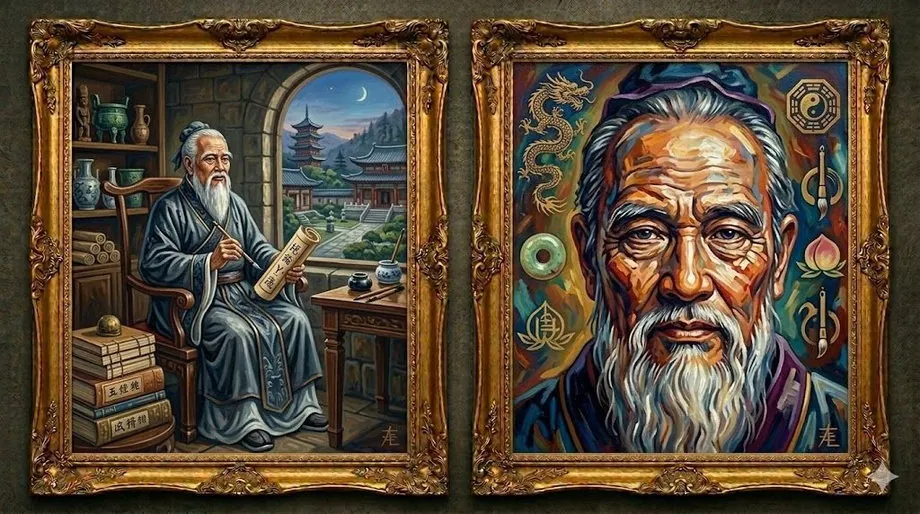
It does not matter how slowly you go as long as you do not stop.Confucius — The Analects, c. 500 BC
Confucius was born in the state of Lu in what is now Shandong Province, China, in 551 BC. His father died when he was three. He grew up in poverty, working menial jobs to support himself and his mother. He was largely self-educated, developing an early passion for the ancient rites, music, and texts of the Zhou dynasty — a civilization he regarded as the model of ordered, virtuous governance.
He spent most of his working life seeking a position from which he could implement his political philosophy — the idea that good governance flows from the moral cultivation of the ruler, which flows from a properly ordered society, which flows from properly cultivated individuals. He held minor official positions but never the major post he sought. At age fifty-five he left Lu and spent thirteen years traveling from state to state with a small group of disciples, offering his counsel to rulers who, with few exceptions, did not take it.
He returned to Lu in his late sixties, spent his final years teaching and editing the ancient texts, and died in 479 BC apparently convinced his mission had failed. His disciples compiled his teachings in the Analects — a collection of conversations and sayings that became the foundation of Chinese civilization for the next two and a half millennia.
The core of Confucius's philosophy is the concept of ren — usually translated as benevolence or humaneness. Ren is the supreme virtue from which all others flow. A person of ren treats others as they themselves would wish to be treated, fulfills their social roles with conscientiousness, and cultivates themselves continuously through study, reflection, and practice.
The superior person — the junzi — is not born but made. Through self-cultivation, through the study of the rites and classical texts, through careful attention to relationships and responsibilities, a person becomes someone whose character is worthy of trust and whose example teaches others without effort. The junzi does not achieve greatness by accumulating wealth or power but by becoming fully what a human being can be.
Confucius placed enormous weight on self-examination: I daily examine myself on three points — whether in transacting business for others I may have been unfaithful; whether in intercourse with friends I may have been insincere; whether I may have not mastered the instructions of my teacher. This daily audit is the concrete practice behind the philosophy: not grand transformation but continuous small correction.
When you know a thing, to hold that you know it; and when you do not know a thing, to allow that you do not know it — this is knowledge.Confucius — The Analects, c. 500 BC
Twenty books of conversations, observations, and sayings. Begin with Book I and read at least through Book VII. Not a systematic treatise but a living record of a philosophical mind at work.
Read Free Online →Some links may be affiliate links. They help support the site at no additional cost to you.

Confucius speaks on the interactive trails — the passage large, the background, the sources, and paths onward.