Cornel West
The Princeton and Harvard philosopher who has spent fifty years arguing that genuine democracy requires not just political rights but the courage to confront the nihilism that poverty, racism, and spiritual emptiness produce.
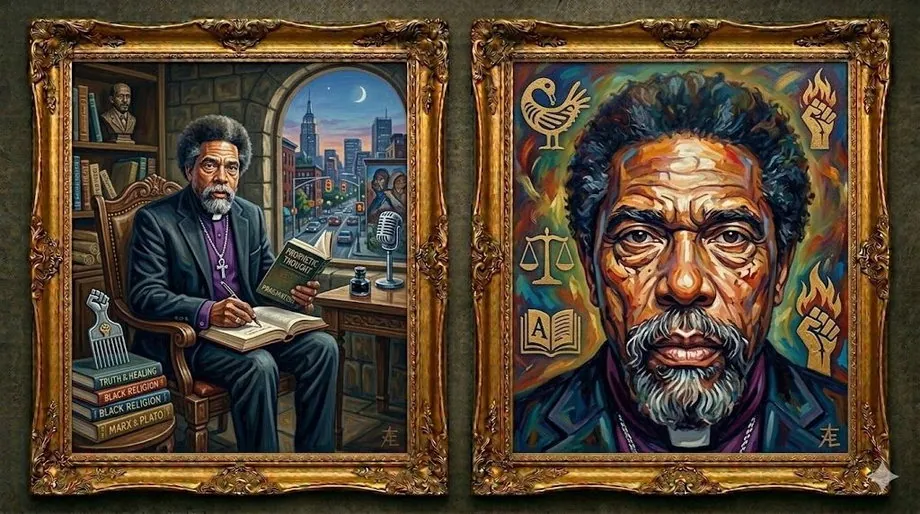
You have to be a thermostat rather than a thermometer. A thermometer just reflects the temperature of the environment. A thermostat changes it.Cornel West — as attributed
Cornel Ronald West was born in Tulsa, Oklahoma, in 1953 and grew up in Sacramento, California. His father was a civilian Air Force administrator; his mother was a teacher and principal. He was shaped from childhood by the Black church — its music, its rhetoric, its philosophy of suffering transformed into solidarity — and by the civil rights movement that was transforming American society during his formative years.
He entered Harvard at seventeen, graduated magna cum laude in three years, completed his doctorate at Princeton in 1980, and became one of the most celebrated and controversial public intellectuals in American life. He has taught at Union Theological Seminary, Yale, Princeton, Harvard, and the University of Paris. He has made rap albums, appeared in the Matrix films, run for president, and been arrested at protest marches while wearing a three-piece suit. He has been praised as the most important Black intellectual of his generation and criticized as a celebrity who has sacrificed scholarly rigor for public performance. He has not been indifferent to either assessment.
Race Matters, published in 1993, became one of the most widely read books on race in American life in the post-civil rights era. Democracy Matters, published in 2004, extended his analysis to the crisis of American democratic life more broadly. He has published more than twenty books and continues to teach, write, and agitate in his seventies.
West's central philosophical contribution is his account of nihilism as the defining crisis of Black American life and, by extension, of American democratic life generally. Nihilism, for West, is not a philosophical position but an existential condition: the lived experience of having no meaning, no hope, no love — of being permanently on the losing end of a system that has decided your life does not matter. This nihilism, he argues, is not produced by drugs or crime or moral failure but by the systematic destruction of the cultural and spiritual resources — the families, the churches, the neighborhoods, the networks of care — through which people maintain the conviction that life is worth living.
His response to nihilism is what he calls the blues response — the tradition, rooted in Black music and Black church, of acknowledging suffering honestly, expressing it aesthetically, and transforming it into something that connects rather than isolates. The blues does not deny that things are terrible. It names the terrible thing with precision and beauty, and in the naming creates community. This is, in different language, what Frankl calls finding meaning in unavoidable suffering — and what Camus calls revolt.
His political philosophy is prophetic pragmatism: a synthesis of American pragmatism (James, Dewey, Rorty) with the prophetic tradition of the Black church (the insistence that injustice must be named, resisted, and transformed). Democracy, for West, is not a system of voting but a way of life — a commitment to the full humanity of every person that must be practiced daily in every institution and relationship, not merely endorsed in the abstract.
Never forget that justice is what love looks like in public.Cornel West — as attributed
His most widely read book — on nihilism, race, and the spiritual and political crisis of American democracy.
His intellectual autobiography and his account of the prophetic pragmatist tradition he is working within.
Some links may be affiliate links. They help support the site at no additional cost to you.
