Desmond Tutu
The South African archbishop who led the Truth and Reconciliation Commission after apartheid and built a theology of forgiveness and human dignity rooted in the African philosophy of Ubuntu.
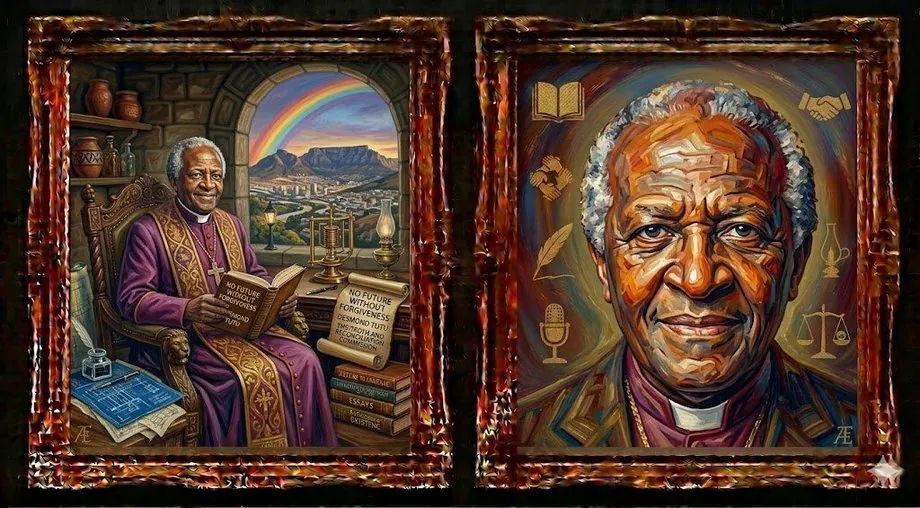
My humanity is bound up in yours, for we can only be human together.Desmond Tutu — as attributed
Desmond Mpilo Tutu was born in Klerksdorp, South Africa, in 1931. His father was a teacher; his mother worked as a domestic servant. He contracted tuberculosis as a teenager and spent twenty months in a hospital run by Father Trevor Huddleston, an Anglican monk whose compassion and dignity in the face of apartheid made a deep impression on the young Tutu. He trained as a teacher, then decided he could not work in a system that deliberately undereducated Black children, and turned to theology instead.
He was ordained as an Anglican priest in 1960, studied theology in London, returned to South Africa and rose through the church hierarchy — becoming the first Black Dean of Johannesburg Cathedral in 1975, the first Black Bishop of Lesotho, then Bishop of Johannesburg, then Archbishop of Cape Town. Throughout this period he was the most visible international voice against apartheid, calling for economic sanctions against South Africa while other leaders counseled patience. He was awarded the Nobel Peace Prize in 1984.
After the end of apartheid and Nelson Mandela's election, Tutu chaired the Truth and Reconciliation Commission — the body that attempted to deal with the crimes of the apartheid era not through prosecution but through a process of testimony, acknowledgment, and conditional amnesty. It was one of the most ambitious experiments in restorative justice in history. Tutu died in Cape Town in December 2021 at ninety.
Tutu's central philosophical contribution is his articulation of Ubuntu — the African philosophical concept usually translated as I am because we are, or a person is a person through other persons. Ubuntu holds that human identity is fundamentally relational: you are not fully yourself in isolation. You become fully human through your relationships with others, through your participation in community, through your recognition of and by other people. The autonomous individual of Western liberalism — self-sufficient, self-defined, self-directed — is, from the Ubuntu perspective, a philosophical fiction and a human impoverishment.
This is not merely an abstract philosophical position. It has direct practical consequences for how one understands suffering, forgiveness, and justice. If my humanity is bound up in yours, then your suffering diminishes me whether I caused it or not, and your flourishing contributes to mine whether I know you or not. And if my wrongdoing against you tears the fabric of the community that sustains us both, then genuine justice must involve the repair of that fabric — not just the punishment of the wrongdoer or the compensation of the victim, but the restoration of the relationship.
This is the philosophical foundation of the Truth and Reconciliation Commission: not that perpetrators of atrocities deserve forgiveness, but that a society that remains organized around enmity and retribution cannot flourish, because the enmity and retribution damage the social fabric that everyone — victim, perpetrator, and bystander — depends on. Forgiveness, for Tutu, is not a moral luxury or a spiritual achievement. It is a social necessity, and the person who practices it liberates themselves as much as they release the one they forgive.
Forgiving is not forgetting; it's actually remembering — remembering and not using your right to hit back.Desmond Tutu — No Future Without Forgiveness, 1999
His account of the Truth and Reconciliation Commission and the philosophy of Ubuntu that guided it. Essential reading on forgiveness as a social and political practice.
Some links may be affiliate links. They help support the site at no additional cost to you.

