Eleanor Roosevelt
Who had a miserable childhood, a difficult marriage, and an acute fear of almost everything — and became one of the most influential and courageous human beings of the twentieth century.
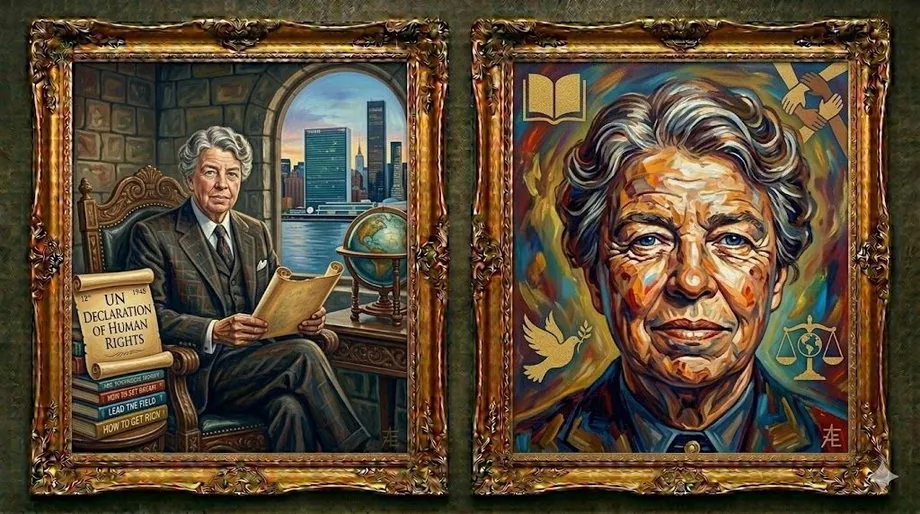
You gain strength, courage and confidence by every experience in which you really stop to look fear in the face.Eleanor Roosevelt — You Learn by Living, 1960
Anna Eleanor Roosevelt was born in New York City in 1884 into a wealthy but deeply troubled family. Her mother, a celebrated beauty, found Eleanor plain and called her Granny. Her father, whom she adored, was an alcoholic who was largely absent. Her mother died of diphtheria when Eleanor was eight. Her father died of delirium tremens two years later. She was raised by her maternal grandmother, a stern woman who provided security but little warmth, and sent to school in England at fifteen, where a teacher named Marie Souvestre became the first person in her life to take her seriously as a mind.
She married her distant cousin Franklin Delano Roosevelt in 1905. The marriage was difficult from the start — her domineering mother-in-law, Sara Roosevelt, treated her as an extension of Franklin's household rather than a person in her own right, and Eleanor spent years in a state she later described as complete submission. When she discovered Franklin's affair with her social secretary Lucy Mercer in 1918, the marriage was effectively transformed: they remained partners but not romantically faithful to each other, and Eleanor slowly, painfully, began to build a life and an identity of her own.
That identity — as a journalist, a human rights activist, a diplomat, and the driving force behind the Universal Declaration of Human Rights — was created against the grain of almost everything her upbringing and social position had prepared her for. She was afraid of almost everything throughout her life. She did almost everything anyway.
Eleanor Roosevelt's philosophy is not systematic — she was not an academic philosopher — but it is coherent and hard-won. Its central insight is that courage is not a feeling but a practice: you do not wait until you are unafraid to act, because that moment never comes. You act despite the fear, and the acting — not the elimination of fear but its consistent defeat in the moment of decision — is what produces the confidence and the capacity that other people call courage.
Her account of fear is remarkably honest for a public figure of her era. She describes in her memoirs and speeches specific fears — of darkness, of mice, of horses, of her children drowning, of public speaking, of social rejection — and describes equally specifically how she addressed each one: by doing the feared thing, deliberately, until the fear diminished to manageable size. This is the behavioral approach to courage that modern psychology would later validate empirically: exposure, not avoidance, is the mechanism by which fear loses its power.
Her human rights work — particularly her chairmanship of the UN Commission on Human Rights that drafted the Universal Declaration — is the political expression of the same philosophy: that the dignity and rights of every person are not contingent on their usefulness to the powerful, not dependent on their nationality or religion or race, but inherent in the fact of their humanity. The Declaration she helped produce has been described as the most translated document in human history and remains the foundation of international human rights law.
No one can make you feel inferior without your consent.Eleanor Roosevelt — as attributed
Her most personal philosophical book — on courage, learning, maturity, and the quality of attention required to grow. Accessible and honest.
Some links may be affiliate links. They help support the site at no additional cost to you.
