Epictetus
Born a slave, had his leg broken by his owner, and wrote the most powerful philosophy of personal freedom ever recorded.
Make the best use of what is in your power, and take the rest as it happens.Epictetus — Enchiridion, c. 135 AD
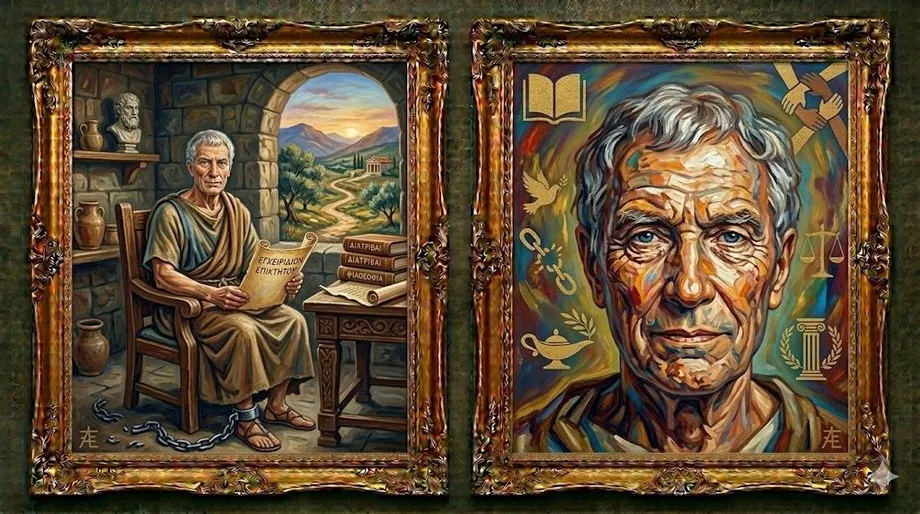
Epictetus was born into slavery around 50 AD in Hierapolis, a city in what is now Turkey. He was brought to Rome as a slave and became the property of Epaphroditus, a freedman who served under the Emperor Nero. According to one account, Epaphroditus broke Epictetus's leg deliberately to demonstrate power over him. When Epictetus calmly noted that the leg was about to break, and then when it did break said only that he had predicted it, his owner was reportedly furious at being unable to produce a reaction.
At some point Epictetus was freed. He established a school in Nicopolis in northwestern Greece and taught Stoic philosophy for the rest of his life. He wrote nothing himself — his teachings were recorded by his student Arrian in the Discourses and condensed into the Enchiridion, the handbook that has been read continuously for nearly two thousand years.
He was lame, he was poor, and by conventional measures he had nothing. He argued, persuasively, that he had everything that actually mattered: clarity about what was and was not in his power, and the discipline to govern himself accordingly.
The Enchiridion opens with forty words that contain the entire Stoic framework: some things are in our control and others not. In our control are opinion, pursuit, desire, aversion — our own mental acts. Not in our control are body, reputation, command, wealth — all external things. This distinction, practiced daily, is the foundation of everything else.
The practical consequence is radical: if you desire only what is up to you, you will always get what you want. If you fear only what is up to you, you will never be afraid of anything outside your control. This is not a trick. It is a complete reorientation away from outcomes — which are never fully in your control — and toward the quality of your own choices, judgments, and responses, which always are.
Epictetus taught three disciplines: desire (wanting only what is genuinely in your power), action (acting always for the common good, with reservation for obstacles), and assent (examining every impression before accepting or rejecting it). These three, practiced consistently, constitute the whole of Stoic philosophy as a lived reality rather than an intellectual position.
Seek not that the things which happen should happen as you wish; but wish the things which happen to be as they are, and you will have a tranquil flow of life.Epictetus — Enchiridion, c. 135 AD
Forty-eight short chapters. The complete Stoic framework in a single sitting. Begin at chapter one. This is one of the most important books ever written.
Read Free Online →Four books of recorded lectures — the full philosophical context behind the Enchiridion.
Read Free Online →Some links may be affiliate links. They help support the site at no additional cost to you.

Epictetus speaks on the interactive trails — the passage large, the background, the sources, and paths onward.