Florence Nightingale
Who transformed nursing from a disreputable occupation into a profession, reduced hospital mortality rates by two-thirds through sanitation reform, and founded modern evidence-based healthcare — while fighting her own family for the right to work.
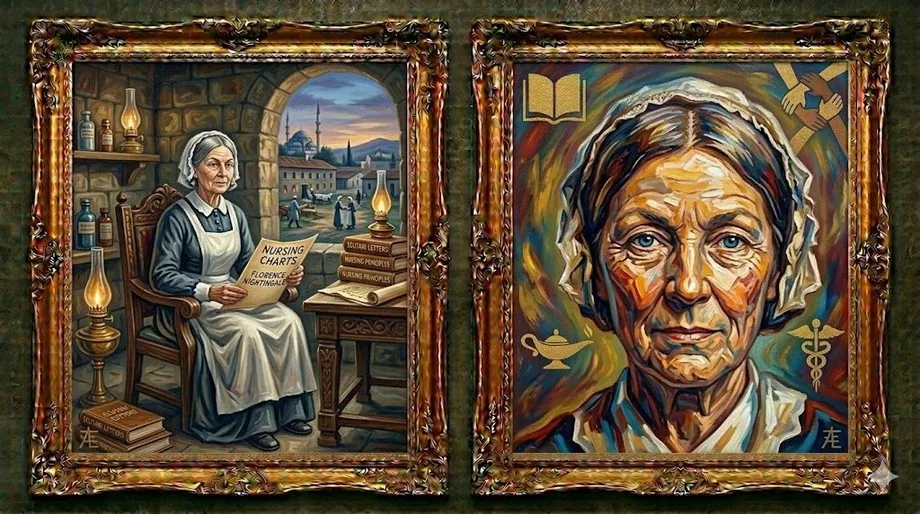
I attribute my success to this: I never gave or took any excuse.Florence Nightingale — as attributed
Florence Nightingale was born in Florence, Italy, in 1820, the second daughter of a wealthy English family that divided its time between their Hampshire and Derbyshire estates. She was exceptionally well-educated for a woman of her time — her father taught her Greek, Latin, French, German, Italian, history, and mathematics — and by her teens she had a clear sense of vocation: she wanted to work in hospitals.
Her family was horrified. Nursing in mid-Victorian England was not a respectable occupation; nurses were poorly paid, poorly trained, and associated with drunkenness and immorality. The possibility that a woman of Nightingale's class would become a nurse was considered as shocking as if she had announced plans to become a prostitute. Her mother and sister subjected her to a decade of opposition, emotional pressure, and social manipulation that she later described as the most destructive period of her life. She eventually prevailed, trained in Germany, and became superintendent of a London hospital in 1853.
In 1854 she led a party of thirty-eight nurses to the military hospitals in Scutari during the Crimean War. She found conditions of indescribable filth — patients lying in their own excrement, no ventilation, no running water, supply chains so broken that soldiers were dying of starvation and preventable infection at ten times the rate of battle casualties. She implemented systematic cleaning, improved supplies and diet, and within months had reduced the mortality rate from 42% to 2%. She became the most famous woman in England. She returned from the Crimea with a debilitating illness — probably brucellosis — that left her largely bedridden for the rest of her fifty-year career.
Nightingale's philosophy of nursing was, at its root, a philosophy of evidence and system. She was a pioneer of statistical analysis and data visualization — her polar area diagrams showing the causes of soldier mortality are among the earliest examples of effective statistical graphics and were specifically designed to persuade politicians and administrators who would not read tables of numbers.
Her conviction — that health outcomes are not random or inevitable but the product of specific, identifiable, controllable environmental conditions — was revolutionary in an era when disease was widely attributed to miasma, Providence, or individual moral failure. If you know what causes preventable deaths, you are morally obligated to change those conditions. This sounds obvious now. In 1855 it required both intellectual rigor and enormous courage to say.
Her Notes on Nursing, published in 1860, was addressed not to medical professionals but to ordinary women managing households and caring for sick family members. Its central argument is that nursing is not primarily about medical knowledge but about creating and maintaining the conditions — cleanliness, fresh air, light, warmth, quiet, proper food — in which the body can heal itself. It remains readable and practical 165 years later.
Nightingale fought the opposition of her family, the skepticism of military bureaucracy, the territorial resentment of male doctors, and the limitations of her own illness to create an entirely new standard for hospital care and to establish nursing as a trained, respectable, essential profession. She did it through meticulous collection of evidence, careful argument, and the refusal to accept the answer no as final.
How little the causes of the sufferings of humanity are attended to by humans.Florence Nightingale — Notes on Nursing, 1860
Her practical philosophy of care — addressed to ordinary people, not medical professionals. Remarkably readable and still relevant.
Read Free Online →Some links may be affiliate links. They help support the site at no additional cost to you.
