Frank Gilbreth
The efficiency pioneer who lost his father as a small child, turned down a place at MIT to support his family as a bricklayer's apprentice, and discovered that human effort is squandered less by weak character than by needless, badly designed motion.
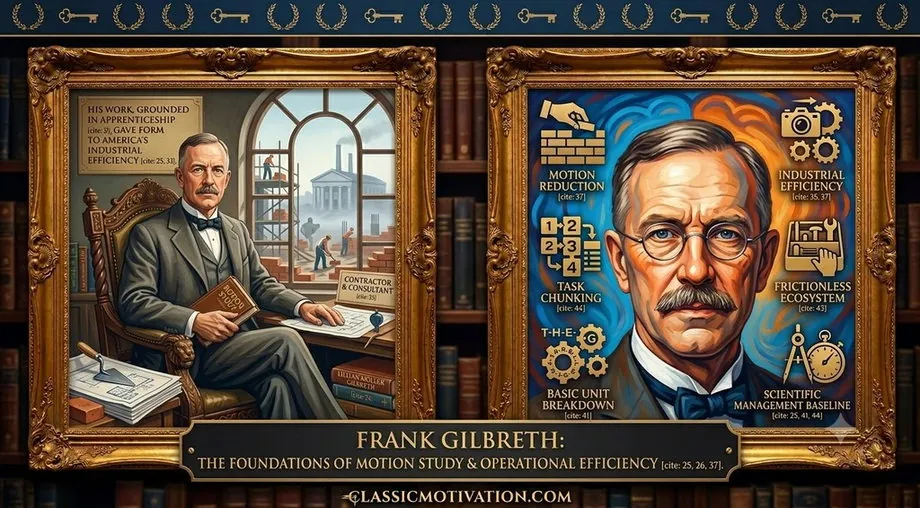
There is no waste of any kind in the world that equals the waste from needless, ill-directed, and ineffective motions, and their resulting unnecessary fatigue.Frank Gilbreth — Motion Study as an Increase of National Wealth, 1915
Frank Bunker Gilbreth was born in Fairfield, Maine, in 1868. His father, who ran a hardware business, died of pneumonia when Frank was only three, leaving the family in precarious circumstances. His mother, determined to give her children a real education, moved the household to Boston. Frank did well in school and, in 1885, passed the entrance examinations for the Massachusetts Institute of Technology. But rather than add to his mother's financial burden, he made a hard choice: he gave up his place at MIT and went to work at seventeen as a bricklayer's apprentice.
On the building sites he made the observation that would shape the rest of his life. He noticed that experienced bricklayers each used a different set of movements to lay a single brick, and that they changed their methods depending on whether they were working fast, training an apprentice, or pacing themselves through a long day — yet none of these methods had been designed to spare effort or prevent exhaustion. Human energy, Gilbreth saw, was being thrown away simply because no one had thought to study how the work was actually done.
Over the next two decades he rose from apprentice to major construction contractor and independent engineering consultant. With his wife and professional partner, Lillian Moller Gilbreth — a pioneering psychologist in her own right — he brought the study of the mind into the design of work itself. Using early motion-picture cameras to capture and break down human movement frame by frame, the Gilbreths transformed industrial output and changed how the physical environment is arranged to support, rather than fight, the worker.
Gilbreth's central claim was that fatigue, hesitation, and lost productivity are usually not failures of character but the predictable result of badly designed motion. In his 1911 book Motion Study, he showed what this meant in practice: by rearranging the materials and cutting the movements needed to lay a brick from eighteen to fewer than five, he raised a bricklayer's output from roughly 120 bricks an hour to 350 — while leaving the worker far less tired at the end of the day. The same logic applies to getting started on any task: when you first have to clear clutter, hunt for tools, and make a dozen small adjustments, you spend your energy before the real work has even begun.
His answer was to engineer the friction out of the work. Standardize the workspace, place every tool where the hand expects it, and a task can be begun in a single smooth motion rather than a series of small decisions. To make this rigorous, Gilbreth broke human action down into a catalogue of elemental hand motions he called "Therbligs" — his own name spelled roughly backward — the earliest serious attempt to analyze complex work into its smallest repeatable units.
For this library, Gilbreth is a valuable counterweight to philosophies built on willpower alone. He showed that lasting achievement depends far less on summoning bursts of motivation and far more on the patient design of a supportive, low-friction environment. His pre-1930 work is the structural ancestor of task-chunking and habit design: strip the friction out of the first move, and the rest of the work follows much more easily.
Motion study is the science of eliminating wastefulness resulting from using unnecessary, ill-directed, and inefficient motions.Frank Gilbreth — Primer of Scientific Management, 1912
The pioneering manual on movement and efficiency — a clear demonstration of how removing wasted motion transforms both output and human effort.
Read Free Online →Some links may be affiliate links. They help support the site at no additional cost to you.
