Fyodor Dostoevsky
Who was led to a mock execution, reprieved at the last moment and sent to four years of Siberian labor camp — and built from that experience the most psychologically searching novels in the Western tradition.
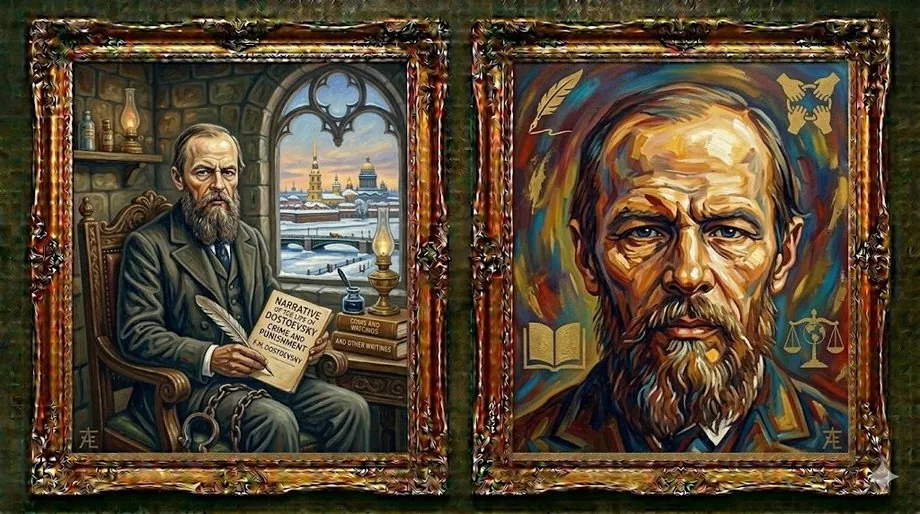
Pain and suffering are always inevitable for a large intelligence and a deep heart.Fyodor Dostoevsky — Crime and Punishment, 1866
Fyodor Dostoevsky was born in Moscow in 1821, the son of a military doctor who worked at a hospital for the poor. His mother died of tuberculosis when he was fifteen. His father — a difficult, alcoholic man — was murdered by his own serfs two years later, possibly because of his brutal treatment of them. Dostoevsky was nineteen. He later told friends that this event triggered his first epileptic seizure; whether this is medically accurate, it is true that epilepsy plagued him for the rest of his life.
He trained as a military engineer but resigned his commission to write. His first novel, Poor Folk, published in 1846, was celebrated by the critic Vissarion Belinsky as the work of a major new talent. Then, in 1849, he was arrested for his association with a radical literary circle — the Petrashevsky Circle — and sentenced to death. He was led to the execution ground, bound, placed before the firing squad. At the last moment, a rider galloped up with a reprieve: the Tsar had commuted the sentences. Several of the prisoners broke down completely. Dostoevsky did not. He was sent to four years of hard labor in a Siberian prison camp followed by compulsory military service — eight years in total before he returned to St. Petersburg.
He returned a changed man and a transformed writer. The literary project he undertook for the rest of his life — Crime and Punishment, The Idiot, Demons, The Brothers Karamazov — is the most sustained and searching exploration of the psychology of guilt, suffering, redemption, and freedom in Western literature.
Dostoevsky's philosophy is inseparable from his fiction, which is its best and truest expression. The central question his novels address is: what is a human being capable of? The answer he arrives at is: anything. The same person who commits a murder can achieve sainthood. The same intelligence that constructs an elaborate justification for evil can arrive, through genuine suffering and genuine encounter with other people, at genuine love.
This is not optimism — his novels are among the most harrowing in the tradition. It is a specific kind of realism: the refusal to simplify human beings into categories of virtue and vice, the insistence that the most damaged and destructive people retain within them the capacity for transformation, and that the most pious and apparently virtuous people contain within them the capacity for self-deception and harm.
His account of suffering is distinctive and controversial. In The Brothers Karamazov, Ivan Karamazov's rebellion against God — his refusal to accept any theodicy that would justify the suffering of innocent children — is one of the most powerful moral arguments in literature. And yet Dostoevsky presents it not as the final word but as a position that something in human experience — represented by his brother Alyosha, by the figure of Father Zosima — exceeds and transcends. The response to Ivan's argument is not another argument but a life: active love, love as a practice rather than a sentiment, love expressed in the daily care of specific actual people rather than abstract humanity.
There is only one means of salvation, then take yourself and make yourself responsible for all men's sins. As soon as you make yourself responsible in sincerity for everything and for everyone, you will see at once that this is really so, and that you are in fact to blame for everyone and for all things.Fyodor Dostoevsky — The Brothers Karamazov, 1880
Begin here. The psychological dissection of a murder and its aftermath is the most searching account of guilt and consequence in Western literature.
His masterpiece — on faith, doubt, suffering, love, and what a human being is capable of becoming. Begin with the Grand Inquisitor chapter (Book V, Chapter 5).
Some links may be affiliate links. They help support the site at no additional cost to you.
