Heraclitus
The most cryptic of the ancient philosophers — who observed that everything flows, that the river you step into is never the same river twice, and whose fragments have puzzled and illuminated Western thought for 2,500 years.
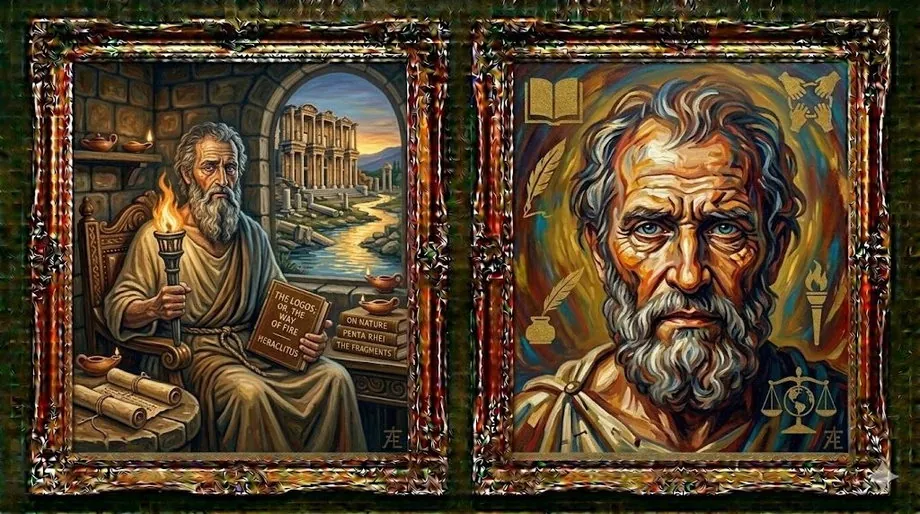
No man ever steps in the same river twice, for it is not the same river and he is not the same man.Heraclitus — Fragments, c. 500 BC
Heraclitus was born in Ephesus, on the western coast of what is now Turkey, around 535 BC, into an aristocratic family. He was famously misanthropic — he despised his contemporaries, refused political office despite being eligible by birth, and eventually withdrew from Ephesian society entirely. Later accounts describe him living in the mountains, subsisting on plants, and ultimately dying of dropsy after an unsuccessful attempt to cure himself by burying himself in cow dung. Whether this is accurate or the kind of story that attaches itself to famous eccentrics is impossible to say.
He wrote a single book — On Nature — which he reportedly deposited in the Temple of Artemis at Ephesus. The book is lost. What survives is approximately 130 fragments, quoted by later writers who were trying to explain, refute, or adapt his ideas. The fragments are deliberately obscure — he was apparently nicknamed the Obscure in antiquity — and their interpretation has been contested for 2,500 years. Plato, Aristotle, the Stoics, Hegel, Nietzsche, Heidegger, and many others have claimed him, each reading the fragments through their own philosophical concerns.
What is clear is that Heraclitus was making observations about the nature of change and unity that no one before him had articulated with such precision and such strange beauty.
The central Heraclitean insight is that everything flows — panta rhei — and that this universal flux is not disorder but the expression of an underlying unity. The river is always the same river and always different water. Fire seems to destroy everything it touches and yet is the principle that underlies all transformation. Opposites are not merely opposed but secretly identical: the road up and the road down are the same road. Sickness makes health pleasant, hunger makes satiety pleasant, weariness makes rest pleasant. Without the contrasts, the positive terms would lose their meaning.
The Logos — the rational principle that governs the flux — is what Heraclitus opposed to the mere appearance of change. Most people, he argued, live as if they were asleep — reacting to the surface of events without perceiving the deeper unity that governs them. Wisdom consists in perceiving the Logos: understanding that change is not chaos but order, that opposition is not contradiction but the tension that holds things together, that the world is one even as it is always becoming.
For this library, Heraclitus matters because he is the earliest formulation of an insight that recurs throughout the tradition: that reality is dynamic rather than static, that growth and change and even destruction are expressions of an underlying principle rather than departures from it, and that wisdom consists in aligning yourself with that principle rather than resisting it. The Stoics built their entire philosophy on the Logos. Marcus Aurelius uses Heraclitean language throughout the Meditations. The idea that obstacles are the way rather than obstacles to the way is Heraclitean at its root.
Character is fate.Heraclitus — Fragments, c. 500 BC
About 130 surviving fragments, available in multiple translations. The Charles Kahn translation and commentary is the most philosophically complete. Read slowly — each fragment rewards long meditation.
Read Free Online →Some links may be affiliate links. They help support the site at no additional cost to you.
