Ibn Khaldun
The fourteenth-century North African historian who invented the philosophy of history — arguing that civilizations rise and fall according to predictable social laws he called asabiyyah, a concept with no adequate English translation.
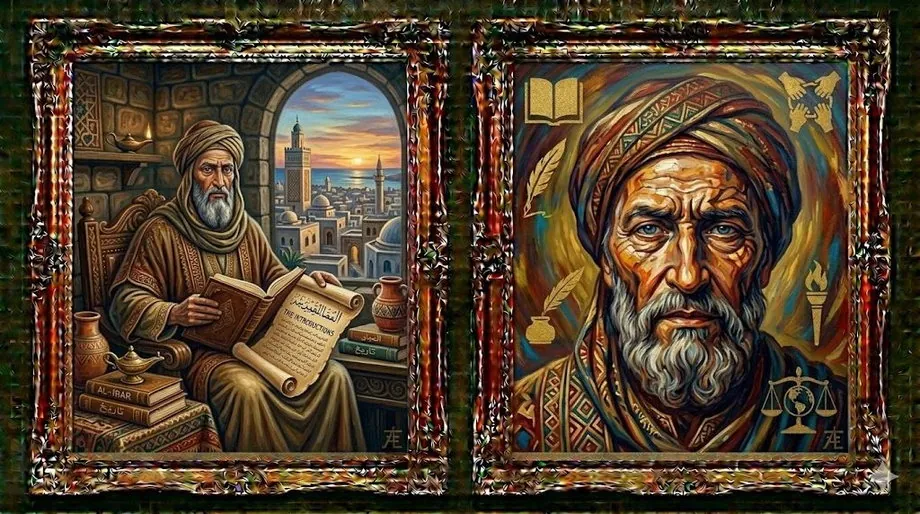
The past resembles the future more than one drop of water resembles another.Ibn Khaldun — Muqaddimah, 1377
Abd al-Rahman ibn Muhammad ibn Khaldun was born in Tunis in 1332 into a family of Andalusian origin that had fled to North Africa after the Christian reconquest of Seville. His family was distinguished — scholars, officials, jurists — and he received an excellent traditional Islamic education in Quran, Arabic grammar, rhetoric, law, and the religious sciences. He also studied mathematics, logic, and philosophy.
His life was extraordinarily eventful — he served in the courts of multiple rulers in Tunisia, Morocco, Granada, and various North African states, often switching sides as political winds changed, sometimes imprisoned, sometimes in favor, always navigating the volatile politics of fourteenth-century Islamic North Africa and Spain. He was also struck by the Black Death, which killed both his parents and many of his teachers. He met Tamerlane outside Damascus in 1401 and apparently had an extended conversation with him — a remarkable encounter between the century's greatest intellectual and its greatest conqueror.
In 1375, exhausted and disillusioned, he withdrew to a castle in the mountains of what is now Algeria, and in the next four years wrote the Muqaddimah — the Introduction — to a vast history of the world. The Muqaddimah turned out to be the most important thing he wrote: a philosophy of history, sociology, and political science of remarkable originality that was not fully appreciated until the nineteenth and twentieth centuries.
Ibn Khaldun's central concept is asabiyyah — usually translated as group feeling, social cohesion, or solidarity — the force that holds human groups together and gives them the power to act collectively. Asabiyyah is strongest in tribal and nomadic societies, where harsh conditions create genuine interdependence and mutual loyalty. It weakens in settled, prosperous, urban civilization, where wealth creates comfort, comfort creates individualism, and individualism erodes the solidarity that made the civilization possible.
This cycle — the rise of vigorous, solidarity-bound groups from the periphery, their conquest of established civilizations, their gradual softening and eventual replacement by the next generation of vigorous periphery groups — is, for Ibn Khaldun, the engine of history. No dynasty lasts more than three or four generations, because the third generation has forgotten the hardships that created the first generation's solidarity and lives off the wealth the first generation created.
The insight that civilizations destroy themselves through their own success — that the very qualities that produce prosperity (peace, division of labor, complexity, comfort) also erode the solidarity and vigor that made the prosperity possible — is one of the most durable and depressing observations in all of social philosophy. It anticipates Arnold Toynbee's theory of the rise and fall of civilizations, Spengler's Decline of the West, and the contemporary research on institutional decay.
For this library, Ibn Khaldun matters because he is one of the earliest thinkers to analyze human societies with the same systematic rigor that Aristotle applied to ethics and that Smith applied to economics. He treated social phenomena as subject to discoverable laws rather than divine mystery or individual whim. This is the foundational move of social science, and he made it three centuries before the European Enlightenment.
Social organization is necessary to the human species. Without it, the existence of human beings would be incomplete.Ibn Khaldun — Muqaddimah, 1377
The Introduction to his universal history — one of the most original works in the history of social thought. Begin with the first book on human civilization; the rest follows from there.
Some links may be affiliate links. They help support the site at no additional cost to you.
