Immanuel Kant
Who never traveled more than seventy miles from Königsberg in his entire life and produced the most comprehensive and influential philosophical system of the modern era.
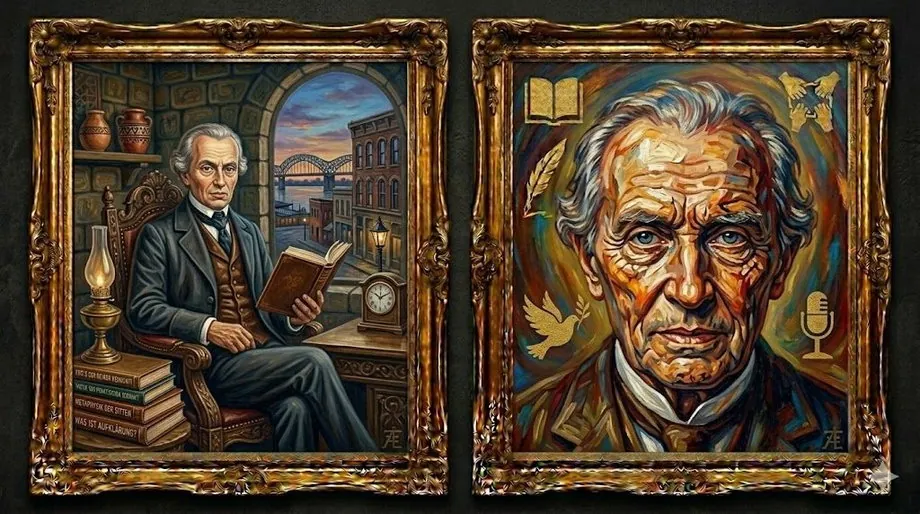
Act only according to that maxim whereby you can, at the same time, will that it should become a universal law.Immanuel Kant — Groundwork of the Metaphysics of Morals, 1785
Immanuel Kant was born in Königsberg, Prussia — now Kaliningrad, Russia — in 1724, the fourth of nine children of a harness maker. He was raised in a Pietist household that emphasized rigorous moral discipline, personal humility, and inner devotion. He attended the Collegium Fridericianum, a Pietist school, and then the University of Königsberg, where he studied philosophy, mathematics, and natural science. He spent his early career as a private tutor to aristocratic families, supporting himself while continuing to develop the philosophical ideas that would eventually transform European thought.
He was appointed Extraordinary Professor of Logic and Metaphysics at Königsberg in 1770 at age forty-six, and Ordinary Professor in 1770. He remained in Königsberg for his entire life — never traveling more than about seventy miles from the city where he was born. He was famously regular in his habits: his afternoon walk was so punctual that neighbors reportedly set their clocks by it. He died in Königsberg in 1804 at seventy-nine, by which time his ideas had already revolutionized European philosophy.
The Critique of Pure Reason, published in 1781 when he was fifty-seven, was the first of his three great Critiques and the work that established him as the most important philosopher since Aristotle. He described his project as a Copernican revolution in philosophy: just as Copernicus had shifted the center of the solar system from the Earth to the Sun, Kant shifted the center of philosophical inquiry from the world to the mind that perceives and structures it.
Kant's philosophy has two aspects that are directly relevant to this library. The first is his moral philosophy — the categorical imperative and the concept of moral autonomy. The second is his account of how the mind actively structures experience rather than passively receiving it.
The categorical imperative — act only according to a maxim that you could will to become a universal law — is Kant's attempt to ground morality entirely in reason rather than in God, tradition, or sentiment. The person who lies to gain an advantage cannot consistently will that lying become universal (since if everyone lied, the very concept of truth that makes lying advantageous would collapse). The person who keeps a promise, who respects the dignity of others, who refuses to treat people merely as means to their own ends, is acting in accordance with practical reason regardless of the consequences. This is the foundation of what modern philosophers call deontological ethics — the view that certain actions are right or wrong independent of their consequences.
His concept of autonomy — self-law — is the moral dimension of self-reliance: the morally mature person governs themselves by principles they have rationally endorsed rather than by external authority, social pressure, or tradition. This is why Emerson's philosophy, though it reaches Kant's conclusion through entirely different means, arrives at the same place: genuine moral agency requires governing yourself from within.
Enlightenment is man's emergence from his self-imposed nonage. Nonage is the inability to use one's own understanding without another's guidance.Immanuel Kant — What Is Enlightenment?, 1784
Four pages that define the project of the entire Enlightenment. The best introduction to Kant and one of the most important short essays ever written. Free and essential.
Read Free Online →His most accessible statement of the categorical imperative and moral autonomy. Demanding but repays careful reading.
Read Free Online →Some links may be affiliate links. They help support the site at no additional cost to you.
