Jim Rohn
America's foremost business philosopher — who grew up in poverty on an Idaho farm, met his mentor Earl Shoaff at twenty-five, and spent fifty years teaching the philosophy of personal development to more than five million people.
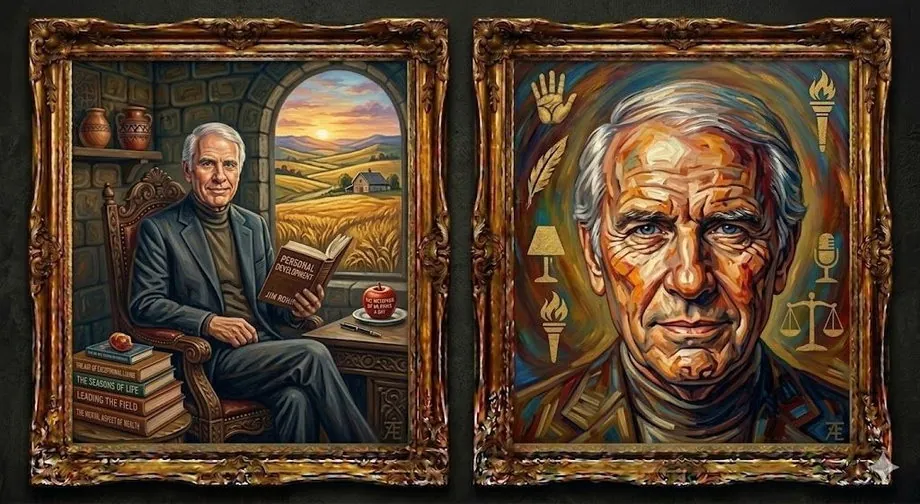
You are the average of the five people you spend the most time with.Jim Rohn — as attributed
Emanuel James Rohn was born in 1930 in Yakima, Washington, and grew up on a farm in Caldwell, Idaho. His parents were farmers — hardworking, decent people without much formal education. He attended college briefly, left, and spent his early twenties drifting through jobs and accumulating debt. By twenty-five he was broke, in debt, and unable to provide adequately for his family. He was embarrassed when the Girl Scouts knocked on his door because he could not afford to buy cookies.
Around this time he met J. Earl Shoaff, a successful entrepreneur and motivational speaker who became his mentor. Over the next five years, working with Shoaff, Rohn turned his financial situation around entirely. When Shoaff died in 1965, Rohn had internalized his mentor's philosophy well enough to begin teaching it. He gave his first paid talk to a small group in 1963. Over the next forty-six years he spoke to more than five million people in person across fifty-six countries, recorded hundreds of hours of audio and video programs, and became — in the words of Anthony Robbins, who was his student — America's foremost business philosopher.
He died on December 5, 2009. His students went on to build some of the most successful careers in personal development of the late twentieth and early twenty-first centuries: Anthony Robbins, Mark Victor Hansen, Brian Tracy, and dozens of others have cited him as a primary influence.
Jim Rohn's philosophy is built around a single conviction: personal development is more important than professional development. The skills, knowledge, and strategies required to succeed in business or career can be learned by almost anyone. What determines who actually succeeds is character — the quality of the person applying those skills. Work harder on yourself than you do on your job, he taught. If you work hard on your job you can make a living; if you work hard on yourself you can make a fortune.
This is Aristotle translated into American vernacular: character is not given but built, through the deliberate, daily choice to develop rather than to remain where you are. Rohn's version of this principle is accessible rather than academic, and that is its value: he could explain it to a twenty-year-old who had never read philosophy and have them leave understanding something true and actionable about the relationship between who they were becoming and what their life would produce.
His philosophy of time is perhaps his most enduring contribution: every day is a decision — not about whether to invest or spend your time, since time passes regardless, but about what you will have built by the time it has passed. You cannot change your destination overnight, but you can change your direction. The person who chooses to learn one hour a day, every day, for five years will be unrecognizable to themselves at the end of it. The person who chooses to do nothing different will be exactly where they are now, five years older.
Formal education will make you a living; self-education will make you a fortune.Jim Rohn — as attributed
His most complete statement of his philosophy — available as audio. More accessible than most books on this list and equally valuable.
His practical framework for applying the philosophy of personal development to financial and life outcomes.
Some links may be affiliate links. They help support the site at no additional cost to you.
