John Muir
Who was beaten with a leather strap throughout childhood, nearly blinded in an industrial accident at twenty-nine, walked a thousand miles from Indiana to the Gulf of Mexico, and founded the American conservation movement almost by himself.
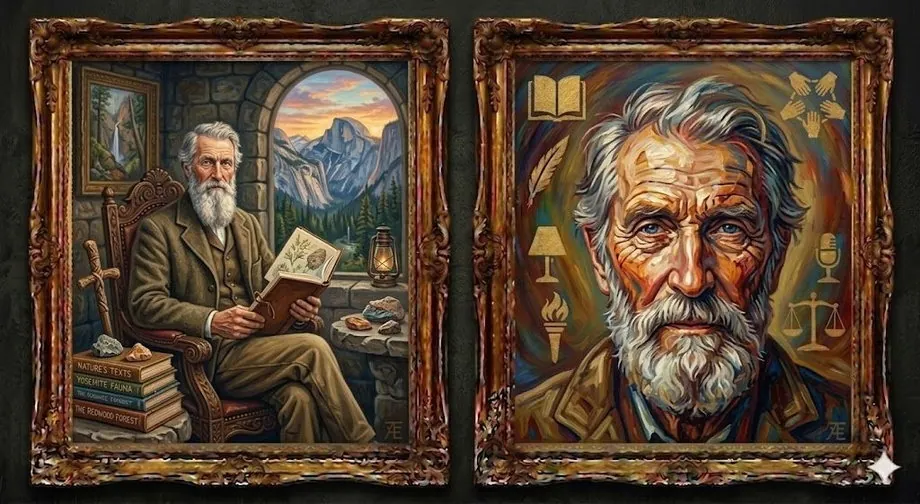
The mountains are calling and I must go.John Muir — Letter to his sister Sarah, 1873
John Muir was born in Dunbar, Scotland, in 1838. His father Daniel was a religious zealot who beat his children with leather straps for the slightest infractions and forced them to memorize the entire New Testament and most of the Old. John memorized everything required and more — learning the complete New Testament in three days — but the childhood was one of cold, hunger, physical punishment, and relentless demand. The family emigrated to Wisconsin when he was eleven and cleared a farm from the wilderness.
He was a mechanical prodigy — he built intricate clocks and mechanical devices from scrap wood in his teens — and enrolled at the University of Wisconsin in 1860, studying botany and geology. He left before completing his degree to walk the continent. In 1867, while working in an Indianapolis carriage factory, an awl slipped and pierced his right eye. As the sight drained from it, his left eye went dark in sympathetic response. He lay in a darkened room for a month, convinced he was permanently blind, before his sight returned. The experience converted him: if he could see again, he would give his eyes to the things most worth seeing.
He walked from Indiana to the Gulf of Mexico — a thousand miles — recording everything in journals. Then he sailed to California and walked into the Sierra Nevada. He spent the rest of his life fighting to preserve what he found there.
Muir's philosophy is a philosophy of attention — of what happens when a human being pays complete and sustained attention to the natural world over decades. The Yosemite Valley, the glaciers of Alaska, the redwoods of the California coast, the mountains of the High Sierra: these were not backdrops for Muir's inner life. They were objects of the most rigorous and devoted attention he could bring, and what he found in them — their age, their process, their interdependence, their capacity to produce in a receptive person something he could only call spiritual — became the foundation of a philosophy of nature and a politics of conservation.
His argument for the preservation of wilderness was not sentimental but philosophical: that wild places have intrinsic value independent of their utility to human beings, and that a civilization that destroys them for short-term economic gain is impoverishing itself in ways it will not be able to repair. This argument — made a century and a half ago — has proved more prescient than almost any other philosophical claim of its era.
His practical contribution was the founding of the Sierra Club in 1892 and his partnership with Theodore Roosevelt — whom he took on a three-day camping trip in Yosemite in 1903, sleeping under the stars and talking through the night — that produced some of the most significant conservation legislation in American history. He was the most effective environmental advocate the country had yet produced, operating in an era when environmental advocacy was not yet a recognized political category. He invented it.
In every walk with nature, one receives far more than he seeks.John Muir — as attributed
His journal of his first summer in Yosemite. The best introduction to his writing and his philosophy of attention.
Read Free Online →The journal of his walk from Indiana to Florida — the journey that began his philosophical education in the natural world.
Read Free Online →Some links may be affiliate links. They help support the site at no additional cost to you.
