Langston Hughes
Who became the poet laureate of the Harlem Renaissance — voicing the dreams, the blues, and the deferred hopes of Black America with a simplicity and a depth that have not been surpassed.
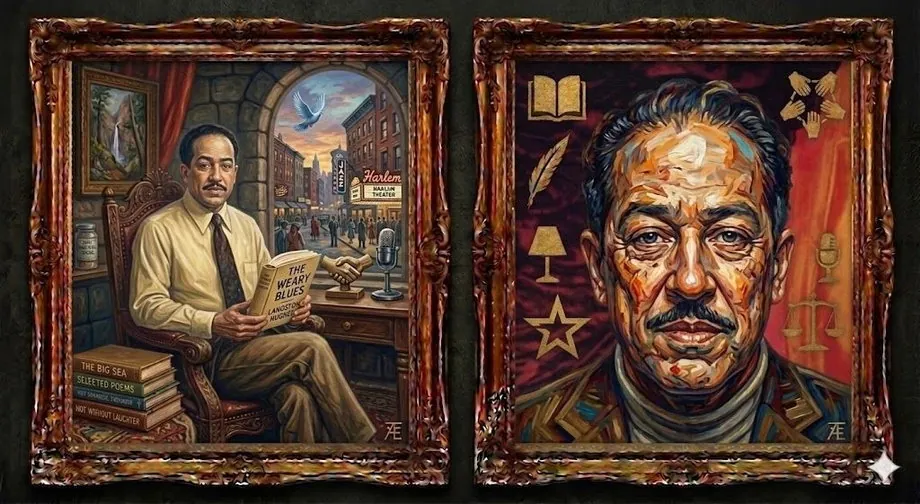
Life is for the living. Death is for the dead. Let life be like music. And death a note unsaid.Langston Hughes — as attributed
James Mercer Langston Hughes was born in Joplin, Missouri, in 1902. His parents separated shortly after his birth; his father, who despised Black Americans for their inability to advance, emigrated to Mexico. His mother moved frequently in search of work. Hughes was raised largely by his maternal grandmother, Mary Langston, in Lawrence, Kansas — a woman whose first husband had died at Harper's Ferry fighting with John Brown, and who told the young Langston stories about Black heroism and resistance that shaped his consciousness permanently.
He was elected class poet in grammar school — possibly, he later suggested wryly, because he was one of two Black students and his classmates assumed Black people had natural rhythm. He took the assignment seriously and discovered that he did, in fact, have something to say in verse. He entered Columbia University in 1921 at his father's insistence, left after a year to work on ships and travel — to Africa, to Europe, to Washington, D.C., where he worked as a busboy at the Wardman Park Hotel and left three poems next to the plate of the poet Vachel Lindsay, who recognized their quality and publicized them. Hughes was discovered as a poet while waiting tables.
His first collection, The Weary Blues, was published in 1926 when he was twenty-four. He remained one of the most prolific and recognized voices of the Harlem Renaissance and of African American literature for the next four decades, writing poetry, plays, short stories, novels, essays, and an autobiography, and supporting himself almost entirely through his writing — a remarkable achievement in any era.
Hughes's philosophy is embedded in his poetry rather than in philosophical prose, and it is a philosophy of the blues: the aesthetic transformation of suffering into beauty, of deferred hope into lasting art, of the gap between American promise and American reality into something that does not despair but insists.
His most famous poem — A Dream Deferred — poses its question with the controlled intensity of a philosophical argument: what happens to a dream deferred? Does it dry up like a raisin in the sun? Or fester like a sore? Or does it explode? The question is not rhetorical. He does not answer it, because the answer depends on what the dreamer does — and the poem is addressed to the dreamers as much as to the defenders of their deferral.
His account of Black American life does not traffic in tragedy or despair. It traffics in blues — which is a different thing. The blues acknowledges that life is hard and sometimes crushingly unjust. It does not stop there. It takes the hard thing and gives it a form — musical, rhythmic, communal — that makes it bearable and sometimes makes it beautiful. This is Camus's revolt and Frankl's meaning-making in a specifically African American register: the refusal to be destroyed by what cannot be changed, and the insistence on creating something out of the material at hand.
Hold fast to dreams, for if dreams die, life is a broken-winged bird that cannot fly.Langston Hughes — Dreams, 1922
His first collection — the poems that established him as the voice of the Harlem Renaissance. Begin here.
His autobiography of his early life — one of the most vivid accounts of the Harlem Renaissance from the inside.
Some links may be affiliate links. They help support the site at no additional cost to you.
