Lao Tzu
The sage who, according to tradition, left civilization behind and wrote the Tao Te Ching in a single day — producing the second most translated book in human history.
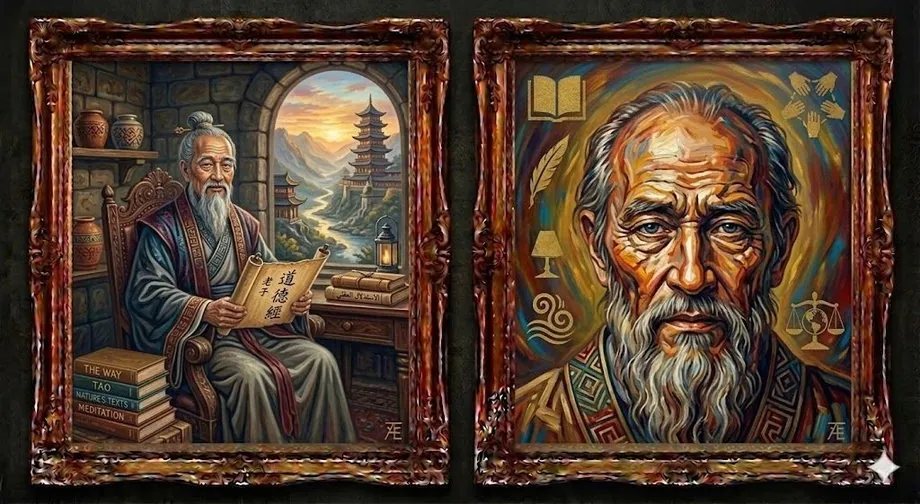
The Tao that can be told is not the eternal Tao.Lao Tzu — Tao Te Ching, c. 600 BC
Almost nothing is known with certainty about Lao Tzu. The most common account describes a man named Li Er who worked as an archivist at the Zhou royal court. Disillusioned with the decay of the dynasty, he eventually left China altogether. At the border, a gatekeeper recognized him and asked him to write down his wisdom before departing. He wrote eighty-one short chapters, handed them to the gatekeeper, and was never seen again.
Whether this account is literally true is uncertain. What is not uncertain is the text itself — the Tao Te Ching, five thousand characters of compressed philosophical verse that has been read, debated, translated, and applied in every corner of the world for 2,500 years. It is the second most translated book in history after the Bible.
The very obscurity of its author may be appropriate. The Tao Te Ching argues consistently for simplicity, for the priority of nature over convention, for the wisdom of not-doing over the restlessness of constant action. A philosopher who wrote his book and walked away, leaving no biography and no school, embodies in his life the philosophy he left behind.
The Tao — usually translated as the Way — is the central concept, and Lao Tzu is careful to say immediately that it cannot be named. As soon as you name it, you have lost it. This is not mystical evasion. It is a precise observation about the relationship between concepts and reality: the map is not the territory, and the Tao is not any human concept of it.
Wu wei — non-action, or effortless action — is the practical application of this insight. The sage does not force outcomes. He acts in harmony with the natural flow of things, like water finding the lowest point without effort, wearing away the hardest rock not by opposing it but by flowing around and through it. The leader who governs through wu wei governs best: the people, when asked what made their prosperity possible, say only that things happened naturally.
The paradoxes of the Tao Te Ching — the soft overcomes the hard, the empty is more useful than the full, knowing others is intelligence but knowing yourself is wisdom — are not riddles. They are observations about how complex systems actually work, observations that Western linear thinking has often missed. The tree that bends survives the storm that breaks the rigid one.
A good traveler has no fixed plans and is not intent on arriving.Lao Tzu — Tao Te Ching, c. 600 BC
Eighty-one short chapters. The Stephen Mitchell and Ursula Le Guin translations are the most readable in English. Read slowly, one chapter per day.
Read Free Online →Some links may be affiliate links. They help support the site at no additional cost to you.

Lao Tzu speaks on the interactive trails — the passage large, the background, the sources, and paths onward.