Mahatma Gandhi
Who developed the philosophy and practice of satyagraha — nonviolent resistance — and used it to end British rule in India, inspiring every subsequent movement for justice that has used nonviolence as its method.
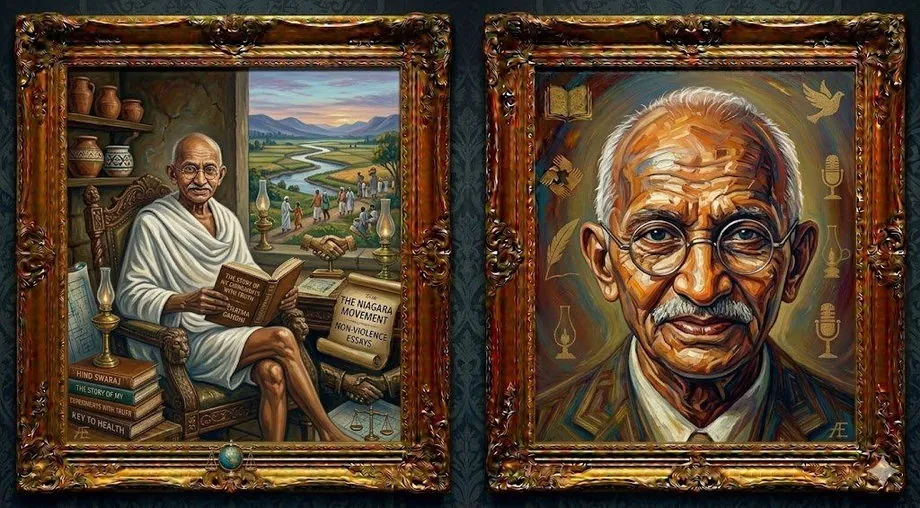
Be the change you wish to see in the world.Mahatma Gandhi — as attributed
Mohandas Karamchand Gandhi was born in Porbandar, on the western coast of India, in 1869, the youngest child of the chief minister of the small princely state of Porbandar. He was a mediocre student, shy and unremarkable, who married at thirteen in an arranged marriage to Kasturba, who remained his wife and closest ally for sixty-two years. He went to London to study law at age eighteen, was called to the bar, and returned to India to practice — unsuccessfully. He was offered a position with an Indian law firm in South Africa in 1893 and took it, planning to stay for a year. He stayed for twenty-one.
South Africa transformed him. The experience of racial discrimination — thrown off a first-class train for being non-white, refused entry to hotels, required to walk in the gutter — converted the shy, unsuccessful lawyer into a political organizer. He founded the Natal Indian Congress, pioneered the technique of nonviolent mass civil disobedience that he called satyagraha (truth-force or soul-force), and spent two decades fighting for the rights of Indians in South Africa before returning to India in 1915.
The next thirty-two years were the campaign for Indian independence. The Salt March of 1930, the Quit India Movement of 1942, repeated imprisonments, fasts, and negotiations — culminating in independence in 1947 and his assassination by a Hindu nationalist on January 30, 1948. He was seventy-eight years old.
Gandhi's contribution to this library is the philosophy of satyagraha — the idea that nonviolent resistance, practiced with complete discipline and willingness to accept suffering without retaliation, is not merely a moral position but a practical strategy that can defeat even overwhelming military and political power.
The philosophical basis of satyagraha is the conviction that the opponent is not an enemy to be destroyed but a person to be converted — that the goal of resistance is not to defeat the oppressor but to awaken their conscience. This requires a quality of courage that Gandhi considered higher than the courage of violence: the courage to accept suffering without retaliating, to refuse to dehumanize the person inflicting the suffering, to maintain the moral high ground under conditions designed to make that impossible.
Gandhi was influenced by Thoreau's Civil Disobedience, the Bhagavad Gita, and Tolstoy's The Kingdom of God Is Within You. He read Ruskin's Unto This Last on a train journey in South Africa and said it immediately transformed his understanding of how to live. His synthesis of these sources — combined with the practical experience of organizing mass movements under conditions of severe repression — produced a philosophy of action that Martin Luther King studied carefully and applied in the American civil rights movement. The lineage runs from Thoreau to Gandhi to King, and its influence continues wherever people choose principled nonviolence over expedient violence.
The weak can never forgive. Forgiveness is the attribute of the strong.Mahatma Gandhi — as attributed
Gandhi's own account of how his philosophy developed through lived experience. Remarkably candid about his failures as well as his achievements.
Read Free Online →Some links may be affiliate links. They help support the site at no additional cost to you.
