Marcus Aurelius
The Roman Emperor who governed the most powerful state in the world and spent his private hours arguing with himself about how to be a decent human being. We publish his notebook in our own translation — all twelve books, free.
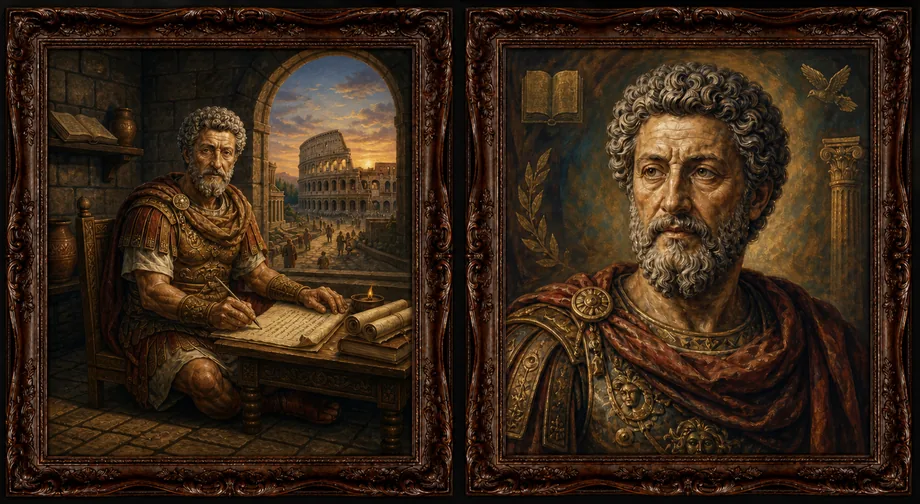
That everything is judgment, and this is in your power. Remove the judgment when you will, and just as when rounding a cape there is calm — all is stable and a waveless bay.Marcus Aurelius — Meditations XII.22, in our rendering
Marcus Aurelius did not choose to be Emperor. He was adopted into the imperial family at age seventeen and trained from that point forward for a role he had not sought and, by all accounts, would not have chosen. He was a philosopher by inclination, a student of Stoicism who would have preferred a quiet life of reading, writing, and conversation. Instead he became, at age forty, the ruler of the Roman Empire at the height of its power and complexity.
What followed was not the triumph the histories describe. Marcus Aurelius spent most of his reign at war — on the Danube frontier, fighting Germanic tribes who posed an existential threat to Rome's northern borders. He lost multiple children. His wife died. Several of his most trusted generals betrayed him. The empire suffered plague on a scale that killed an estimated five million people. He dealt with all of it.
The Meditations — the private journal he kept throughout these years, found after his death and never intended for publication — is the record of a man who was fighting simultaneously on two fronts: the external battles of empire and the internal battle to remain governed by reason rather than by anger, fear, grief, or the corrupting influence of absolute power. He lost some of those internal battles. He recorded that honestly too. What makes the Meditations extraordinary is not that it shows a perfect man. It shows a man trying, failing, trying again, and never quite stopping.
Marcus Aurelius was a Stoic — a practitioner of the philosophy founded by Zeno of Citium in Athens around 300 BC and developed by Epictetus, Seneca, and others in the centuries that followed. Stoicism held that the only true good is virtue — the alignment of one's actions with reason and nature — and that everything else, including health, wealth, reputation, and even life itself, is what the Stoics called an indifferent: neither good nor bad in itself, useful or harmful only insofar as it is used well or badly.
The practical consequence of this view is the dichotomy of control: divide all things into what is up to you (your judgments, your responses, your values) and what is not up to you (everything external). Focus entirely on the former. Accept the latter as it comes. This is not passivity — Marcus Aurelius was the most active ruler of his age. It is a specific relationship to outcomes: do the work, do it well, accept what the work produces, and do not mistake external outcomes for the measure of your worth.
His Meditations return obsessively to the same themes: the brevity of life and the urgency of using it well; the smallness of any individual concern against the immensity of time; the importance of not being moved by praise or blame; the discipline of waking up in the morning and choosing, again, to govern yourself before you govern anything else. He wrote to himself in the second person: You have one job. Do it.
No longer talk at all about what kind of man the good man is — but be one.Marcus Aurelius — Meditations X.16, in our rendering
Written in Greek during military campaigns, never intended for publication, found after his death. The most widely read work of Stoic philosophy and one of the most influential books ever written. Begin with Book II. Read one entry per day.
Read Our Free Edition → Trace It Into the Novel →We publish the Meditations ourselves
A new English rendering set beside the original Greek and Xylander’s 1558 Latin. Twelve volumes, free to read or download — no signup, no paywall.


Ours is above, and free. If you would rather hold a printed single volume, this is the standard one.
Some links may be affiliate links. They help support the site at no additional cost to you.

Marcus Aurelius speaks on the interactive trails — the passage large, the background, the sources, and paths onward.