Martin Luther King Jr.
Who led the American civil rights movement using the philosophy of nonviolent resistance he learned from Gandhi, and who was assassinated at thirty-nine while still fighting for economic justice.
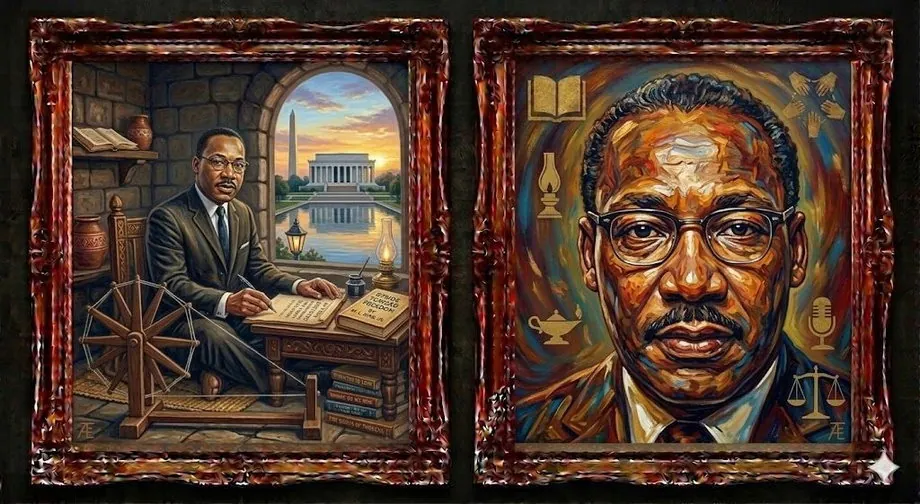
Darkness cannot drive out darkness; only light can do that. Hate cannot drive out hate; only love can do that.Martin Luther King Jr. — Strength to Love, 1963
Michael King Jr. was born in Atlanta, Georgia, in 1929. His father, a Baptist minister, changed both their names to Martin Luther King in honor of the German reformer during a trip to Germany in 1934. King grew up in a middle-class Black family in the segregated South, skipped two grades, and entered Morehouse College at fifteen. He earned a divinity degree from Crozer Theological Seminary in Pennsylvania and a doctorate in systematic theology from Boston University in 1955, at twenty-six.
He had accepted the pastorate of Dexter Avenue Baptist Church in Montgomery, Alabama, in 1954 — the year the Supreme Court handed down Brown v. Board of Education. In December 1955 Rosa Parks was arrested for refusing to give up her bus seat, and King was elected to lead the Montgomery Bus Boycott. He was twenty-six years old. His house was bombed. He was arrested. The boycott lasted 381 days and ended with the Supreme Court ruling bus segregation unconstitutional. The movement had found its leader and its method.
For the next thirteen years he led the Southern Christian Leadership Conference, organized demonstrations, marches, and campaigns across the South, was stabbed, had his home repeatedly bombed, was surveilled and harassed by the FBI, was jailed dozens of times, and delivered speeches that rank among the greatest in the English language. He was awarded the Nobel Peace Prize in 1964 at thirty-five. He was assassinated in Memphis, Tennessee, on April 4, 1968. He was thirty-nine years old.
King's philosophy was built on three foundations: the Christian theology of the beloved community, the Gandhian method of nonviolent resistance, and the American democratic tradition of equal rights under law. These three came together in his conviction that the goal of the civil rights movement was not merely to defeat segregation but to create a genuinely beloved community — a society organized not around power and domination but around mutual care and recognition.
His Letter from Birmingham Jail, written in the margins of a newspaper and on scraps of paper while imprisoned in April 1963, is one of the most important documents in American history — a systematic defense of civil disobedience, a rebuttal of white moderates who urged patience, and a philosophical argument about the nature of just and unjust laws rooted simultaneously in Augustine, Aquinas, Buber, and Jefferson. It repays close reading in a way that most political documents do not.
What is most remarkable about King for this library is the quality of attention he brought to the relationship between the method of resistance and its goal. He understood, as Gandhi had, that you cannot build a just society through unjust means — that the means prefigure the end, that a movement organized around hatred and dehumanization will, if it succeeds, produce a society organized around hatred and dehumanization. The insistence on nonviolence was not tactical but philosophical: it was the only method consistent with the society he was trying to build.
The arc of the moral universe is long, but it bends toward justice.Martin Luther King Jr. — speech at National Cathedral, 1968
Written in jail on newspaper margins. One of the most important documents in American history. Read it slowly — every paragraph earns its place.
Available at libraries and booksellersA collection of sermons that contain his complete philosophical and theological framework in accessible form.
Some links may be affiliate links. They help support the site at no additional cost to you.

