Maya Angelou
Who was mute for five years after a trauma in childhood, became one of the most celebrated voices of the twentieth century, and demonstrated throughout her life that survival and creativity are not separate things.
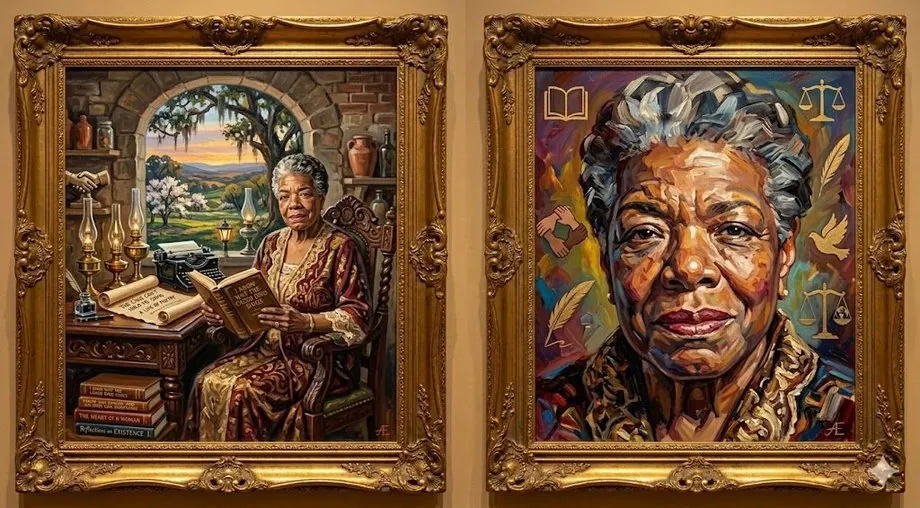
You may encounter many defeats, but you must not be defeated.Maya Angelou — as attributed
Marguerite Annie Johnson — who would become Maya Angelou — was born in St. Louis, Missouri, in 1928. When she was three, her parents divorced and she and her brother Bailey were sent to live with their grandmother in Stamps, Arkansas. When she was seven, she was raped by her mother's boyfriend. She told her brother, who told the family. The man was arrested, tried, convicted — and then kicked to death by a mob before he could serve his sentence.
The eight-year-old Maya concluded that her voice had killed him. She stopped speaking. She was mute for five years — reading voraciously, memorizing poetry, absorbing language while producing none — until a teacher named Bertha Flowers persuaded her back to speech by reading to her and insisting that she read aloud in return.
The life that followed was improbable by any measure: she worked as San Francisco's first Black female cable car conductor at sixteen, gave birth to a son at seventeen, worked as a cook, a madam, a nightclub dancer, a calypso singer, a journalist in Cairo and Ghana, a civil rights coordinator for Martin Luther King, an actress, a playwright, and a professor. I Know Why the Caged Bird Sings, published in 1969, was the first autobiography by a Black woman to become a bestseller. She published six more volumes of autobiography and seven collections of poetry. She delivered a poem at President Clinton's inauguration in 1993. She received the Presidential Medal of Freedom in 2011. She died in 2014 at eighty-six.
Maya Angelou is not primarily a philosopher in the academic tradition, but her body of work constitutes a coherent philosophy of survival, creativity, and human dignity that belongs in this library alongside the more systematic thinkers.
Her central conviction — lived before it was articulated — is that survival and creativity are the same act. The five years of muteness were not merely an absence; they were a period of intense internal cultivation, of storing language and meaning that would eventually demand expression. The caged bird sings because singing is not merely a luxury but a necessity — a way of maintaining the self that cannot be taken, even when everything external has been taken.
She wrote about race, about violence, about poverty, about sexual trauma, about the complexity of love and family with a directness and generosity that made her work accessible to people who had never encountered literary autobiography before. Her gift was not only her prose style, which is extraordinary, but her refusal to simplify — her insistence on presenting the full complexity of human experience, including the parts that are ugly and the parts that do not resolve neatly, with the conviction that truth-telling is itself a form of respect for the reader.
You may encounter many defeats, but you must not be defeated. She said this many times in many forms. She had lived it first.
My mission in life is not merely to survive, but to thrive; and to do so with some passion, some compassion, some humor, and some style.Maya Angelou — as attributed
The first volume of her autobiography. One of the most important American memoirs of the twentieth century. Begin here.
Her most celebrated poetry collection — the title poem is one of the most powerful statements of human resilience ever written.
Some links may be affiliate links. They help support the site at no additional cost to you.
