Miyamoto Musashi
Who fought sixty-one duels and never lost one, then retired to a cave and wrote The Book of Five Rings — the most concentrated account of mastery as a way of life ever produced.
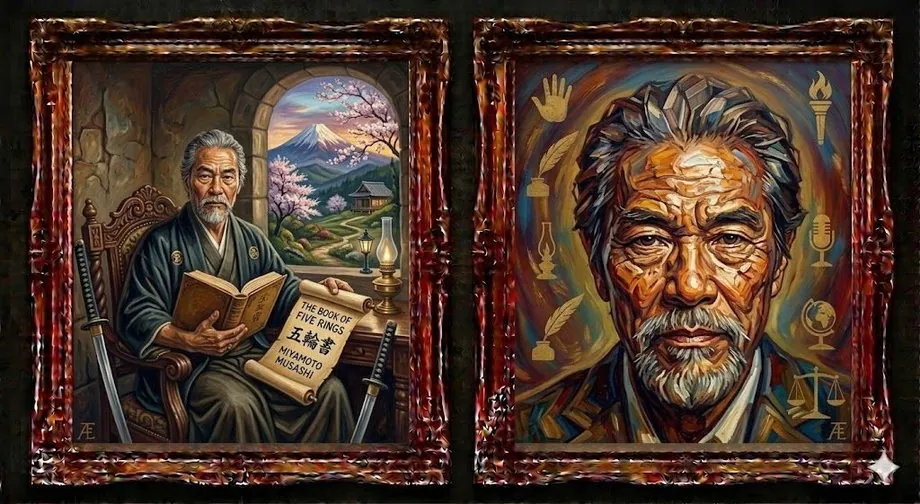
Today is victory over yourself of yesterday; tomorrow is your victory over lesser men.Miyamoto Musashi — The Book of Five Rings, 1645
Miyamoto Musashi was born in 1584 in the Harima Province of Japan. His father was a sword-fighter of considerable skill, and Musashi learned the use of weapons from childhood. He fought his first duel at age thirteen, killing an adult swordsman. He fought his second at sixteen. He fought at the Battle of Sekigahara in 1600 on the losing side, surviving the aftermath that claimed most of his companions. He spent the next several decades traveling Japan as a ronin — a masterless samurai — seeking out opponents, refining his technique, and developing what became the Niten Ichi-ryu style of two-sword fighting.
His most famous duel was with Sasaki Kojiro in 1612. Kojiro was the established master of the region, famous for his swallow's wing technique with an unusually long sword. Musashi arrived by boat, hours late, having apparently spent the time napping on the journey, carrying a bokken he had carved from an oar during the crossing. He killed Kojiro with a single strike. The apparent rudeness of arriving late was, by most interpretations, deliberate psychological strategy: he forced Kojiro to wait, to grow angry, to lose the equanimity that a duel requires.
In his later years he turned to art — ink painting, sculpture, calligraphy — and began transmitting his philosophy in writing. He moved into a cave called Reigando in 1643 and spent his final two years writing The Book of Five Rings, completing it seven days before his death in 1645 at the age of sixty-one.
The Book of Five Rings is organized into five chapters named for elements: Earth, Water, Fire, Wind, and Emptiness. The Earth chapter establishes the philosophical foundation: the Way of the warrior is the resolute acceptance of death, and only from that acceptance can the warrior act with genuine freedom. The Water chapter describes the specific techniques of the Niten Ichi-ryu style. The Fire chapter covers the dynamics of combat — timing, rhythm, psychological pressure. Wind covers common errors. Emptiness is the most difficult and shortest chapter: the goal of all practice is a mind that is genuinely empty, capable of responding spontaneously without interference from habit, fear, or desire.
What makes the book more than a manual is its consistent insistence that the Way of strategy is the Way of life — that the disciplines required to master combat (rigorous self-knowledge, the refusal of illusion, the cultivation of timing and perception, the acceptance of death) are the same disciplines required to master anything. Mastery is not a skill. It is a quality of attention and character that, once developed in one domain, expresses itself in all domains.
Musashi painted, sculpted, and wrote poetry in his old age with the same quality of attention he had brought to swordsmanship. He is, in this sense, an argument made with a life: that the cultivation of excellence in any domain, pursued with sufficient depth and honesty, opens eventually onto something universal.
Do nothing which is of no use.Miyamoto Musashi — The Book of Five Rings, 1645
Written seven days before his death. Short and dense. The Victor Harris translation is most readable; the Thomas Cleary translation is most philosophically complete.
Read Free Online →Some links may be affiliate links. They help support the site at no additional cost to you.
