Nelson Mandela
Who spent twenty-seven years in prison for his opposition to apartheid — eighteen of them in a cell on Robben Island — and emerged without bitterness to lead South Africa's first democratic government.
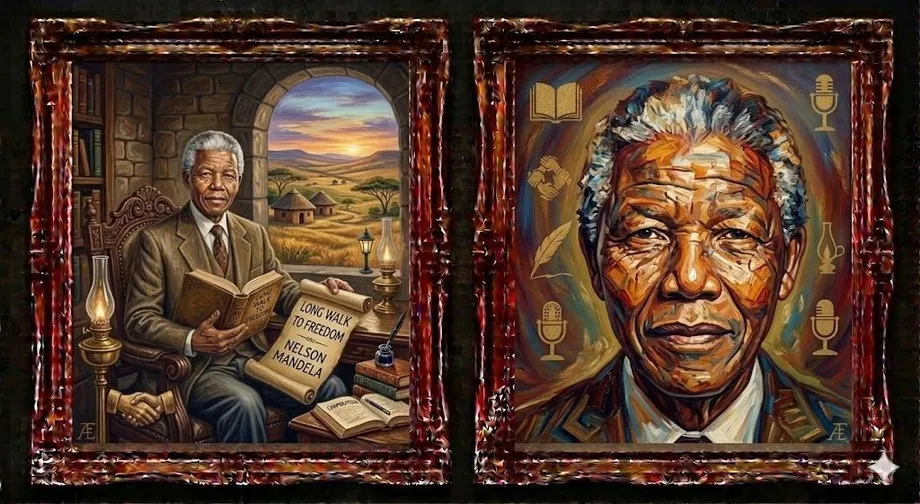
It always seems impossible until it is done.Commonly attributed to Nelson Mandela — traced by scholars to James Freeman Clarke (1810–1888)
Nelson Rolihlahla Mandela was born in Mvezo, a village in the Transkei region of South Africa, in 1918. He was the first in his family to attend school, where his teacher gave him the English name Nelson. His father died when he was nine; he was taken in by the Thembu regent Jongintaba Dalindyebo, who raised him alongside his own son and gave him an education. He attended Fort Hare University — the only institution of higher learning for Black South Africans at the time — until he was expelled for participating in a student strike.
He fled an arranged marriage, moved to Johannesburg, finished his degree by correspondence, and began studying law. He joined the African National Congress in 1944, co-founding the ANC Youth League which pushed the organization toward more active resistance to the apartheid system that was being systematically constructed by the Nationalist government elected in 1948. Through the 1950s he was repeatedly banned, arrested, and tried as the apartheid state attempted to suppress resistance. In 1961, after the Sharpeville massacre convinced him that nonviolent resistance alone was insufficient, he helped found Umkhonto we Sizwe — the armed wing of the ANC. He was arrested in 1962, tried for sabotage and conspiracy, and sentenced to life imprisonment in 1964.
He served twenty-seven years — eighteen on Robben Island, quarrying limestone in a courtyard where the sun's reflection permanently damaged his eyesight, and nine in other prisons. He was released on February 11, 1990. He was elected President of South Africa in 1994. He served one term and stepped down in 1999.
Mandela's philosophy is not systematic in the academic sense — he was a lawyer and a politician, not a philosopher. What he left behind is a body of testimony: speeches, letters, his autobiography, and above all the example of his own choices, which constitute one of the most complete demonstrations of human moral capacity in the twentieth century.
The central question his life poses is: how does a person spend twenty-seven years in prison without being consumed by bitterness? His answer, worked out in practice rather than in theory, involves several elements. First, the maintenance of a clear purpose that transcends personal grievance: the struggle was not about him, it was about a principle, and the principle survived his imprisonment. Second, the deliberate cultivation of understanding for his opponents — he learned Afrikaans in prison, read Afrikaner history, and came to understand the fears that drove the apartheid system even as he opposed it absolutely. Third, the refusal to allow the prison to define him: he organized, studied, taught, and maintained his dignity in conditions designed to strip it away.
The Truth and Reconciliation Commission that he supported after his election was the institutional expression of the same philosophy: that the path forward for a traumatized society is not retribution but acknowledgment — the honest confrontation with what happened, the refusal to deny it, and the willingness to find a way to continue together. This is not weakness. It is the most difficult and most powerful form of strength.
I learned that courage was not the absence of fear, but the triumph over it.Nelson Mandela — Long Walk to Freedom, 1994
His autobiography — one of the great documents of the twentieth century. Every page is relevant to the question of how to maintain integrity under pressure.
Some links may be affiliate links. They help support the site at no additional cost to you.
