Paulo Freire
The Brazilian educator who developed a philosophy of education rooted in the dignity of the oppressed — and whose Pedagogy of the Oppressed became one of the most influential educational texts of the twentieth century.
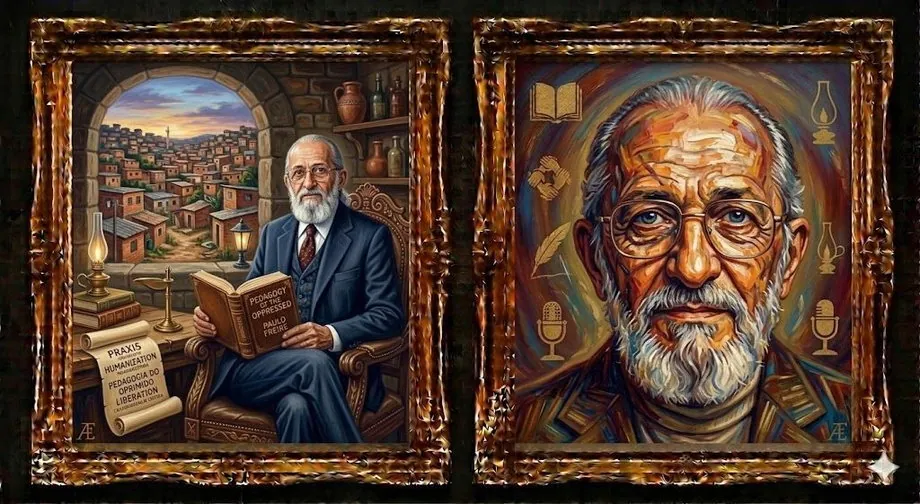
Education either functions as an instrument to facilitate the integration of the younger generation into the logic of the present system, or it becomes the practice of freedom.Paulo Freire — Pedagogy of the Oppressed, 1968
Paulo Reglus Neves Freire was born in Recife, Brazil, in 1921 into a middle-class family that was driven into poverty by the Great Depression. He experienced hunger as a child and later said that hunger had taught him about the relationship between economic circumstance and the capacity to learn. He studied law, then turned to education, working with illiterate workers and peasants in northeastern Brazil in the 1950s and early 1960s.
His literacy method — which linked the teaching of reading to the critical examination of the social and political conditions that shaped learners' lives — proved remarkably effective. In 1963 he was appointed to direct a national literacy program. In 1964 the military coup overthrew the Brazilian government. Freire was arrested, held for seventy days, and then exiled. He spent sixteen years outside Brazil, working first in Chile, then at Harvard, then at the World Council of Churches in Geneva, and in various African countries that had recently achieved independence. He returned to Brazil in 1979 after the amnesty, eventually becoming Secretary of Education for the city of São Paulo.
Pedagogy of the Oppressed, written during his exile in Chile and published in 1968, has been translated into more than forty languages and has sold millions of copies. It is one of the most cited books in the social sciences.
Freire's central argument is against what he calls the banking concept of education: the idea that education consists of depositing information into passive students who receive, memorize, and repeat it. This model, he argues, is not neutral — it reproduces the social structures that produced it by training people to be passive recipients rather than active agents in their own lives and their society.
His alternative is problem-posing education: a dialogical process in which teacher and student learn together, in which the starting point is the learner's own experience and the analysis of the conditions of their actual lives, and in which literacy — the ability to read both words and the world — is the tool of liberation rather than accommodation.
The philosophical depth of Pedagogy of the Oppressed lies in his account of consciousness: the move from naive consciousness (accepting the world as given, as natural, as inevitable) to critical consciousness (understanding that the world is made, that it has been made in ways that benefit some and harm others, and that it can therefore be made differently). This move — from passive recipient to active agent — is what genuine education produces. Everything else is training for compliance.
His insistence that genuine dialogue requires the humility to recognize that no one teaches another, nor is anyone self-taught — that people teach each other, mediated by the world — connects to every tradition in this library that places learning at the center of human development.
Leaders who do not act dialogically, but insist on imposing their decisions, do not organize the people — they manipulate them.Paulo Freire — Pedagogy of the Oppressed, 1968
His foundational work — on education, dialogue, consciousness, and liberation. Demanding in places but one of the most important educational texts of the twentieth century.
Some links may be affiliate links. They help support the site at no additional cost to you.
