Ralph Waldo Emerson
Who lost his first wife eighteen months after their wedding, rebuilt himself entirely, and wrote the definitive American philosophy of the individual.
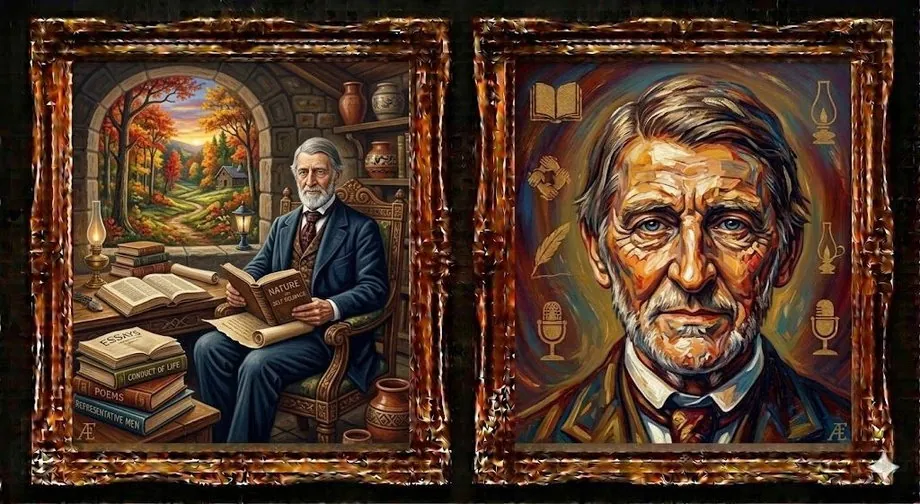
Trust thyself: every heart vibrates to that iron string.Ralph Waldo Emerson — Self-Reliance, 1841
Ralph Waldo Emerson was born in Boston in 1803, the son of a Unitarian minister who died of tuberculosis when Emerson was eight. He was raised in genteel poverty by his mother and a formidable aunt, Mary Moody Emerson, who pushed him intellectually from childhood. He entered Harvard at fourteen, graduated, taught school, and then entered the ministry.
He married Ellen Tucker in 1829. She died of tuberculosis in 1831, eighteen months after their wedding. He was twenty-seven. The grief was profound and destabilizing — he visited her tomb daily for a year. What emerged from the experience was a complete philosophical reorientation: a break with organized religion, a turn toward direct personal experience as the primary source of spiritual authority, and the conviction that each person carries within them a source of wisdom that no institution can give them or take away.
He resigned his ministry, traveled to Europe — meeting Carlyle, Coleridge, and Wordsworth — and returned to Concord, Massachusetts, where he lived for the rest of his life. The philosophical core he forged in his twenties held for sixty years and shaped almost every major American thinker who followed him.
Self-Reliance, published in 1841, is his central statement: envy is ignorance; imitation is suicide; trust thyself. The essay argues against conformity — the slow surrender of one's own perspective to the accumulated expectations of society — with a force that has not diminished in 180 years. Every soul has its own specific nature, its own unrepeatable angle on the world, its own contribution that no one else can make. Failing to express that nature is not merely a personal loss. It is a waste of what is genuinely irreplaceable.
Compensation argues that every loss contains within it a corresponding gain — an insight that anticipates Napoleon Hill by a century. The universe maintains a balance: deprivation in one area produces capacity in another; suffering that is fully met produces strength that comfort never could. This is not optimism. It is a structural observation about how growth works.
Emerson's influence runs through almost everything in this library. He shaped Thoreau, who was his neighbor and protégé. He shaped William James and the entire pragmatist tradition. He shaped the American ideal of the self-made person. Napoleon Hill's conviction that individual mental states determine external outcomes is, at its root, Emersonian. He is the philosophical root of the American belief that who you are is not determined by where you came from.
To believe your own thought, to believe that what is true for you in your private heart is true for all men — that is genius.Ralph Waldo Emerson — Self-Reliance, 1841
Begin with Self-Reliance, then Compensation, then Circles. Three essays that change how you see what is possible.
Read Free Online →Contains Experience — written after the death of his five-year-old son. One of the most honest accounts of grief ever written.
Read Free Online →Some links may be affiliate links. They help support the site at no additional cost to you.

Ralph Waldo Emerson speaks on the interactive trails — the passage large, the background, the sources, and paths onward.