Jalal al-Din Rumi
The Persian Sufi mystic and poet whose Masnavi and Divan-i Shams have been read for 800 years as the most complete poetic account of the soul's longing for union with the divine — and with itself.
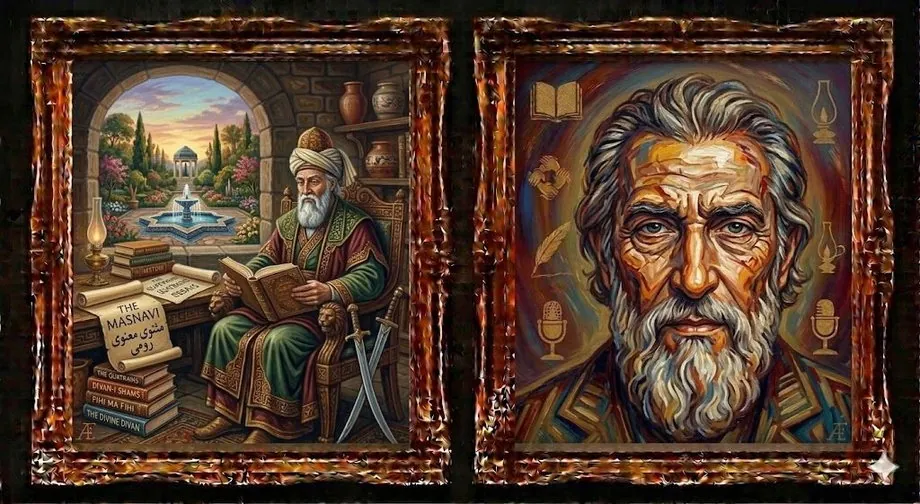
Out beyond ideas of wrongdoing and rightdoing, there is a field. I'll meet you there.Rumi — as translated, c. 1250
Jalal al-Din Muhammad Rumi was born in 1207 in Balkh, in what is now Afghanistan, into a family of Islamic scholars. His father Baha ud-Din Walad was a theologian and mystic who fled westward with his family around 1215 to escape the approaching Mongol invasions — a journey that took more than a decade and covered thousands of miles, passing through Mecca and eventually settling in Konya, in what is now Turkey, where Rumi would spend the rest of his life.
He trained as an Islamic scholar and theologian and had established himself as a respected teacher in Konya when, in 1244, he met Shams-i-Tabrizi — a wandering dervish from Tabriz who transformed him completely. The two men entered into an intense spiritual friendship that lasted two years and produced, from Rumi's side, an outpouring of poetry unlike anything he had written before. When Shams disappeared — murdered, most historians believe, by Rumi's jealous students — Rumi's grief became the fuel for the greatest body of mystical poetry in the Persian language. He named his massive collection of lyric poems the Divan-i Shams — the Works of Shams — in his friend's honor.
He spent the final years of his life composting the Masnavi — a six-volume work of spiritual poetry, stories, and teachings that is sometimes called the Persian Quran. He died in Konya in 1273. His tomb there remains a place of pilgrimage. His poetry has been translated into dozens of languages and remains among the best-selling poetry in the world more than 750 years after his death.
Rumi's philosophy is inseparable from his mysticism and his poetry. The central image is the reed flute — the ney — cut from the reed bed and crying for its origin. This longing, he argues, is not a deficiency but the essential human condition: we are separated from our source and the pain of that separation is what drives us toward wisdom, toward love, toward God, toward the reunion that is the proper end of human existence.
This might seem remote from the practical achievement philosophy of Napoleon Hill or the Stoic discipline of Epictetus, and in method it is entirely different. But the underlying insight — that there is something in the human person that reaches beyond its current condition toward something larger, and that this reaching is not pathology but the truest expression of what we are — connects Rumi to Frankl's will to meaning, to Maslow's self-actualization, to Emerson's Over-Soul, and to every account in this library of the human drive to become more than we currently are.
His poetry on love — human and divine, as categories he deliberately refuses to keep separate — reaches the concept of self-transcendence that Frankl identifies as the highest form of the will to meaning: the person who is most fully themselves is the person who has moved beyond absorption in the self toward absorption in something larger. Love, for Rumi, is not the merger of two egos but the dissolution of the ego into something that contains and exceeds both lovers.
Yesterday I was clever, so I wanted to change the world. Today I am wise, so I am changing myself.Rumi — as attributed
Six volumes of spiritual poetry and stories. Begin with Book I — the reed poem that opens it is one of the most beautiful and complete statements of spiritual longing in any language.
The most accessible entry point into Rumi in English. Read slowly — these poems are not decorations, they are arguments.
Some links may be affiliate links. They help support the site at no additional cost to you.
