Samuel Smiles
The Scottish physician and reformer who gave the genre of self-help its name — and whose 1859 book sold 250,000 copies in its first year.
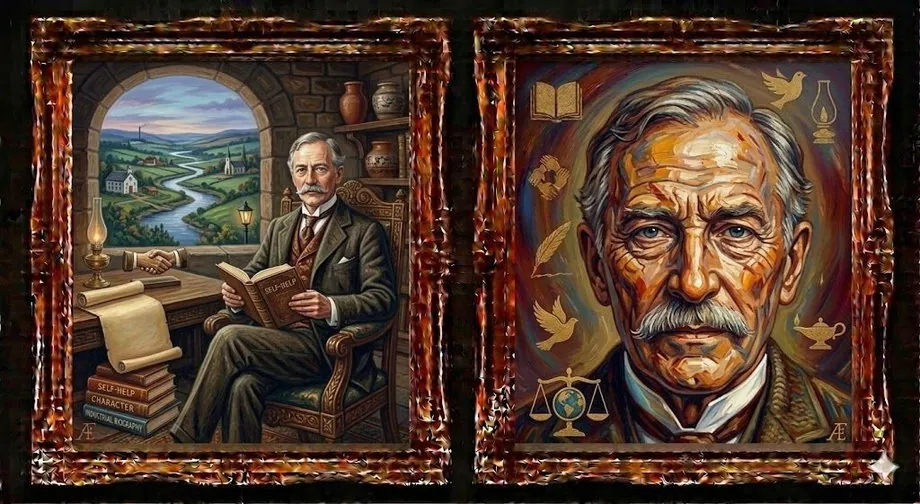
Heaven helps those who help themselves.Samuel Smiles — Self-Help, 1859
Samuel Smiles was born in Haddington, Scotland, in 1812, the eldest of eleven children. His father died of cholera when Smiles was seventeen, leaving the family in difficult circumstances. He trained as a physician, practiced medicine for some years, then moved into journalism and railway administration while continuing to write and lecture on the side. He was a committed reformer — an advocate for workers' rights, education reform, and political change — who came to believe, over time, that political reform without individual moral development was insufficient. The institutions could change; the people within them had to change first.
The lectures that became Self-Help were originally given to a mutual improvement society in Leeds in the 1840s — a group of young working men who had organized to educate themselves. Smiles expanded them into a book and submitted it to a publisher, who rejected it. He published it himself in 1859. It sold 20,000 copies in its first year and 250,000 in the next three decades, translated into dozens of languages, read by people from Japan to Egypt to India who saw in its examples of persevering craftsmen and self-taught engineers a template for their own aspirations.
Self-Help is organized around a simple argument: character is destiny. Not birth, not wealth, not education, not political circumstance — character. Smiles illustrates this argument with dozens of profiles of engineers, inventors, artists, and scientists who built their lives through persistence, integrity, and the refusal to be limited by their circumstances. George Stephenson, the railway pioneer, was illiterate until his late teens. James Watt faced poverty and repeated failure before the steam engine succeeded. Turner, the painter, was the son of a barber. The examples were chosen to be recognizable as ordinary people — not aristocrats, not the educated classes — who had achieved extraordinary things through the cultivation of ordinary virtues.
Smiles's virtues are practical ones: energy, perseverance, application, thrift, and — above all — the refusal to waste time. His portraits of working men who spent their evenings studying while their neighbors spent theirs drinking are designed as evidence, not instruction: these things have been done; they can be done again; the only question is whether you will do them.
Self-Help gave the genre its name and established its template. Napoleon Hill read it. Every subsequent book on achievement, from Think and Grow Rich to the present day, operates within the framework Smiles established: character is primary, circumstance is secondary, and the distance between them is crossed through deliberate, sustained effort.
We learn wisdom from failure much more than from success. We often discover what will do, by finding out what will not do.Samuel Smiles — Self-Help, 1859
The book that named the genre. Remarkably readable for a Victorian text — his portraits of working-class achievers are still vivid. Begin with chapter one.
Read Free Online →His second major work — more concentrated than Self-Help and, for many readers, more useful.
Read Free Online →Some links may be affiliate links. They help support the site at no additional cost to you.
