Seneca
Who was exiled, recalled, made tutor to Nero, and eventually ordered to kill himself — and wrote the most urgent meditation on time and mortality ever produced.
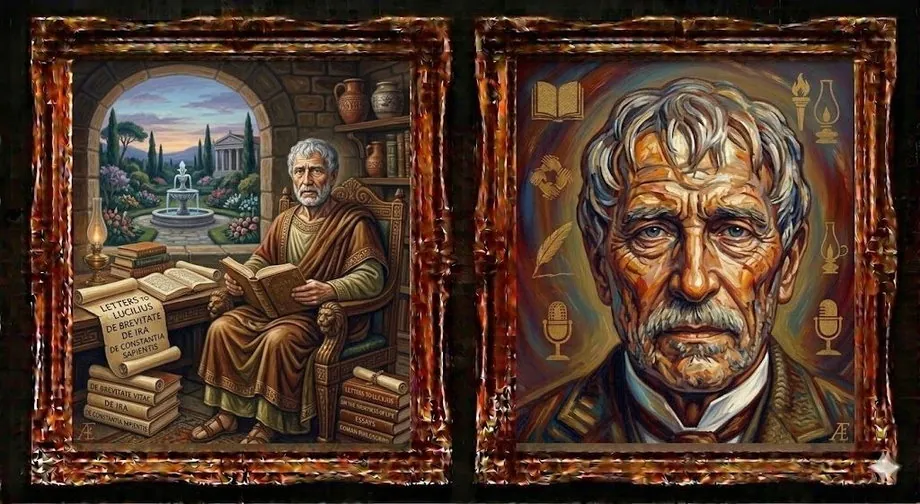
It is not that we have a short time to live, but that we waste a good deal of it.Seneca — On the Shortness of Life, c. 49 AD
Lucius Annaeus Seneca was born in Cordoba, Spain, around 4 BC. He was brought to Rome as a child and educated in Stoic philosophy, rhetoric, and law. He built a successful career as an orator and writer, then was exiled to Corsica by the Emperor Claudius in 41 AD — apparently on a charge of adultery with the emperor's niece, which historians consider a political pretext. He spent eight years on the island, writing and studying.
He was recalled to Rome in 49 AD at the request of Agrippina, who wanted him to tutor her son — the twelve-year-old who would become the Emperor Nero. For the first five years of Nero's reign, Seneca and the general Burrus effectively governed the Roman Empire, and governed it well. As Nero's character deteriorated, Seneca's influence waned. He retired from court in 62 AD. Three years later, implicated in a conspiracy against Nero — probably falsely — he was ordered to take his own life. He did so, with characteristic philosophical composure, while dictating to his secretaries.
He had spent his life writing about how to die well. When the moment arrived, he demonstrated that he had meant what he wrote.
Seneca's philosophical contribution is the application of Stoic principles to the concrete texture of daily life. Where Epictetus was systematic and Aurelius was meditative, Seneca was urgent. His Letters to Lucilius — 124 letters written in the last years of his life to a younger friend — are the most readable philosophical correspondence in the Western tradition. He writes as a man who knows he is running out of time.
On the Shortness of Life is his most concentrated argument: life is not short, but most people live as if it will be long. They postpone the things that matter — deep friendship, philosophical reflection, genuine presence — until some future moment of leisure that never arrives. The person who is always busy, always occupied with other people's demands, is not living their own life at all. They are renting it out.
His answer is not withdrawal but attention: doing fewer things more fully, being present to what is actually happening rather than always oriented toward the next task, and treating time as the most precious resource — more precious than money, since money can be recovered but time, once spent, is gone without trace.
Omnia aliena sunt, tempus tantum nostrum est. Everything else belongs to others; time alone is ours.Seneca — Letters to Lucilius, c. 65 AD
Twenty-four pages. The most urgent meditation on time ever written. Read in one sitting, then ask what you have been postponing.
Read Free Online →124 letters on friendship, death, time, and how to live. The most readable philosophical correspondence in the ancient world.
Read Free Online →Some links may be affiliate links. They help support the site at no additional cost to you.


Seneca speaks on the interactive trails — the passage large, the background, the sources, and paths onward.