Simone de Beauvoir
Who graduated second in philosophy from the École Normale Supérieure — behind only Sartre — and wrote the foundational text of modern feminism alongside a body of existentialist philosophy about how to live an authentic life.
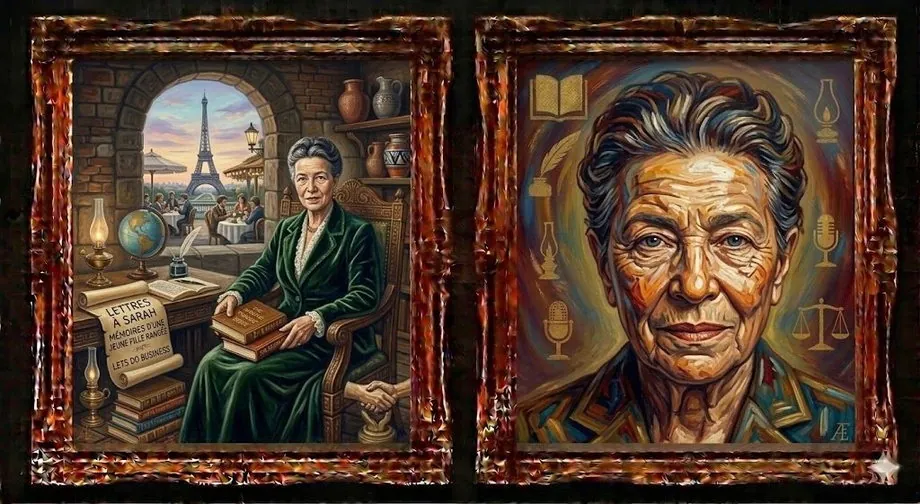
One is not born, but rather becomes, a woman.Simone de Beauvoir — The Second Sex, 1949
Simone de Beauvoir was born in Paris in 1908 into a bourgeois family that became financially straitened when she was a young teenager. The loss of money was, paradoxically, a liberation: it meant she would have to support herself, which meant she would have to take her education seriously. She threw herself into philosophy, entering the École Normale Supérieure and passing the agrégation — the most demanding French academic examination — in 1929 at age twenty-one. She came second. The person who came first was Jean-Paul Sartre, twenty-three years old. She spent the next fifty years in intellectual partnership with him, a relationship that was unconventional in ways that were scandalous in their time and have remained contentious in every time since.
She taught philosophy in Rouen and then Paris while writing fiction and philosophy throughout the 1930s and 1940s. The Second Sex, published in 1949, was a scandal — condemned by the Vatican, dismissed by Camus, attacked from both left and right — and became one of the most influential books of the century. She won the Prix Goncourt for her novel The Mandarins in 1954. She continued writing, traveling, and speaking until her death in Paris in 1986, six years after Sartre.
She refused the Légion d'honneur and the Grand Prix national des lettres, on the grounds that she did not wish to be absorbed into the institutions she had spent her life criticizing.
The Second Sex begins with a question: what is a woman? De Beauvoir's answer is that Woman is not a fixed biological category but a social construction — or more precisely, that while the biological category exists, the meaning assigned to it, the constraints imposed upon it, and the identity required of it are historical products that can be examined, questioned, and changed. One is not born, but rather becomes, a woman. The same is true, she argues, of every category of human identity: we are always in the process of becoming, and that process is shaped by the social conditions in which we find ourselves but is never entirely determined by them.
This connects to her existentialist philosophy, which she developed alongside but distinctly from Sartre's. Her Ethics of Ambiguity argues that human existence is irreducibly ambiguous — we are both free and situated, both subjects and objects, both alone and bound to others — and that the task of an ethical life is to embrace that ambiguity rather than flee it. The person who denies their freedom by conforming completely to a role is in bad faith. The person who denies their situatedness by pretending to be entirely self-sufficient is equally in bad faith. Authentic existence requires holding both truths simultaneously.
Her memoirs — four volumes covering her entire life — are among the most honest and searching accounts of a philosophical life ever written. She does not present herself flatteringly. She presents herself accurately, which is considerably more useful.
I am too intelligent, too demanding, and too resourceful for anyone to be able to take charge of me entirely.Simone de Beauvoir — Memoirs of a Dutiful Daughter, 1958
The foundational text of modern feminism. Begin with the Introduction. Even readers who disagree with her conclusions will find the questions she poses unavoidable.
Her most accessible philosophical work — on freedom, responsibility, and how to live with the irreducible ambiguity of human existence.
Some links may be affiliate links. They help support the site at no additional cost to you.
