Socrates
Who wrote nothing, was condemned to death for asking questions, and refused to escape when his students offered him the chance — the founding act of Western philosophy.
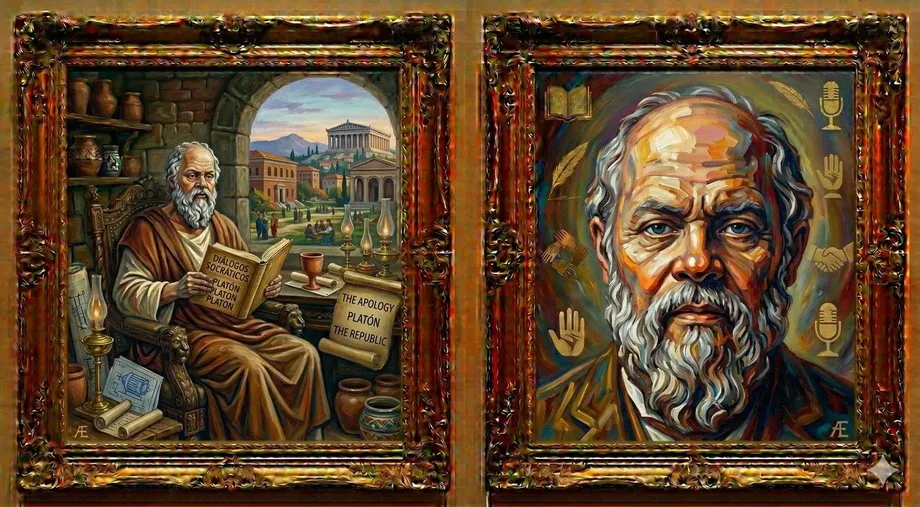
The unexamined life is not worth living.Socrates — as recorded by Plato, Apology, 399 BC
Socrates was born in Athens around 470 BC, the son of a stonemason and a midwife. He served with distinction as a soldier in the Peloponnesian War, demonstrating in battle the physical courage his philosophy would later treat as the first of all virtues. He married Xanthippe, with whom he had three sons. He was, by all accounts, profoundly ugly — short, stocky, with a snub nose and prominent eyes — and seems to have been entirely unbothered by this fact.
He wrote nothing. What we know of his philosophy comes entirely from others, primarily Plato, who was his most devoted student, and Xenophon. This creates an irresolvable problem of attribution: is the Socrates of the dialogues Plato's creation, Socrates's actual philosophy, or some combination? No one knows. What is clear is that the method — the patient, relentless questioning that exposes hidden assumptions and produces either genuine knowledge or honest acknowledgment of ignorance — was practiced in the Agora, the marketplace, and wherever Athenians gathered, for at least the last thirty years of Socrates's life.
In 399 BC he was charged with impiety and corrupting the youth of Athens. The charge was probably political — Athens had recently lost the Peloponnesian War, several of the city's worst leaders had been Socrates's associates, and there was a desire to assign blame. He was tried before a jury of 500 citizens, found guilty by a modest majority, and sentenced to death. Offered the chance to propose his own punishment, he suggested the city pay him a pension for his services. He was sentenced to die by drinking hemlock. His students arranged and paid for an escape. He refused, argued that escaping would be a violation of his agreement with the laws of the city, and died in prison with his friends around him, spending his last hours discussing the immortality of the soul.
Socrates's central conviction was that the unexamined life is not worth living — that the person who never asks whether their beliefs, values, and assumptions are actually correct is not fully alive in the relevant sense. This is not a counsel of perpetual doubt. It is an argument for integrity: the alignment between what you believe you value and what you actually value, which cannot be achieved without honest examination.
The Socratic method — elenchus — proceeds by asking a person to define something they claim to know (what is courage? what is justice? what is piety?) and then examining their definition until it proves inadequate. Almost everyone fails. This is the point: the examination reveals not that knowledge is impossible but that most people's confident beliefs are confused, and that recognizing confusion is the beginning of actual knowledge rather than its end.
His position at his trial demonstrates the same integrity. He could have proposed exile and been exonerated. He could have agreed to stop philosophizing in exchange for his life. He refused both, on the grounds that his mission — to examine himself and others, to encourage virtue and discourage complacency — was something he could not abandon without betraying who he was. The manner of his death is an argument: this is what living according to your values actually requires.
I know that I know nothing.Socrates — as attributed
Socrates's defense speech at his trial. Short, essential, and one of the most powerful philosophical documents ever recorded. Read it first.
Read Free Online →The account of Socrates's final hours — his arguments for the immortality of the soul and the calm manner of his death. Read after the Apology.
Read Free Online →Some links may be affiliate links. They help support the site at no additional cost to you.
