Sun Tzu
The Chinese general whose thirteen-chapter philosophy of strategy has been continuously studied for 2,500 years — and whose insight that all warfare is deception extends far beyond the military.
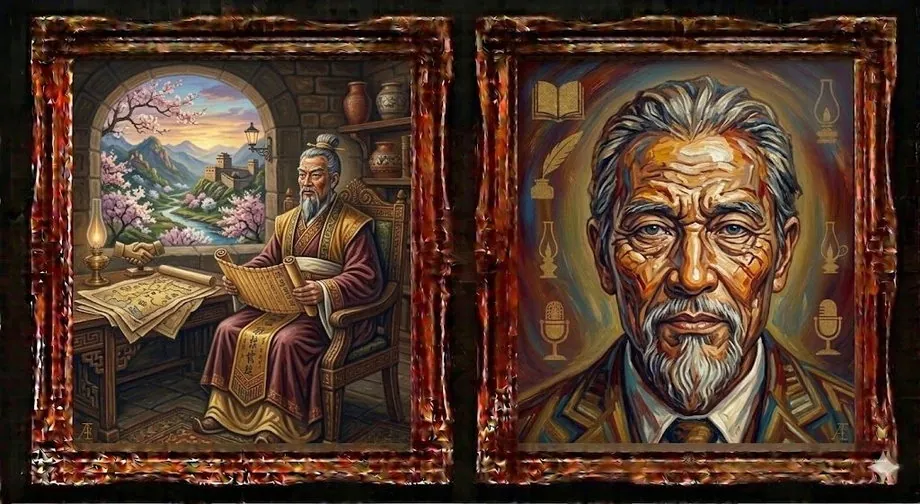
Supreme excellence consists in breaking the enemy's resistance without fighting.Sun Tzu — The Art of War, c. 500 BC
Almost nothing is known with certainty about Sun Tzu. The historian Sima Qian, writing some four centuries after the fact, identifies him as Sun Wu, a general from the state of Qi who served King Helü of Wu around 512 BC. He allegedly demonstrated his military theories to the king by successfully drilling the king's concubines as soldiers. When two of them refused to obey commands a second time after being warned, he had them beheaded — including the king's two favorites. The king protested. Sun Tzu noted that when orders are unclear, the fault is the general's; when they are clear and still not followed, the fault is the soldiers'. The remaining concubines performed perfectly. The king appointed him general.
Whether this story is accurate is uncertain. What the text itself demonstrates is a mind of extraordinary precision and subtlety — someone who had thought very deeply about the relationship between knowledge, deception, timing, and the disposition of forces, and had compressed those thoughts into a text of remarkable economy.
The Art of War consists of thirteen short chapters, totaling perhaps ten thousand characters in the original Chinese. It has been translated into dozens of languages, studied by generals from Napoleon to Mao Zedong to Norman Schwarzkopf, and applied in business, law, sports, and diplomacy. It has been continuously in print for 2,500 years, which is a form of empirical validation that no other strategy text can match.
The central insight of The Art of War is that victory belongs to the side with better information, not necessarily the side with greater force. Know yourself and know your enemy, and in a hundred battles you will never be defeated. Not knowing yourself, you lose half your battles before they begin. Not knowing your enemy, you lose the other half. This sounds obvious. It is not practiced.
The related principle — that the greatest victory is to win without fighting — is not pacifism. It is efficiency: a battle won costs resources, even in victory. The enemy defeated before the battle begins, by superior positioning, by deception, by cutting off supply lines, by making their position untenable without direct engagement, costs nothing. The strategist who waits for the battle to be already won before committing forces is operating at the highest level of the art.
The application to non-military domains is direct: in any competitive situation, the person who has done more preparation, who knows their own capabilities and their opponent's limitations more accurately, who positions themselves advantageously before the direct confrontation begins, wins more often with less effort. This is not about winning at others' expense — it is about the discipline of preparation and the intelligence of positioning. The best business strategy, the best negotiation, the best career move all share the same structure: create conditions where the outcome is already determined before the decisive moment arrives.
In the midst of chaos, there is also opportunity.Sun Tzu — The Art of War, c. 500 BC
Thirteen short chapters. Read Thomas Cleary's translation for clarity and depth. Each chapter repays slow, careful reading.
Read Free Online →Some links may be affiliate links. They help support the site at no additional cost to you.
