Swami Vivekananda
Who introduced Hindu philosophy to the Western world at the 1893 Parliament of the World's Religions in Chicago — and whose synthesis of Advaita Vedanta with social action remains one of the most complete accounts of spiritual strength ever written.
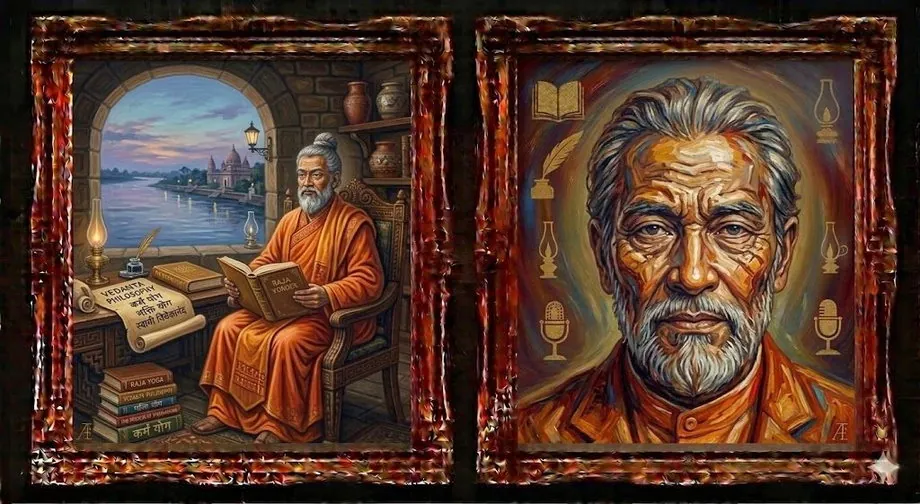
Take up one idea. Make that one idea your life — think of it, dream of it, live on that idea. Let the brain, muscles, nerves, every part of your body, be full of that idea, and just leave every other idea alone. This is the way to success.Swami Vivekananda — as attributed
Narendranath Datta was born in Calcutta in 1863 into an educated Bengali family. His father was an attorney; his mother was a woman of deep religious devotion and formidable intelligence whose influence on him was profound. He was an exceptional student — intellectually precocious, physically vigorous, spiritually restless — who encountered the saint Ramakrishna Paramahamsa around 1881, at eighteen.
The encounter transformed him. Ramakrishna was an ecstatic mystic who had achieved states of spiritual realization through devotion to the goddess Kali, but who recognized in this young intellectual skeptic something he had been waiting for. Their relationship — the unlettered saint and the university-educated rationalist — lasted five years, until Ramakrishna's death from throat cancer in 1886. In those five years Vivekananda underwent an experience of religious transformation that he spent the rest of his short life translating into philosophical language and social action.
He traveled across India for years as a wandering monk, experiencing the poverty and suffering of his country directly. In 1893 he traveled to the United States, arriving with almost no money, to address the Parliament of the World's Religions in Chicago. His opening words — Sisters and Brothers of America — were greeted with a standing ovation before he had said anything else. His subsequent addresses established him as the most compelling voice at the Parliament and launched him on a two-year lecture tour that introduced Vedanta and Yoga to Western audiences. He returned to India in 1897, founded the Ramakrishna Mission to combine spiritual practice with social service, and died in 1902 at thirty-nine.
Vivekananda's philosophy synthesizes Advaita Vedanta — the non-dual philosophy of the Upanishads, which holds that the individual self and the universal Self are ultimately identical — with a fierce commitment to social action and human dignity. The two might seem contradictory: if all is one, why does the suffering of others concern me? His answer is that genuine non-dualism requires the recognition that the suffering of any person is my suffering, because there is ultimately no separation between persons. The person who genuinely understands non-dualism serves others not out of duty or compassion but out of the direct recognition that there is no other.
His account of human potential is among the most forceful in this library. Each soul is potentially divine — the goal of all practice is to manifest that divinity. Not to acquire something from outside, not to become something foreign to one's nature, but to remove the obstacles — ignorance, fear, habit, social conditioning — that prevent the expression of what is already there. This is, in different language, what every tradition in this library is pointing toward: the development and expression of capacities that are genuinely present but imperfectly actualized.
His lectures on Raja Yoga, Karma Yoga, Jnana Yoga, and Bhakti Yoga remain among the clearest introductions to the Hindu philosophical tradition available in English. His insistence that spiritual strength must express itself in practical service — that a person cannot be genuinely spiritual and simultaneously indifferent to the suffering of those around them — connects Vedanta to every form of active, engaged philosophy in this library.
The greatest religion is to be true to your own nature. Have faith in yourselves.Swami Vivekananda — as attributed
His most accessible philosophical work — on the psychology and practice of meditation and mental discipline. Begin here before any other Vivekananda.
Read Free Online →On work as a spiritual practice — action without attachment to results as the path of active people. Essential reading for achievement philosophy.
Read Free Online →Some links may be affiliate links. They help support the site at no additional cost to you.

