Wangari Maathai
The first African woman to win the Nobel Peace Prize — who founded the Green Belt Movement, planted more than fifty million trees, and was imprisoned and beaten by the Kenyan government for her environmental activism.
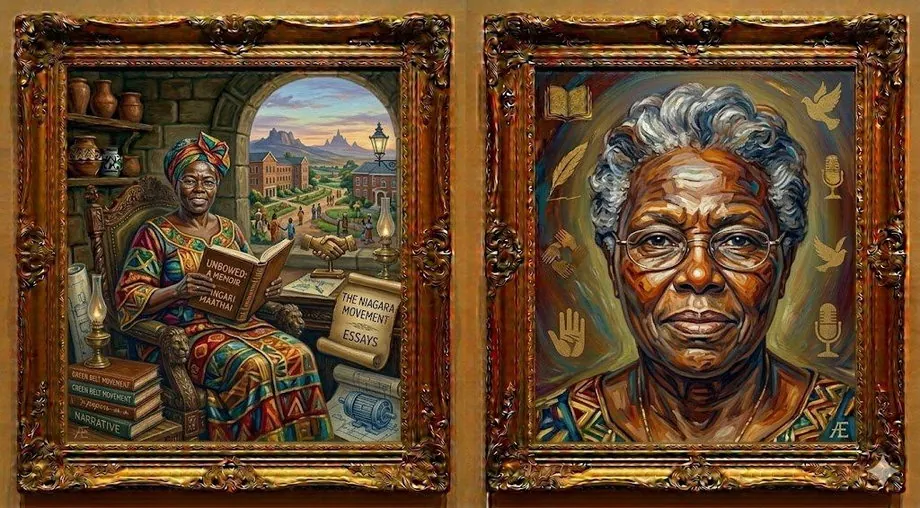
In the course of history, there comes a time when humanity is called to shift to a new level of consciousness.Wangari Maathai — Nobel Peace Prize Lecture, 2004
Wangari Muta Maathai was born in Ihithe village in the Central Highlands of Kenya in 1940. She was the first woman in East and Central Africa to earn a doctorate, receiving her PhD in veterinary anatomy from the University of Nairobi in 1971, having previously studied in the United States at Mount St. Scholastica College in Kansas and the University of Pittsburgh. She became a professor and department chair at the University of Nairobi before turning to environmental activism.
In 1977 she founded the Green Belt Movement — an organization that paid rural women a small stipend to plant trees to combat deforestation, soil erosion, and the drying up of rivers and streams. What began as an environmental project became a vehicle for civic education, women's empowerment, and political organization. The Kenyan government under Daniel arap Moi recognized the threat this represented and subjected Maathai to repeated harassment, imprisonment, and violence. She was beaten unconscious by government forces during a 1999 protest to save Karura Forest in Nairobi. She was dismissed from her university position. She was publicly insulted by the president.
She continued. By the time she received the Nobel Peace Prize in 2004 — the first African woman to do so — the Green Belt Movement had planted more than fifty million trees across Kenya and had spread to other African countries. She served in the Kenyan parliament from 2002 until her death from ovarian cancer in 2011 at seventy-one.
Maathai's philosophy connects environmental conservation, democratic governance, and human dignity in a single coherent argument. The three are not separate problems with separate solutions. Deforestation destroys the watersheds that small farmers depend on. Small farmers driven into poverty by failed harvests are more susceptible to political manipulation. Political manipulation sustains corrupt governments that further exploit natural resources. The problems form a system, and the solution must address the system.
Her concept of the three legs of the stool — sustainable management of natural resources, democratic governance, and a culture of peace — expresses this systemic understanding. Remove any leg and the stool falls. Plant trees without empowering the women who plant them, and the planting stops when the stipend stops. Empower women without democratic governance, and their gains are appropriated by the powerful. Democratic governance without a culture of peace produces elections that become opportunities for ethnic violence.
The deepest insight in her work — articulated most fully in Unbowed, her memoir, and The Challenge for Africa — is that environmental degradation and political degradation have the same root: the disconnection of a people from their land, their traditions, and their sense of responsibility for the world they inhabit and will leave to their children. The act of planting a tree is not merely environmental. It is a statement of accountability to the future, a refusal to consume what one has not earned the right to consume, and an expression of the conviction that the actions of a single person in a single place can contribute to the healing of something much larger than themselves.
It's the little things citizens do. That's what will make the difference. My little thing is planting trees.Wangari Maathai — as attributed
Her autobiography — one of the most remarkable accounts of environmental activism, personal courage, and African political life in the twentieth century.
Some links may be affiliate links. They help support the site at no additional cost to you.
