William Blake
Who saw angels in a tree at age four, argued with the spirit of Milton, engraved his own books by hand, was tried for sedition, sold almost nothing in his lifetime, and is now recognized as one of the most original and necessary visionaries in the English tradition.
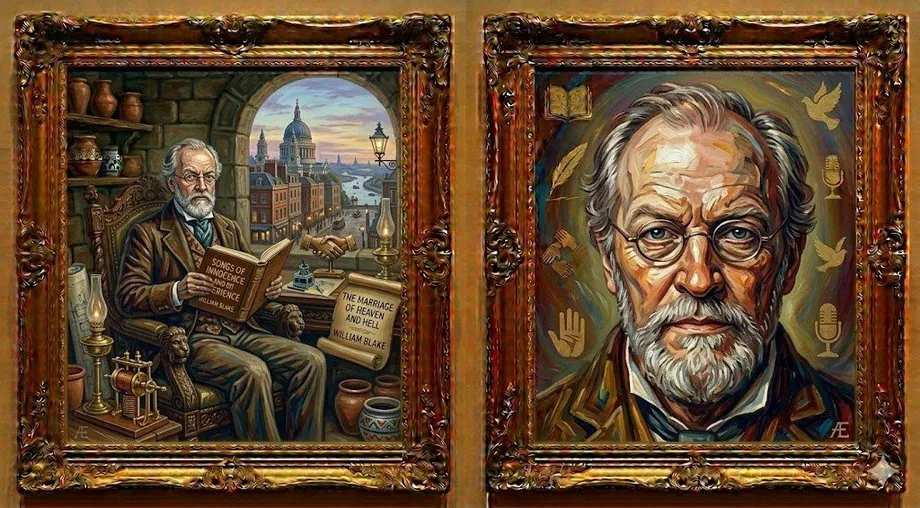
No bird soars too high if he soars with his own wings.William Blake — Proverbs of Hell, 1793
William Blake was born in London in 1757 to a hosier and his wife, who recognized early that their son was unusual. At four he reported seeing angels in a tree at Peckham Rye. At ten he began drawing. At fourteen he was apprenticed to an engraver and spent seven years learning the craft that would eventually allow him to produce his illuminated books — works of extraordinary visual and literary art that he engraved, printed, hand-colored, and sold largely without success for the rest of his life.
He married Catherine Boucher in 1782, a woman who was illiterate when they married, whom he taught to read, and who helped him print and hand-color his books for forty-five years. When he died in 1827 she was sitting beside him, and he reportedly spent his last hours working and singing hymns. He told her he was going to a country he had always wished to see. He left almost no money. His works sold for almost nothing during his lifetime. By the twentieth century he was recognized as one of the greatest artists and poets in the English language.
He was tried for sedition in 1803 after a soldier claimed Blake had said damn the king. He was acquitted, but the experience confirmed his understanding of the power that the institutions of his day exercised over human imagination and human freedom.
Blake's philosophy is a visionary philosophy — rooted not in argument but in image, in myth, in the direct perception of a reality that ordinary consciousness either cannot see or has been trained not to see. His central argument, articulated across the prophetic books and concentrated in the short lyric poems of Songs of Innocence and Experience, is against what he called mind-forged manacles: the self-imposed limitations of perception and imagination that cause people to live in a fraction of their actual capacity.
The Marriage of Heaven and Hell — his most philosophically concentrated work — is a systematic inversion of conventional moral categories. The devils in his infernal vision speak the truth that conventional religion has repressed: Energy is eternal delight. The road of excess leads to the palace of wisdom. No bird soars too high if he soars with his own wings. These are not endorsements of licentiousness. They are arguments for the fullest possible development and expression of human creative power, which conventional religion, conventional morality, and conventional reason all conspire to suppress.
For this library, Blake matters because he is the most radical possible version of the Emersonian argument: that the source of genuine authority is within, that the conventions of church and state and social respectability are forms of slavery however comfortable they feel, and that the human being who fully expresses their own imaginative and creative nature is not a dangerous eccentric but the fullest realization of what a human being can be. He died singing. That is a kind of evidence.
If the doors of perception were cleansed every thing would appear to man as it is, Infinite.William Blake — The Marriage of Heaven and Hell, 1793
His most philosophically concentrated work — a systematic assault on moral and spiritual convention. Begin here for his philosophy.
Read Free Online →The lyric poems — including The Tyger, London, and The Lamb. The most accessible entry point into his work.
Read Free Online →Some links may be affiliate links. They help support the site at no additional cost to you.

William Blake speaks on the interactive trails — the passage large, the background, the sources, and paths onward.