William James
The founding father of American psychology — who endured a decade of depression, illness, and existential crisis before discovering, from within that darkness, a practical philosophy of habit, will, and the deliberate command of attention.
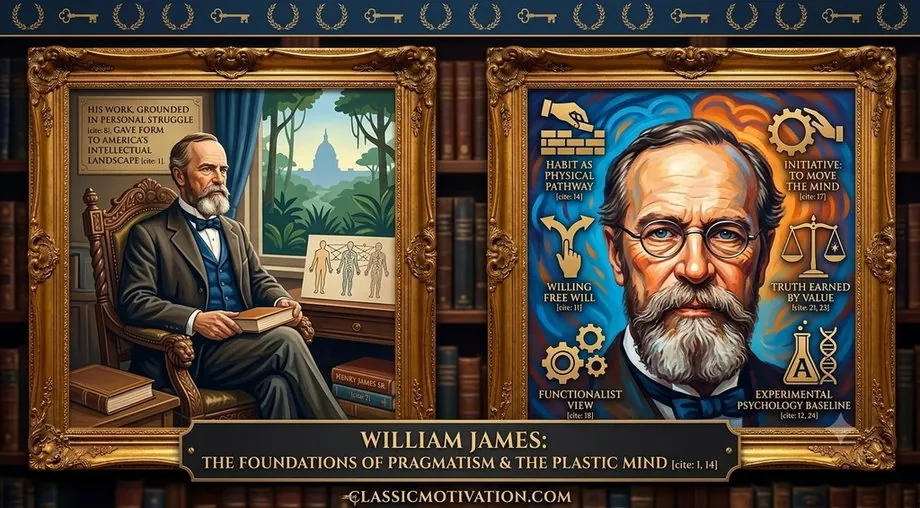
Could the young but realize how soon they will become mere walking bundles of habits, they would give more heed to their conduct while in the plastic state.William James — The Principles of Psychology, 1890
William James was born in New York City in 1842 into a wealthy, restless, and intellectually demanding family. His father, Henry James Sr., was a theological writer who moved his children between New York, London, Paris, and Geneva in search of the perfect education, and the household prized brilliant conversation above almost everything else. It produced extraordinary minds — his brother Henry became one of America's greatest novelists — but it also left William without firm ground beneath him.
As a young man he drifted. He studied painting, gave it up, and entered Harvard Medical School with little conviction. In 1865 he joined a scientific expedition to the Amazon, where he contracted smallpox and his already fragile health gave way. The years that followed were the darkest of his life: chronic illness, eye trouble, and a deepening depression that peaked around 1870. He was haunted by the memory of an institutionalized patient he had seen, an image of total helplessness, and by a single terrifying question — if the mind is wholly governed by biology, then human effort means nothing.
The turn came in April 1870. Reading the French philosopher Charles Renouvier, James found free will defined as the power to hold one thought in mind when he might have chosen others. He recognized that his own passivity was hardening his despair, and made a decision he recorded in his diary: his first act of free will would be to believe in free will. From that resolution he slowly rebuilt his life — completing his degree, joining the Harvard faculty, founding one of the first psychology laboratories in the United States, and writing his monumental The Principles of Psychology.
James grounded his psychology in the body. In The Principles of Psychology (1890) he argued that habits are not mere preferences but physical paths worn into the plasticity of the nervous system. When we hesitate or put something off, we are not waiting passively; we are deepening a groove of resistance. And because action and feeling are bound together — we do not run because we are afraid, he held, so much as we feel afraid because we run — the way out is not to wait for the right mood but to move first and let the feeling follow.
This is why James insisted that a new habit be launched with as strong and decided an initiative as possible, and then protected without exception in its early days. A single lapse, he warned, undoes more than many days of practice can rebuild. The practical work of self-government is to remove the small daily debates and make the right action as nearly automatic as a well-worn habit can be — for at bottom, James held, the act of will is simply the effort to hold your attention on what matters.
For this library, James matters because his pragmatism keeps philosophy tethered to lived consequence. An idea, for James, is not a fixed truth to be admired but a tool that earns its keep by guiding action well. His work is the pre-1930 foundation beneath much of modern psychology, and his enduring claim is a hopeful one: the self is not fixed but built, assembled day by day out of the actions we actually choose.
Never suffer an exception to occur till the new habit is securely rooted in your life. Each lapse is like the letting fall of a ball of string which one is carefully winding up; a single slip undoes more than a great many turns will wind again.William James — The Principles of Psychology, 1890
His masterwork. The chapter on Habit remains one of the most concentrated and practical statements ever written on how repeated action shapes character.
Read Free Online →His landmark study of faith, conversion, and the inner life — examined not as doctrine but as lived human experience.
Read Free Online →Some links may be affiliate links. They help support the site at no additional cost to you.

William James speaks on the interactive trails — the passage large, the background, the sources, and paths onward.