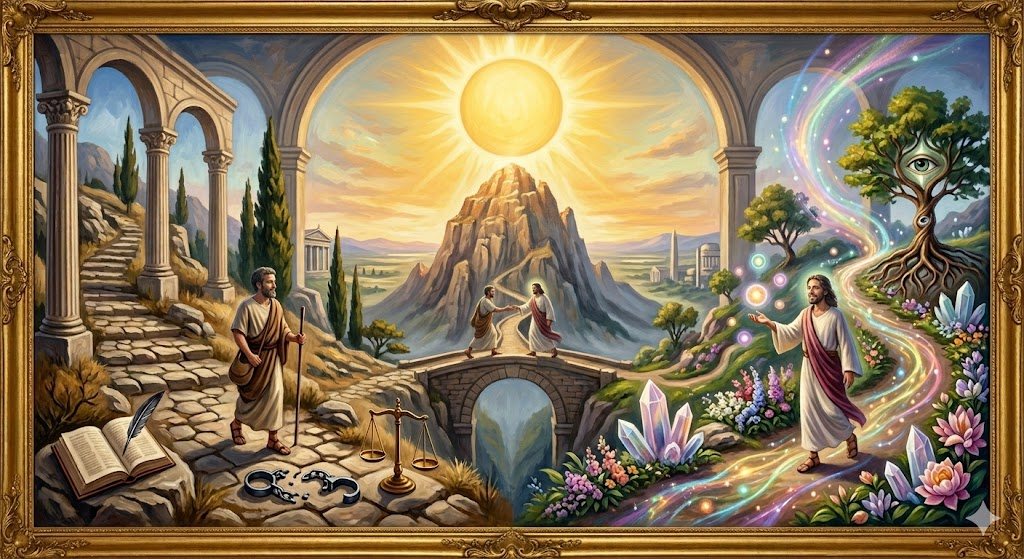
There are many roads up a mountain, and two of the most traveled in the history of human motivation sit at interesting angles to each other: ancient Stoicism and modern New Age philosophy. On the surface they can seem like opposites, one rooted in discipline and reason, the other in energy and spiritual openness. But spend a little time with both, and you begin to see they are reaching for remarkably similar heights.
The Stoic Foundation
Stoicism was born in Athens around 300 BCE, founded by Zeno of Citium, and later carried forward by some of antiquity's most compelling voices: Epictetus, Marcus Aurelius, and Seneca among them. Its core idea is elegant and demanding in equal measure: you cannot control what happens to you, but you can always control how you respond.
The Stoics drew a sharp line between what lies within our power (our judgments, intentions, and responses) and what does not: other people's actions, external events, fortune, and loss. Wisdom, they taught, begins the moment you stop fighting that distinction and start working with it. Virtue, acting with reason, courage, justice, and temperance, is the only true good. Everything else is, in Stoic terms, "preferred indifferent." Nice to have, but not essential to a life well lived.
What makes Stoicism perennially powerful is its practicality. It was never just philosophy for the academy. Marcus Aurelius wrote his Meditations on campaign, between battles. Epictetus was a former slave. These were people who used philosophy the way a craftsman uses tools: daily, under pressure, to build something worth building.
The New Age Perspective
New Age philosophy, as it emerged and gathered momentum through the twentieth century, draws from a wide and eclectic river: Eastern mysticism, quantum consciousness theories, transpersonal psychology, and the Human Potential Movement. Where Stoicism centers on disciplined reason, New Age thought tends to center on energy, intention, and spiritual interconnection.
Its foundational premise is that consciousness is not merely a product of the brain but a creative force in the universe. Thoughts and feelings carry vibrational frequency. The inner world shapes the outer world. Practices like meditation, visualization, affirmation, and gratitude are not just psychological tools. They are, in New Age thinking, ways of aligning oneself with a universal intelligence that responds to human intention.
The New Age tradition is optimistic by nature. It believes in human transformation, in the possibility of healing, abundance, and awakening. It invites the individual to see themselves as a co-creator of reality, not merely a reactor to it.
Where They Converge
Here is what is striking: strip away the different vocabularies, and both philosophies are making a similar claim about the human being. Both insist that the inner life is primary. Both place enormous weight on attention, on where you direct your mind and what you choose to focus on. Both see most human suffering as rooted in misperception: the Stoics would say we suffer because we misidentify what is truly good; the New Age teacher would say we suffer because we are misaligned with our deeper nature and creative potential.
Both also carry a profound sense of personal responsibility. Neither tradition lets you off the hook. You are not a helpless victim of circumstance. You are an agent, a chooser, a person whose inner orientation matters enormously.
Where They Diverge
The differences are real, though. Stoicism is largely secular in its architecture. It appeals to reason and the natural order, not to cosmic intention or spiritual energy. It counsels acceptance of what is, while New Age thought tends to encourage manifestation of what could be. The Stoic says: work with reality as it is. The New Age teacher says: you have more power to shape reality than you know.
One tradition asks you to let go of desire for outcomes; the other teaches you to envision and attract them. These are not trivial differences. They reflect genuinely different understandings of what a human being is and how the universe operates.
The Fellow Traveler's View
Perhaps both are partly right. Stoicism teaches the indispensable skill of equanimity: the inner steadiness that no circumstance can permanently disturb. New Age philosophy reminds us that possibility is real, that belief shapes behavior, and that the human spirit is not a fixed quantity.
The wisest travelers, it seems, have always borrowed from more than one road. Discipline and wonder. Acceptance and aspiration. Reason and faith. Two roads, one mountain.