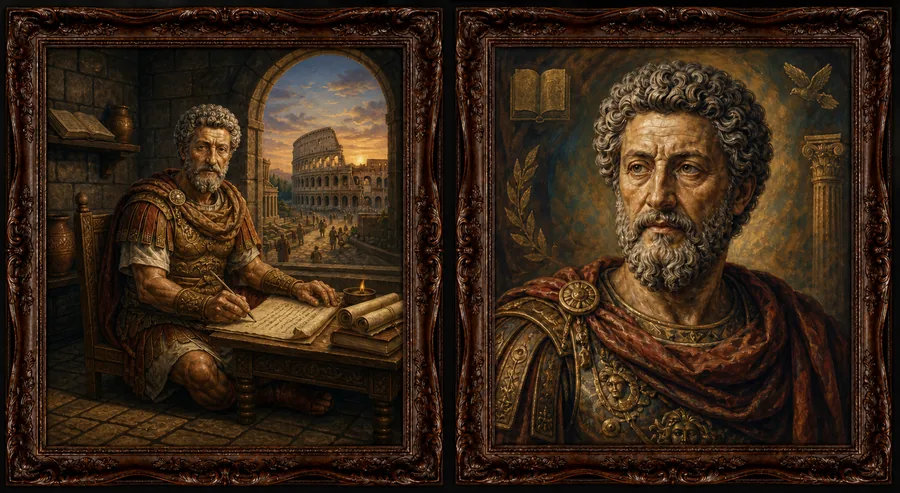
The Meditations were written by a man whose life kept demanding new beginnings: emperor at forty against his wishes, at war on the Danube for years at a stretch, through the Antonine plague, the rebellion of his most trusted general, and the deaths of eight of his children. The private notebook he kept — never meant for readers — returns constantly to one problem: how to begin again, and again, without bitterness.
We put five modern questions to that notebook.
“I can barely get out of bed to face the day. Where does starting over actually start?”
Book V opens with Marcus arguing with himself about getting up in the morning — likely written in a military camp in his fifties, an emperor with every excuse to stay warm. The passage is a dialogue he stages against his own reluctance.
At dawn, when you resist waking, hold this thought ready: I am getting up to do a human being's work. Why resent the very thing I was made for? Or was I made for lying warm under blankets? — “But it feels better.” — So you were born to feel good, and not to act?
The Three Sources
“In the morning when thou risest unwillingly, let this thought be present — I am rising to the work of a human being. Why then am I dissatisfied if I am going to do the things for which I exist and for which I was brought into the world?”
Full Greek text in To Myself, Book V, §1. Open the parallel edition →
Full Latin text in To Myself, Book V, §1. Open the parallel edition →
“I'm starting a new chapter surrounded by strangers. What should I expect from people?”
The most famous opening in the book. Marcus spent his days surrounded by courtiers, flatterers, and rivals, and began at least one morning by preparing himself for all of them — then immediately refusing himself the luxury of contempt.
Tell yourself at daybreak: today I will meet interference, ingratitude, arrogance, dishonesty, envy, and selfishness — all of it caused by the ignorance of good and evil in those who act this way. But none of them can injure me, and I cannot be angry with my own kind, or hate them. We were born to work together, like feet, like hands, like the two rows of teeth.
The Three Sources
“Begin the morning by saying to thyself, I shall meet with the busy-body, the ungrateful, arrogant, deceitful, envious, unsocial. All these things happen to them by reason of their ignorance of what is good and evil... For we are made for co-operation, like feet, like hands, like eyelids.”
Full Greek text in To Myself, Book II, §1. Open the parallel edition →
Full Latin text in To Myself, Book II, §1. Open the parallel edition →
“The thing in my way feels too big — the debt, the diagnosis, the age on my license. What do the Stoics say to the obstacle itself?”
Book V, section 20 contains the sentence on which a whole shelf of modern bestsellers rests. Marcus wrote it about other people — the ones who obstruct our plans — before widening it into a principle about everything that blocks a path.
The mind converts whatever hinders an action into fuel for the action. What blocks the road becomes the road.
The Three Sources
“That which is a hindrance is made a furtherance to an act; and that which is an obstacle on the road helps us on this road.”
Full Greek text in To Myself, Book V, §20. Open the parallel edition →
Full Latin text in To Myself, Book V, §20. Open the parallel edition →
“I'm fifty. Sixty. Seventy. Isn't it simply too late?”
Marcus wrote both of these passages under the daily expectation of death — from plague in the camps, from campaign, from age. His answer to “too late” is not reassurance. It is a redefinition of what any of us ever actually possesses.
Do not act as if you had ten thousand years. The debt hangs over you. While you live — while you still can — become good. For no one loses any life except the one being lived now, and no one lives any life except the one being lost now.
The Three Sources
“Do not act as if thou wert going to live ten thousand years. Death hangs over thee. While thou livest, while it is in thy power, be good.” (IV.17) · “No man loses any other life than this which he now lives, nor lives any other than this which he now loses.” (II.14)
Full Greek text in To Myself, Book IV §17 and Book II §14. Open the parallel edition →
Full Latin text in To Myself, Book IV §17 and Book II §14. Open the parallel edition →
“I keep planning the person I want to become. When does the plan end and the person begin?”
Late in the notebook, Book X, the tone sharpens. Marcus had spent a lifetime reading philosophy and knew the trap of it — that studying the good life can become a substitute for living one. He gives himself one line, possibly the bluntest he ever wrote.
Stop discussing what a good person is like. Be one.
The Three Sources
“No longer talk at all about the kind of man that a good man ought to be, but be such.”
Full Greek text in To Myself, Book X, §16. Open the parallel edition →
Full Latin text in To Myself, Book X, §16. Open the parallel edition →