Aristotle
The most comprehensive thinker the ancient world produced — who lost his father at ten, his mother shortly after, and built an intellectual system that has never been fully superseded.
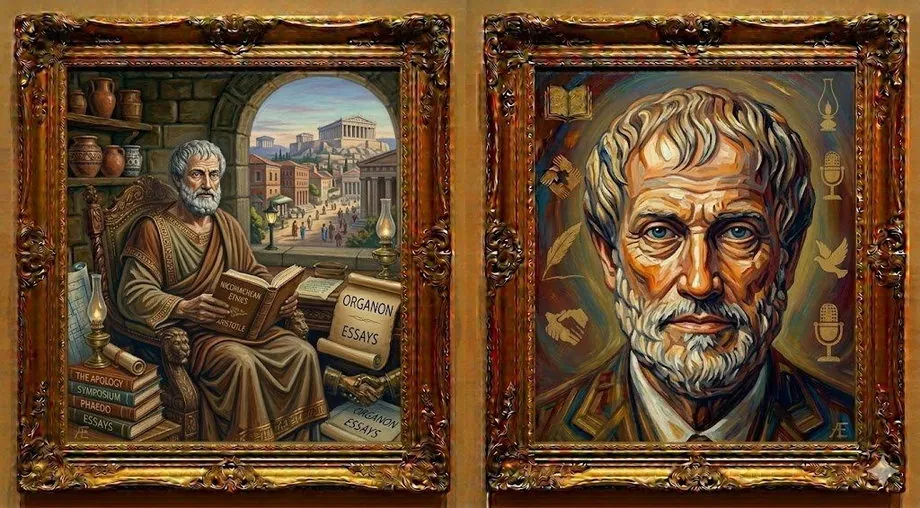
We are what we repeatedly do. Excellence, then, is not an act but a habit.After Aristotle — a modern paraphrase of the Nicomachean Ethics, not his words
Aristotle was born in Stagira, a small town in northern Greece, in 384 BC. His father Nicomachus was a physician to the Macedonian court — a fact that may explain Aristotle's lifelong passion for observation, classification, and the close study of natural phenomena. His father died when he was about ten. His mother died young as well. He was raised by a guardian named Proxenus, who sent him to Plato's Academy in Athens at age seventeen.
He remained at the Academy for twenty years — first as a student, then as a teacher — until Plato died in 347 BC. He was not chosen to succeed Plato as head of the Academy. Whether this was because his philosophy had already diverged too far from Plato's, or for other reasons, is not entirely clear. What is clear is that Aristotle left Athens and spent several years traveling, observing, and writing before returning to found his own school, the Lyceum, in 335 BC.
In the intervening years he was invited to Macedonia to tutor the thirteen-year-old prince who would become Alexander the Great. The relationship lasted three years. What either of them took from it is a matter of considerable historical speculation. Alexander built the largest empire the ancient world had seen. Aristotle built an intellectual system of comparable scope. The teacher and student shared something — a comprehensive ambition, a confidence that the whole of reality could be understood — even if they expressed it in entirely different registers.
Aristotle did not build a single philosophy. He built an encyclopedia of knowledge: logic, physics, biology, psychology, politics, rhetoric, poetics, metaphysics, and ethics. His works on logic — collectively known as the Organon — established the foundation of Western rational inquiry and remained authoritative for two thousand years. His biological works described more than five hundred species and were so accurate that they were not substantially improved upon until the seventeenth century.
For this library, the most important of his works is the Nicomachean Ethics — named either for his father Nicomachus or for his son of the same name, who may have edited it. The Ethics opens with the claim that every art, inquiry, action, and pursuit aims at some good, and that the good at which all human activity ultimately aims is eudaimonia — human flourishing. Not happiness in the modern hedonistic sense, but something closer to living well and doing well, the full exercise of distinctively human capacities in accordance with virtue.
Virtue, for Aristotle, is not an inborn trait. It is a disposition acquired through habit. We become just by doing just acts, brave by doing brave acts, self-disciplined by practicing self-discipline. Character is not given to us — it is built, through repeated choices, until the right choice becomes not an effort but a second nature. This is the most practically important insight in all of ancient philosophy: that who you are is not fixed, that the person you become is the accumulated result of the choices you have made and the habits those choices have formed.
The doctrine of the mean is Aristotle's account of how to find the right action in any given domain: virtue lies between deficiency and excess. Courage is the mean between cowardice and recklessness. Generosity lies between miserliness and profligacy. Practical wisdom — phronesis — is the master virtue that perceives where the mean lies in any particular situation. It cannot be reduced to a rule. It is a form of trained perception that develops only through experience.
Happiness depends upon ourselves.Attributed to Aristotle — source unverified
The foundational text of Western virtue ethics. Ten books on the nature of the good life, the virtues, friendship, and practical wisdom. Begin with Book I and Book II.
Read Free Online →Man is a political animal — the analysis of how the polis shapes and is shaped by the virtues of its citizens.
How language persuades and how narrative works on the human mind — still the most complete accounts of both.
Some links may be affiliate links. They help support the site at no additional cost to you.


Aristotle speaks on the interactive trails — the passage large, the background, the sources, and paths onward.