Plato
Student of Socrates, teacher of Aristotle — who watched his mentor die for the act of philosophical inquiry and spent the rest of his life building the institution that would preserve that inquiry.
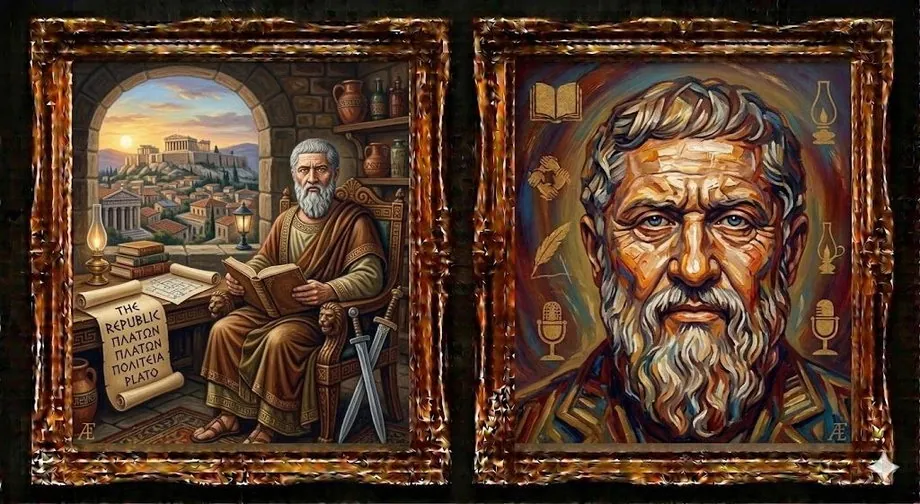
The measure of a man is what he does with power.Plato — as attributed
Plato was born in Athens around 428 BC into an aristocratic family with deep political connections. He was educated in gymnastics, music, and the traditional subjects expected of an Athenian of his class, and showed early promise as a poet and playwright. At around twenty he encountered Socrates and abandoned everything else. He became Socrates's devoted student and was present, or very nearly present, at the trial and execution of his teacher in 399 BC when Plato was about twenty-nine years old.
The execution transformed him. He left Athens — possibly to escape the political climate, possibly out of grief — and traveled for several years, visiting Megara, Egypt, and eventually Sicily, where he became entangled in the court politics of Dionysius I of Syracuse. He returned to Athens around 387 BC and founded the Academy, the first institution of higher learning in the Western world. He led it for the next forty years, until his death in 348 BC. Aristotle was his most distinguished student, entering the Academy at seventeen and remaining for twenty years.
Plato's works survive nearly complete — an extraordinary circumstance for ancient writers — probably because the Academy preserved and transmitted them carefully. Nearly thirty dialogues and a collection of letters constitute one of the most influential bodies of philosophical writing ever produced.
Plato's dialogues use Socrates as their primary interlocutor, but the philosophy they develop goes far beyond what we can attribute to the historical Socrates. The Theory of Forms — the idea that the physical world is a shadow of a more fundamental reality consisting of perfect, eternal, unchanging forms or ideals — is distinctively Platonic. Mathematical objects, justice, beauty, the good: these exist in a realm more real than the physical world, which merely participates imperfectly in them. The philosopher's task is to turn attention from the shadows toward the light.
The allegory of the cave in the Republic captures this precisely: prisoners chained in a cave mistake the shadows on the wall for reality. The philosopher who escapes and sees the sun is the one who has turned toward genuine knowledge. Returning to the cave to help the others — as the philosopher-king must in Plato's ideal state — is dangerous and thankless, because the prisoners, unaccustomed to the light, will resist and may kill the returning philosopher. This is, clearly, the story of Socrates.
For this library, the most important of Plato's dialogues are the Apology (Socrates's defense at his trial), the Phaedo (his final hours), the Republic (justice, education, the ideal state), and the Symposium (the nature of love and beauty). Each can be read independently. The Republic is the most ambitious and the most demanding — a complete political and educational philosophy organized around the question of what justice is.
Ignorance, the root and stem of all evil.Plato — as attributed
Begin here. Socrates's defense speech at his trial. Short, essential, the starting point for everything else in Plato.
Read Free Online →Ten books on justice, education, the soul, and the ideal state. Begin with Book VII and the allegory of the cave, then return to Book I.
Read Free Online →Some links may be affiliate links. They help support the site at no additional cost to you.

