Viktor Frankl
The man who tested the philosophy of meaning against the worst conditions of the 20th century — and found that it survived.
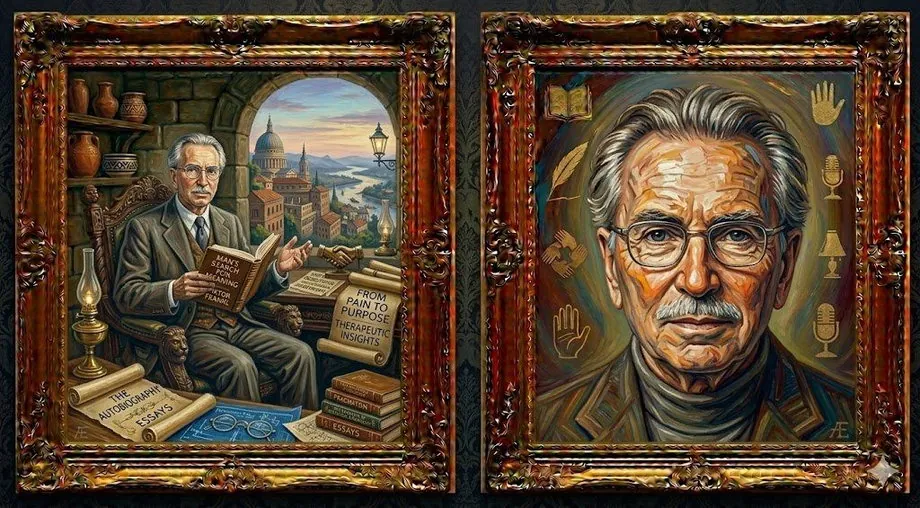
Those who have a 'why' to live can bear with almost any 'how'.Friedrich Nietzsche — quoted by Viktor Frankl in Man's Search for Meaning, 1946
Viktor Frankl was born in Vienna in 1905 into a Jewish family. By his mid-twenties he was already a practicing psychiatrist with a developing theory about human motivation that differed fundamentally from both Freud and Adler — his two most influential predecessors. Freud had argued that the primary human drive was the will to pleasure. Adler had argued it was the will to power. Frankl believed both were wrong. The primary drive, he argued, was the will to meaning — the deep human need to find a reason, a purpose, a why that made the suffering and effort of life worthwhile.
He had been developing this theory in his clinical work for years, calling his approach logotherapy — from the Greek logos, meaning reason or meaning. In 1942, before he had published a full account of it, he was arrested and deported with his family to the Theresienstadt concentration camp. His father died there. His mother was killed at Auschwitz. His wife Tilly died at Bergen-Belsen. His brother died in Auschwitz. Frankl himself was transferred through Auschwitz to two other camps before his liberation in 1945.
He arrived in the camps as a theorist. He left as a witness. The theory he had built in the comfortable conditions of a Vienna practice had been tested against conditions almost no human being has faced — and had survived the test. Not because the camps confirmed his optimism, but because they confirmed the precise, limited claim he had been making: that meaning is available to a human being regardless of external circumstance, and that it is the presence or absence of that meaning — not physical comfort, not safety, not even health — that determines whether a person continues.
Frankl's observations in the camps were precise and clinical, even under the most dehumanizing conditions he could document them. He noticed that the people who survived longest were not consistently the strongest, the youngest, or the physically most robust. They were the people who had something to live for — a person waiting for them outside the camp, a work they needed to complete, a purpose that the camp could strip everything from except the person's commitment to it.
He observed men sharing their last piece of bread. He observed men who had given up every material comfort find an inner richness — a freedom, he called it — that the camp could not touch. He observed that the decision about how to respond to suffering — not the suffering itself, but the response to it — remained available even when every other freedom had been removed. Everything can be taken from a man but one thing: the last of the human freedoms — to choose one's attitude in any given circumstances.
This was not an argument for passive acceptance. Frankl did not advise people to make peace with injustice. He was describing something more specific: that within the space between stimulus and response — however narrow that space becomes — there remains a human capacity to choose. And that the exercise of that capacity, even in extremis, is what preserves the humanity of the person who exercises it.
Everything can be taken from a man but one thing: the last of the human freedoms — to choose one's attitude in any given circumstances.Viktor Frankl — Man's Search for Meaning, 1946
Logotherapy rests on three central pillars. First: life has meaning under all circumstances, even the most miserable. Second: the primary motivational force in human beings is the will to find meaning in life. Third: we have the freedom to find meaning in what we do and what we experience — or, if nothing else, in the stand we take when confronted with a situation of unchangeable suffering.
Frankl was careful about what he meant by meaning. He did not mean a single grand purpose, a cosmic destiny, or a philosophical system. He meant something far more specific and personal: the meaning available in this particular life, this particular set of circumstances, this particular moment. Meaning cannot be given. It can only be found — by each person, in their own specific conditions, through their own honest examination of what they are for and what they owe.
He identified three primary sources of meaning. The first is creative — through what we give to the world: work, accomplishment, creation. The second is experiential — through what we receive from the world: beauty, truth, love, another person. The third, and the one his experience made most vivid, is attitudinal — through the stand we take when we are confronted with unavoidable suffering. In that last source lies the full reach of the philosophy: meaning is available even when everything else has been taken.
Frankl wrote Man's Search for Meaning in nine days following his liberation — dictating it in a single sustained effort as if he feared losing what he had observed. It has sold more than 16 million copies in 24 languages and has been named by the Library of Congress as one of the ten most influential books in America.
Written in nine days. The first half is a clinical account of life in four concentration camps. The second half is an introduction to logotherapy. Begin with Part One. Read Part Two when you are ready to understand why Part One matters philosophically.
Available at libraries and booksellersA more complete account of logotherapy — the full clinical and philosophical framework. More demanding than Man's Search for Meaning and considerably more complete.
A collection of lectures that traces the philosophical foundations of logotherapy from Kierkegaard through Nietzsche to Frankl's own clinical work. The clearest account of the theoretical framework.
Some links may be affiliate links. They help support the site at no additional cost to you.
