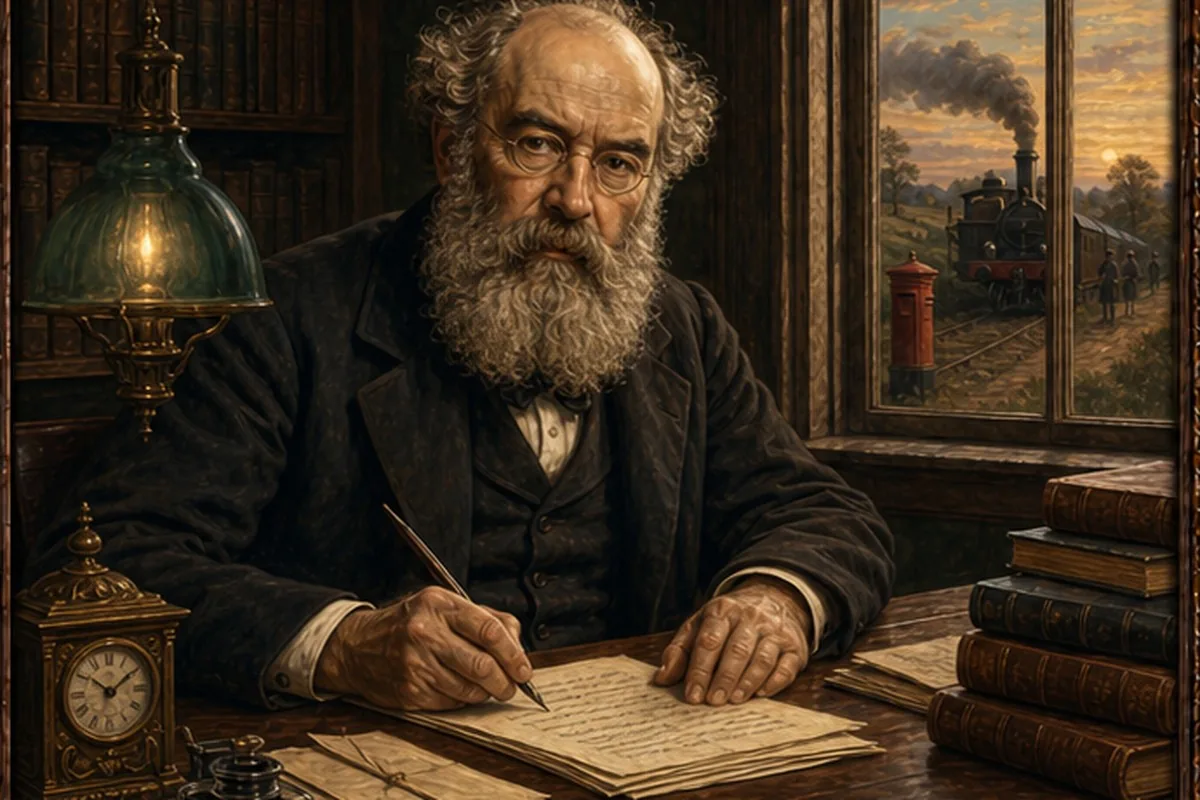
There is a particular kind of person who ruins his own reputation by telling the truth about how he works. Anthony Trollope is the patron saint of that condition.
By the time he died in 1882 he had written forty-seven novels. He had also written travel books, biographies, short stories, and a quantity of journalism nobody has ever finished counting. He did this while holding a full-time job at the British Post Office — a real job, not a sinecure — where he surveyed postal routes across Ireland, Egypt and the West Indies, and where he is credited with bringing the roadside pillar box to Britain. The red letter boxes still standing on English streets are, in a small way, his.
Then, a year after his death, his Autobiography was published, and his reputation collapsed for the better part of fifty years.
It collapsed because of a paragraph about a watch.
The method
Trollope rose at five in the morning. He paid a groom five pounds a year — extra, out of his own pocket — to wake him with a cup of coffee, and he was frank about what that arrangement was worth to him:
I do not know that I ought not to feel that I owe more to him than to anyone else for the success I have had.
He was at his desk by half past five. He wrote until half past eight. Then he went to work at the Post Office and did a full day.
Inside those three hours he did the thing that scandalised the literary world:
It had at this time become my custom, — and it still is my custom, though of late I have become a little lenient to myself, — to write with my watch before me, and to require from myself 250 words every quarter of an hour.
Two hundred and fifty words. Fifteen minutes. A watch laid flat on the desk where he could see it.
And then the line that ought to be more famous than it is, because it is the whole argument in fourteen words:
I have found that the 250 words have been forthcoming as regularly as my watch went.
Read that twice. He is not claiming the words were good. He is claiming they came — that a quota, honestly kept, produces text as reliably as a mechanism produces time. He had removed the question of whether he felt like writing from the list of things that could affect the outcome.
At that rate the arithmetic is merciless and mild at once. Two hundred and fifty words a quarter-hour is a thousand an hour, three thousand a morning, and, as he noted, “over ten pages of an ordinary novel volume a day.” Sustain that ten months of the year and you have three three-volume novels. Which is close to what he did, for decades, in the hours before most of his contemporaries were awake.
He kept a record, too. Not a journal of feelings — a tally:
In this I have entered, day by day, the number of pages I have written.
The watch measured the quarter-hour. The diary measured the year. Between the two there was nowhere for a bad week to hide.
Why this was unforgivable
To understand why the Autobiography did such damage, you have to understand what the Victorians believed a novelist was.
A novelist was a vessel. Inspiration arrived, or did not arrive; the artist waited on it; the work, when it came, came whole, because it came from somewhere beyond the desk. The whole Romantic apparatus depended on the idea that art is received rather than manufactured.
Trollope walked into that cathedral and announced that he made novels the way a man makes boots.
To me it would not be more absurd if the shoemaker were to wait for inspiration, or the tallow-chandler for the divine moment of melting.
The tallow-chandler. He is comparing the composition of The Way We Live Now to the rendering of animal fat into candles, and he is not being self-deprecating — he means it as a compliment to both trades. A shoemaker who waited for the muse would be an absurd shoemaker and, more to the point, a poor one. Why should the novelist be granted an exemption from the ordinary conditions of competent work?
The critics never forgave him. Here, they decided, was proof that Trollope had been a tradesman all along: a manufacturer of readable goods, disqualified from serious consideration by his own confession. His standing fell and stayed down until the middle of the twentieth century.
The judgment was wrong, and wrong in an instructive way. It assumed that a book produced on a schedule must be a lesser book — that method and quality are opposed. Trollope’s actual novels are the refutation. The Way We Live Now is one of the great English satires on financial fraud. The Barsetshire books have never gone out of print. He was not producing filler on a timer; he was producing some of the century’s most durable fiction on a timer, which is a different and much more disturbing fact.
What the quarter-hour is actually for
Here is where the modern retelling usually goes wrong. Trollope is often summarised as advocating short bursts — the “fifteen-minute method,” work in small increments, anyone can find fifteen minutes. That is a comfortable idea and it is not his.
He did not write for fifteen minutes. He wrote for three hours, every morning, before dawn, for most of his adult life, while employed full-time. The fifteen minutes was not the session. It was the unit of accountability — the interval at which he checked whether the work was actually happening.
That distinction is the whole insight, and it is worth sitting with.
A three-hour block is easy to lie about. You can spend it rearranging, researching, sharpening, staring, and come away with the sincere impression of having worked. Everyone who has ever tried to make something has had that morning. The failure is invisible at three-hour resolution.
At quarter-hour resolution it is not invisible. Either two hundred and fifty words exist or they do not. The watch is not there to hurry him; it is there to make self-deception impractical. He has arranged his morning so that he cannot arrive at half past eight with a comfortable story about how it went.
This is why a small daily task is the phrase he reaches for, and why he sets it against a figure from mythology:
A small daily task, if it be really daily, will beat the labours of a spasmodic Hercules. It is the tortoise which always catches the hare.
Note the condition, which does all the work: if it be really daily. Not most days. Not when the conditions are right. The whole force of the claim sits inside that qualifier, and it is the qualifier that everyone quoting the line tends to drop.
The advice he actually gave
Trollope did offer direct counsel to anyone hoping to write, and it is characteristically unglamorous:
I therefore venture to advise young men who look forward to authorship … to seat themselves at their desks day by day as though they were lawyers’ clerks; — and so let them sit until the allotted task shall be accomplished.
As though they were lawyers’ clerks. Not as though they were geniuses awaiting visitation. The clerk’s virtue is that he arrives, and remains, and finishes, and does so again tomorrow, and the quality of his morning is not contingent on the quality of his mood.
There is a hardness in Trollope that shouldn’t be sanded off. “It was also my practice,” he wrote, “to allow myself no mercy.” He is describing a self-imposed severity that would not suit everyone and that he himself relaxed with age — note the honest aside in the passage above, though of late I have become a little lenient to myself. Even the tortoise slowed down eventually. He tells you that too, which is the mark of the same honesty that cost him so dearly.
What to take
The temptation is to take the number. Two hundred and fifty words, fifteen minutes, and the machinery of a great career. But the number was Trollope’s, fitted to Trollope’s work and Trollope’s hours, and copying it is the least interesting thing available here.
What transfers is the structure underneath it, which has three parts and no romance in any of them.
Fix the hour before the day can bid for it. He wrote from half past five because nothing competes for half past five. The Post Office could have all the hours it wanted; it could not have that one. Most people’s creative work fails not because the hour was too short but because the hour was never protected in the first place.
Choose a unit small enough to be honest. Whatever the equivalent is in your work — words, pages, calls, lines, drawings — the interval has to be short enough that a bad stretch shows up while it is happening rather than at the end of the month. The watch is a truth-telling device, not a whip.
Keep the tally. The diary is the least discussed part of the method and possibly the most important. It converts a vague sense of “going well” into a number you cannot argue with, which is exactly why most of us don’t keep one.
And then the part no system supplies: doing it tomorrow, in the same way, when it has stopped being novel. If it be really daily.
Trollope’s honesty about all this cost him fifty years of literary standing. It is worth noticing what he got in return — forty-seven novels, several of which we are still reading — and worth asking whether he would have made the trade knowingly. Reading the Autobiography, one suspects he would. He was a man who preferred the accurate account to the flattering one, in his ledgers and in his life, and he told the truth about the watch on his desk for the same reason he wrote by it: because the alternative was a story he would have had to keep telling himself.
An Autobiography was published in 1883. It is in the public domain, and you can read it free.