Anthony Trollope
The postal surveyor who wrote forty-seven novels in the hours before work — a watch flat on the desk, two hundred and fifty words demanded of himself every quarter of an hour — and who wrecked his own reputation by admitting it.
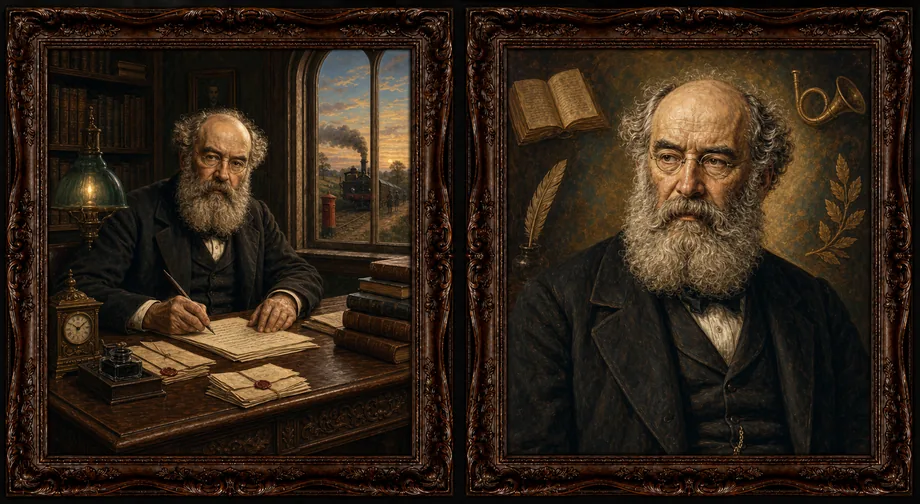
A small daily task, if it be really daily, will beat the labours of a spasmodic Hercules. It is the tortoise which always catches the hare.Anthony Trollope — An Autobiography, 1883
Anthony Trollope was born in London in 1815 into a family sliding steadily out of the middle class. His father was a failing barrister whose temper and misjudgements drove away clients; the family farm failed too; creditors circled. Trollope was sent as a charity pupil to Harrow and Winchester, where he was conspicuously the poorest boy present, unwashed and unable to pay, and where he was beaten and shunned for it. He described those years without softening them. They lasted twelve.
At nineteen he took a junior clerkship at the General Post Office in London on the strength of a family connection, and spent seven undistinguished years being reprimanded for lateness and debt. What rescued him was a transfer to Ireland in 1841 as a postal surveyor’s clerk — a job that put him on horseback, moving between towns, measuring and rationalising the delivery of mail. He turned out to be extremely good at it.
He stayed in the Post Office for thirty-three years. He mapped routes across Ireland, England, Egypt and the West Indies, negotiated postal treaties, and is credited with introducing the roadside pillar box to Britain — the freestanding letter box that still stands, red and cylindrical, on English streets. The novels were written around this work, not instead of it.
Trollope rose at five. He paid a groom five pounds a year, out of his own pocket, to wake him with coffee, and later wrote that he owed that man more than anyone else for the success he had. He was at his desk by half past five and wrote until half past eight, at which point he left for a full day at the Post Office.
Inside those three hours he ran the discipline that made him famous and then infamous: a watch laid flat on the desk, and a requirement of two hundred and fifty words from himself every quarter of an hour. He kept a written tally — day by day, the number of pages produced — so that a slack week could not disguise itself as a busy one.
The quarter-hour is often misread as the length of his working session. It was not. It was the interval at which he audited himself. A three-hour block is easy to lie about; fifteen minutes is not. Either the words exist or they do not, and Trollope arranged his mornings so that the answer arrived four times an hour instead of once a season.
I have found that the 250 words have been forthcoming as regularly as my watch went.Anthony Trollope — An Autobiography, 1883
Trollope wrote An Autobiography in 1876 and left instructions that it be published after his death. It appeared in 1883, and it did him enormous damage.
The Victorians held that a novelist was a vessel: inspiration arrived or it did not, and the artist waited on it. Trollope announced instead that he made novels the way a man makes boots — that it would be no more absurd for a shoemaker to wait for inspiration, or a tallow-chandler for the divine moment of melting. Reviewers took the confession as proof that he had been a tradesman all along, and his literary standing fell for roughly fifty years.
The judgment was wrong in an instructive way. It assumed that method and quality are opposed — that a book produced on a schedule must be a lesser book. The Way We Live Now remains one of the great English satires on financial fraud; the Barsetshire novels have never gone out of print. He was not producing filler on a timer. He was producing durable fiction on a timer, which is a far more unsettling fact, and the one his critics could not absorb.
Published a year after his death. The source of everything on this page — the watch, the quota, the tally, the groom with the coffee, and the sentences that cost him his reputation. Short, plain and startlingly honest about money and method.
Read Free Online →The first of the Barsetshire novels and the book that made him. A quiet story about a clergyman’s conscience that turns out to be about how institutions damage decent people.
Read Free Online →His late masterpiece and his angriest book — a satire on financial speculation, credit and the social power of a man everyone suspects is a fraud. Written, like the rest, before breakfast.
Read Free Online →We have written at length about the quarter-hour, what it was actually for, and why telling the truth about it was the most expensive sentence Trollope ever wrote.