Napoleon Hill
The man who spent 20 years answering one question — and changed the world with the answer.
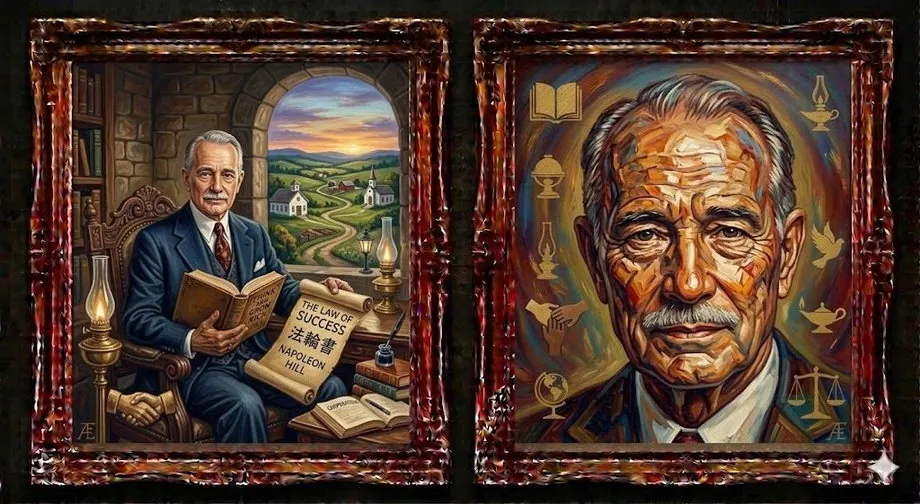
Whatever the mind can conceive and believe, it can achieve.Napoleon Hill — Think and Grow Rich, 1937
Napoleon Hill was born on October 26, 1883, in a one-room log cabin in Pound, Virginia. The mountains of Appalachia were poor country. His mother died when he was nine years old. His father remarried a woman who proved to be one of the most influential people in Hill's life — not because she was kind, but because she believed in him with a directness that cut through his own self-pity. When she arrived, young Napoleon was described as the worst boy in the county. She decided, without much evidence, that he was the smartest boy in the county. She gave him a typewriter. He began writing.
He was working as a reporter when, in 1908, he was assigned to interview Andrew Carnegie for a magazine article. Carnegie had built the largest steel empire in history, sold it for $480 million, and was then in the process of giving all of it away. The interview was supposed to take three hours. It lasted three days. At the end of it, Carnegie proposed something unusual: he would introduce Hill to the 500 most successful people alive — industrialists, inventors, statesmen, scientists — and Hill would interview each of them and compile what he found into a philosophy of achievement that ordinary people could use. The commission came with no salary and no guarantee of publication. Hill would have to fund the project himself, largely by selling the results of his research in other forms as it progressed.
He accepted. The work took twenty years.
Hill's central finding — the thing that every one of his 500 subjects had in common — was not intelligence, not education, not connections, and not luck. It was what he called Definiteness of Purpose: a specific, written aim pursued with burning desire through organized planning, applied faith, and unwavering persistence regardless of obstacle or temporary defeat.
He organized his findings into 13 principles, which he first published in the 8-volume Law of Success in 1928 and then condensed into Think and Grow Rich in 1937. The condensed version became one of the best-selling books of all time — over 100 million copies sold across more than 70 languages.
What makes Hill's work durable is not its optimism. It is its specificity. He did not argue that positive thinking produces positive results. He argued that a specific mental and behavioral system — practiced daily, consistently, over years — produces specific results. The difference matters. The first claim is magical. The second is mechanical. And the mechanism he described — desire, faith, planning, decision, persistence, the mastermind alliance — has been validated by the life stories of every person in his research and by the millions of people who have applied the principles since.
Hill's last major work, Outwitting the Devil, was written in 1938 but remained unpublished for 73 years at the insistence of his wife, who feared the controversy its directness would provoke. Published in 2011, it is widely considered his most honest and penetrating work — a dialogue with the force of drift and indecision that, he argued, claimed the vast majority of human lives.
The starting point of all achievement is desire. Keep this constantly in mind. Weak desires bring weak results, just as a small fire makes a small amount of heat.Napoleon Hill — Think and Grow Rich, 1937
The concepts Hill identified and named that appear throughout this library:
The original 8-volume work — the full philosophy before it was condensed. More demanding than Think and Grow Rich and considerably more complete.
Available at libraries and booksellersThe condensed masterwork. One of the top-selling books in history — over 100 million copies. The clearest statement of the 13 principles.
Available at libraries and booksellersWritten in 1938, published 2011. Hill's most honest and searching work — a direct confrontation with drift, indecision, and the forces that claim most human lives.
Available at libraries and booksellersWho shaped Hill, and who Hill shaped:
Explore the 13 Principles
The full framework Hill distilled from 20 years of research — organized and explained.
Some links may be affiliate links. They help support the site at no additional cost to you.


Napoleon Hill speaks on the interactive trails — the passage large, the background, the sources, and paths onward.