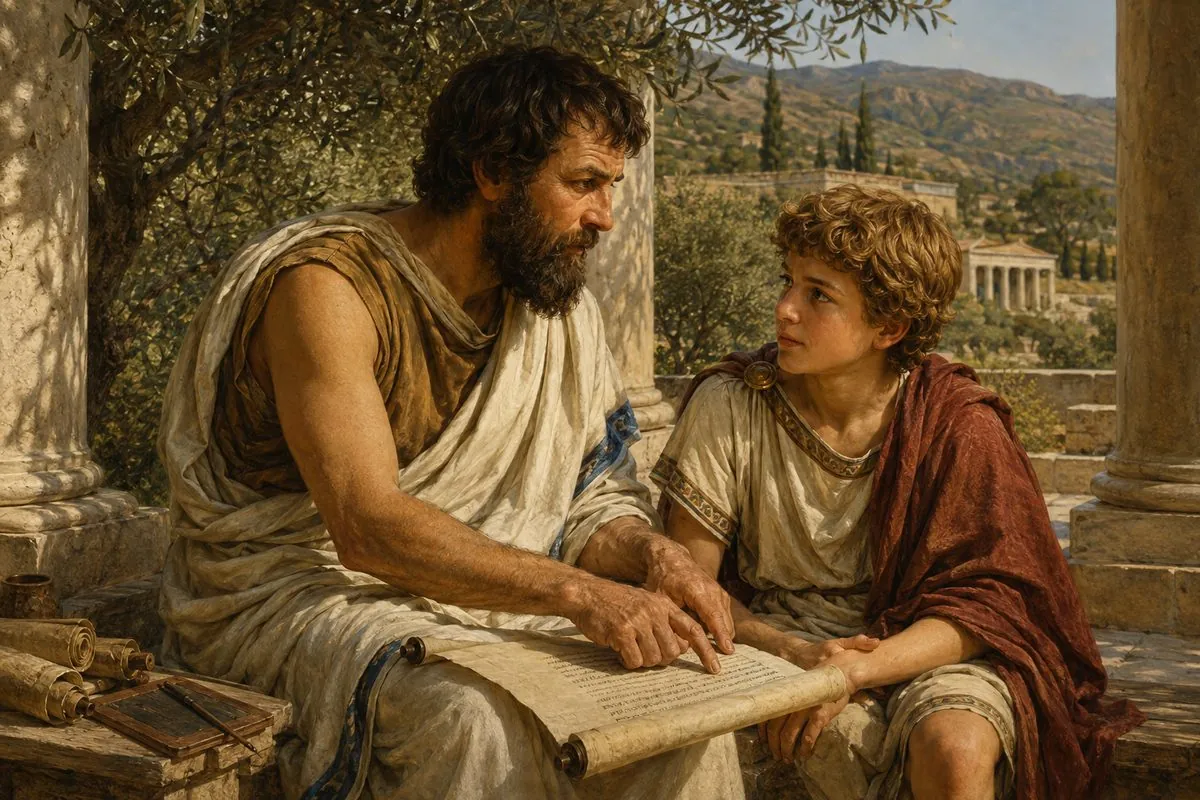
Before Alexander was “the Great,” he was a thirteen-year-old prince with an intimidating father, an uncertain future, and a mind still being formed.
Before Aristotle became one of history’s most influential philosophers, he was a scholar searching for a place to teach, investigate, and build something of his own.
For several formative years, their lives intersected.
Aristotle taught Alexander at Mieza, a royal retreat in Macedonia. Tradition places their lessons beneath the trees near a sanctuary of the Nymphs. There, the philosopher and the future conqueror reportedly studied poetry, politics, ethics, medicine, natural science, and the customs of distant peoples.
The teacher was trying to classify the world. The pupil was preparing to enter it.
What happens when a mind trained to understand the world becomes determined to possess it?
The philosopher’s question
Aristotle was born in 384 BCE in Stagira, a Greek city near Macedonia. His father was connected to the Macedonian royal court as a physician, giving Aristotle an early association with medicine, observation, and the natural world.
At about seventeen, Aristotle traveled to Athens and entered Plato’s Academy. He remained there for roughly twenty years.
Plato often began with ideal forms: What is perfect justice? What is the ideal state? What is the true nature of beauty?
Aristotle increasingly looked toward the visible world. How do animals differ? Why do political systems rise and fail? What makes an argument valid? What habits produce character? What does it mean for a human being to flourish?
His governing question was not merely what the world should be. It was also: How does the world actually work?
That question shaped his life. Aristotle collected observations, compared constitutions, classified living things, analyzed stories, and examined the structure of thought itself. His extraordinary achievement began with disciplined curiosity.
The prince’s question
Alexander was born in 356 BCE to King Philip II of Macedonia and Olympias.
Philip was transforming Macedonia from a vulnerable northern kingdom into the dominant military power in Greece. He reorganized the army, cultivated alliances, employed diplomacy and gold, and developed the formidable Macedonian phalanx.
Alexander grew up surrounded by ambition, rivalry, danger, and expectation.
When Aristotle became his tutor around 343 or 342 BCE, Alexander was approaching the age when a Macedonian prince would begin assuming political and military responsibilities.
Aristotle could teach him how earlier thinkers understood virtue, government, literature, and nature. But Alexander’s deepest question would become different from his teacher’s.
Aristotle asked: What can be understood? Alexander increasingly asked: What can be achieved?
That second question would carry him across the known world. It would also make it nearly impossible for him to stop.
Lessons beneath the trees
We do not possess a transcript of Aristotle’s lessons to Alexander. Later generations filled the silence with legends, invented letters, and imagined conversations.
But the subjects Alexander probably encountered matter.
He studied Homer, especially the Iliad. Achilles became more than a literary character to him. He represented glory, courage, destiny, and the possibility of achieving a name that death could not erase.
Alexander also learned about medicine. Later accounts describe him taking an interest in the health of his companions and discussing treatments with physicians.
He encountered politics and ethics: the nature of leadership, the purposes of government, and the qualities expected of a ruler. He learned about geography, animals, cultures, and distant lands.
Aristotle did not give Alexander a simple formula for conquering Persia. He gave him something potentially more powerful: an enlarged conception of the world and an appetite to investigate it.
Education does not determine what a student will become. It expands what the student can imagine becoming. Alexander’s imagination became enormous.
The pupil leaves the garden
By sixteen, Alexander was serving as regent while Philip campaigned.
At eighteen, he held an important command at the Battle of Chaeronea, where Macedonia defeated Athens and Thebes.
At twenty, after Philip’s assassination, Alexander inherited a dangerous throne. Rival claimants existed. Subject peoples saw an opportunity to rebel. Greek cities questioned whether the young king could preserve his father’s power.
Alexander responded with extraordinary speed. He secured Macedonia, campaigned in the north, and destroyed Thebes after it revolted. The violence sent an unmistakable message throughout Greece.
Then, in 334 BCE, he crossed the Hellespont into Asia. The student of Aristotle was now leading an army against the Persian Empire, the greatest imperial power of the region.
Over the next eleven years, Alexander defeated Persian armies, captured royal cities, entered Egypt, occupied Babylon, crossed Central Asia, and reached northwestern India.
He continually adapted his tactics and administration. He absorbed information about unfamiliar terrain and peoples. He founded or renamed cities and adopted elements of Persian government.
The pupil’s education remained visible—but it was being used in ways the teacher may never have envisioned.
Understanding is not possession
Aristotle and Alexander represent two forms of ambition.
Aristotle wanted to bring the world within the reach of reason. Alexander wanted to bring it within the reach of action.
Both ambitions can produce extraordinary lives. Both contain dangers.
The desire to understand can become endless preparation. We can study, classify, plan, and analyze without ever risking ourselves in action.
The desire to achieve can become endless expansion. Every accomplishment establishes a new frontier. Every victory makes rest feel like decline.
Aristotle’s danger was that thought might become detached from life. Alexander’s danger was that action might lose any definition of enough.
An extraordinary life requires both capacities: the patience to understand before acting and the courage to act before certainty is complete.
The world grows larger
As Alexander moved east, Aristotle established the Lyceum in Athens.
There, Aristotle and his associates studied logic, biology, politics, ethics, rhetoric, poetry, and many other subjects. Ancient traditions claim Alexander supplied Aristotle with funds, reports, or specimens from his conquests. The extent of that support is uncertain, but Alexander’s expeditions undeniably widened the Greek world’s geographical horizon.
Their lives now unfolded in parallel. Alexander collected territories. Aristotle collected knowledge.
Alexander tested how far a person could travel and still command. Aristotle tested how much of existence a system of thought could encompass.
Yet distance was growing between them in more than geography.
Alexander increasingly adopted Persian customs and incorporated Persian elites into his government. Some Macedonians believed he was abandoning their traditions.
Aristotle’s political thinking remained rooted largely in the world of Greek city-states. Alexander was improvising a multicultural empire for which no Greek philosophical blueprint was sufficient.
The student had entered a world larger than the teacher’s political framework.
The fracture
The most painful point of intersection came through Callisthenes, Aristotle’s relative, who accompanied Alexander’s expedition as a historian.
Callisthenes resisted Alexander’s effort to introduce proskynesis, a Persian court practice that many Macedonians and Greeks considered inappropriate when directed toward a human ruler.
In 327 BCE, Callisthenes was implicated in a conspiracy against Alexander, arrested, and later died in captivity.
We cannot know precisely what Aristotle thought or whether this permanently destroyed his relationship with Alexander. Later stories accusing Aristotle of participating in a plot against his former pupil are unreliable.
But Callisthenes’s death captures the widening distance between the school at Mieza and the court Alexander had created.
The prince who studied virtue beneath the trees had become a king who found opposition increasingly difficult to distinguish from betrayal. Power had changed the conditions under which he heard the truth.
When the army answered
In India, Alexander’s soldiers finally refused to continue.
They had followed him across deserts, mountains, rivers, and empires. They had won battle after battle. But at the Hyphasis River in 326 BCE, they reached their limit.
Alexander wanted to move farther east. His army said no.
This was an answer that no enemy had been able to give him.
Alexander withdrew to his tent and waited, but the soldiers did not change their minds. Eventually, he agreed to turn back.
The exceptional leader sometimes sees possibilities others cannot see. The dangerous leader begins believing that other people’s limits are merely failures of courage.
Determination can carry a person beyond ordinary limits, but it cannot make limits cease to exist.
What survived
Alexander died in Babylon in 323 BCE. He was thirty-two years old.
He had conquered an enormous territory but left no uncontested adult successor and no political structure capable of holding his empire together without him. His generals divided the territory and fought over its remains.
Aristotle died the following year.
Alexander’s empire fragmented. Aristotle’s arguments endured.
But that is not the entire judgment.
Alexander’s campaigns transformed connections among Greek, Egyptian, Persian, Central Asian, and South Asian worlds. The cities, trade routes, political changes, and cultural encounters associated with his conquests helped shape the Hellenistic age.
Aristotle’s work survived through schools, manuscripts, translations, arguments, and generations of readers.
One changed the intellectual architecture of the world. The other changed its historical geography. Neither legacy was simple. Neither life offers a model to imitate without qualification.
The question between them
The deepest lesson of Aristotle and Alexander is not that thought is superior to action or that courage is superior to contemplation.
It is that every extraordinary life is built around a governing question.
Aristotle’s question was: What can I understand? Alexander’s question was: How far can I go?
The first produced an immense intellectual system. The second produced an immense but unstable empire.
Our own governing questions operate in the same way. They direct attention, organize effort, justify sacrifice, and determine what counts as success.
Someone asking “How can I win?” will notice opportunities to compete. Someone asking “How can I understand?” will notice patterns and causes. Someone asking “How can I serve?” will notice needs. Someone asking “What can I build that will endure?” will notice systems, successors, and foundations.
But every question also conceals something. “How can I win?” may conceal whether the contest is worth entering. “How can I grow?” may conceal the value of limits. “How can I preserve this?” may conceal whether it should be allowed to end.
Before devoting a life to answering a question, we should examine the question itself.
The extraordinary life
Aristotle and Alexander suggest a more complete formula for an extraordinary life:
- Observe before concluding.
- Learn before commanding.
- Act before certainty becomes an excuse.
- Adapt when the world exceeds the original plan.
- Listen when trusted people resist you.
- Know the difference between persistence and compulsion.
- Build something capable of surviving your absence.
- Decide what “enough” means before success makes the decision harder.
Understand like Aristotle. Act with Alexander’s courage. But do not inherit either man’s question without examining it.
The most important question is not simply whether you can understand the world or how far you can go.
What question is your life already answering—and is it worthy of the answer your life will become?